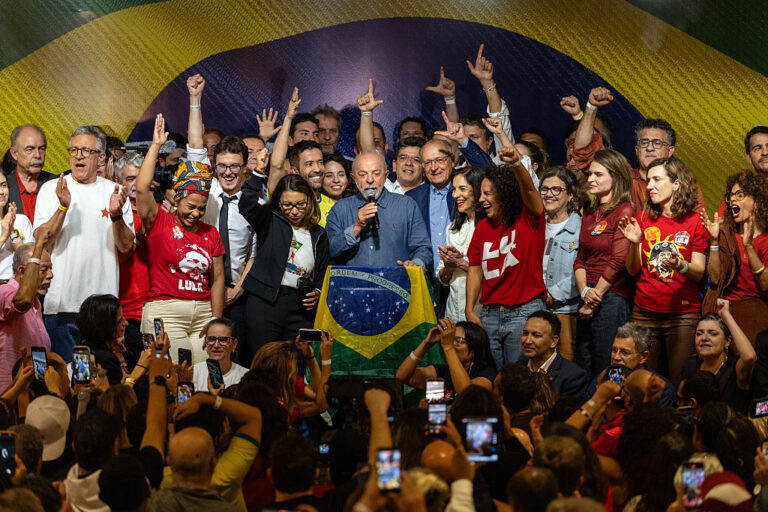
In a victory regarded as both a democratic milestone and the beginning of another difficult political chapter, Brazilian President Luiz Inácio Lula da Silva has secured a historic fourth non-consecutive presidential term.
The president defeated conservative challenger Flávio Bolsonaro in a remarkable political comeback that could reshape the country’s democracy, economic direction and international relations.
Lula’s victory, which defied late-campaign predictions and a first-round deficit, represents a significant setback for the far right in Latin America. The result also positions Brazil as a counterweight to the growing influence of right-wing political movements across the region and beyond.
The 80-year-old president secured 51.8 per cent of the vote against Bolsonaro’s 48.2 per cent, according to the reported election results. His victory overturned expectations that the son of jailed former president Jair Bolsonaro was on course to capitalise on widespread dissatisfaction with the incumbent administration.
The outcome breaks new ground in Brazilian electoral history. Since the country adopted its current two-round presidential election system under the 1988 Constitution, no candidate who led the first round had subsequently lost the runoff. Lula’s comeback demonstrates how voter mobilisation, strategic alliances and an effective campaign can reverse an apparent electoral defeat.
His fourth presidential mandate also makes him the first Brazilian president elected to the office four times. By the end of his new term in 2030, Lula will have spent 16 non-consecutive years leading Latin America’s largest economy, cementing his place among the country’s most consequential political figures.
Beyond the numbers, the election represents an important test of democratic resilience. Brazil has experienced deep political divisions in recent years, culminating in the January 8, 2023, attacks on government institutions following Lula’s return to office. The successful completion of his mandate and the conduct of another competitive election offer evidence that the country’s democratic institutions have survived considerable pressure.
However, the rejection of Bolsonaro’s candidacy has not ended the political confrontation. The former president has reportedly refused to concede and indicated that he would seek to have the result annulled, while prominent figures on the Brazilian right have questioned the outcome. Such reactions threaten to prolong tensions and test public confidence in the electoral system.
Lula’s campaign gained momentum after his disappointing first-round performance, with the president sharpening his message, strengthening alliances and reaching voters who had either abandoned his political base or stayed away from the polls. The campaign also benefited from increased digital mobilisation and the participation of younger political advisers who helped expand his reach on social media.
The result highlights the importance of broad coalitions in an increasingly polarised political environment. Some voters supported Lula because of his policies, while others were motivated primarily by opposition to the Bolsonaro family’s political agenda. The mobilisation of previously disengaged voters and support from some former Bolsonaro backers proved important to his comeback.
Internationally, Lula’s victory challenges the recent momentum of right-wing movements across Latin America and parts of Europe. While conservative parties have gained ground in several countries, Brazil’s election demonstrates that such advances are not inevitable and that established left-wing political movements can remain competitive when they adapt to changing voter expectations.
The result also carries implications for relations between Brazil and the United States. Bolsonaro had presented himself as a natural partner of President Donald Trump’s administration, whose approach to the Western Hemisphere has involved economic pressure, political alliances and efforts to strengthen Washington’s regional influence. Lula’s return could complicate those ambitions and reinforce Brazil’s preference for a more independent foreign policy.
Lula is expected to continue pursuing multilateral diplomacy, seeking trade agreements and diversifying Brazil’s international partnerships to reduce its vulnerability to major trading partners, including the United States and China. However, the extent to which he can maintain this approach will depend on economic conditions, domestic political support and the response of Washington.
Despite the political significance of his victory, Lula faces substantial economic challenges. Analysts have warned that Brazil’s fiscal deficit is approaching 10 per cent of gross domestic product following extensive pre-election spending, while public debt is projected to reach approximately 83 per cent of GDP. Rising borrowing costs and mounting debt obligations could constrain the government’s ability to finance its social programmes.
The administration will therefore face pressure to present a credible plan for stabilising public finances without abandoning commitments to poverty reduction and social protection. Economists have identified the need to control the growth of mandatory spending, including pensions, social benefits, public-sector costs and other constitutionally required expenditures, while reviewing tax incentives and improving government revenue.
Financial markets have reacted negatively to the election outcome amid concerns about fiscal sustainability and the direction of economic policy. Analysts say Lula’s early decisions, particularly his choice of finance minister and the credibility of his proposed economic programme, will be crucial to restoring investor confidence and preventing fiscal pressures from developing into a wider economic crisis.
His legislative position presents another major obstacle. The conservative opposition retains considerable influence in Congress, giving it the capacity to obstruct government proposals, demand concessions and shape the legislative agenda. Lula will need to negotiate across party lines to advance his priorities, making political compromise essential to the success of his fourth administration.
Nevertheless, opportunities remain for progress on economic reforms. Brazil’s consumption tax reform is expected to continue towards implementation, while infrastructure concessions could attract further private-sector investment. The government’s ability to sustain regulatory improvements and encourage investment will be important in supporting economic growth, creating employment and strengthening public finances.
Environmental policy will also remain a major test. Lula’s administration has sought to reduce deforestation and strengthen Brazil’s international climate credentials, but plans for oil exploration in the Equatorial Margin could create tensions between economic ambitions and environmental commitments. A conservative-leaning Congress could further complicate efforts to protect environmental regulations.