The President has ordered a crackdown on political thuggery. Nigerians are entitled to ask whom he means, and why it took until this week.
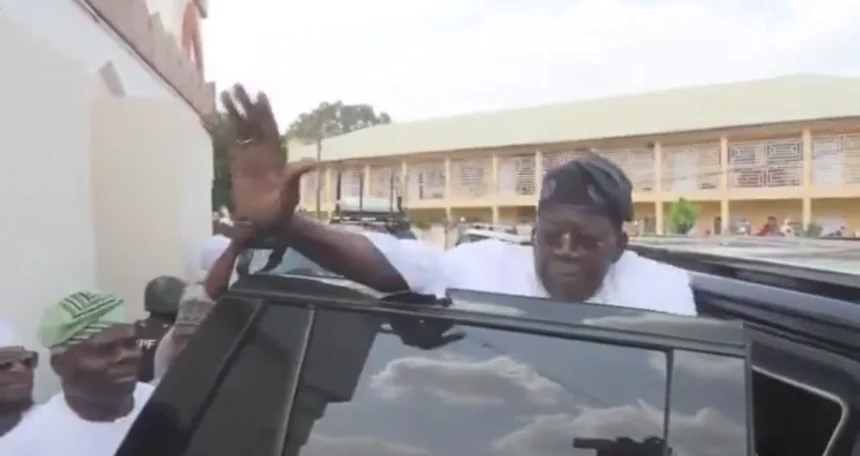
On November 13, after Friday prayers at the Shehu Shagari Central Mosque in Garki, Abuja, President Bola Tinubu was booed. Several videos show people chanting against him, including “Bamayi,” the Hausa for “we don’t want,” and “Tinubu Must Go.” That much is confirmed by Premium Times, Daily Trust and Leadership, all of which obtained the footage. An eyewitness told Premium Times that worshippers had been blocked from entering and leaving by the presidential security arrangements, and that the booing began among people who had been barricaded in.
Some outlets, including The News Chronicle, went further and reported stones thrown at the convoy. The Presidency denies it, and Bayo Onanuga dismissed the claim. The Presidency also released its own video of what it called a rousing welcome, and its digital adviser, Otega Ogra, said opposition videos showed “alleged paid thugs.” No outlet we have read has shown that anyone was injured. So this newspaper will say what it can stand behind: the President was heckled, stones are alleged and disputed, and nobody has established that he was attacked. And one more thing, plainly: no Nigerian, the President included, should be assaulted for the crime of being unpopular.
The same day, the President announced something else. Premium Times reports that he authorised security agencies to confront thuggery “with full force,” and promised that all parties would be free to campaign anywhere without molestation. That is a good sentence. Now look at the week it was written in.
The week behind the sentence
On November 4, Peter Obi’s convoy was attacked near Watt Market in Calabar, and police arrested a 27-year-old suspect. On November 5, Atiku Abubakar’s convoy was attacked in Birnin Kebbi. Amnesty International, analysing footage, described armed gangs with cutlasses attacking vehicles and blocking roads, while the Atiku campaign said the crew’s cameras were smashed. On November 7, a rally for the Nigeria Democratic Congress in Asaba turned violent; Delta State police say one person died and five were injured. On November 12, armed men with cutlasses, cudgels and stones invaded an NDC town hall in Oregun, Lagos, attacking supporters and a journalist from TheCable. Daily Trust counted political violence in at least seven states in a single week.
The opposition says these attackers were sponsored by the APC. The APC says there is no evidence, and its campaign council condemned the Oregun attack and asked for arrests. We cannot tell you who sent the men, and the ADC and the NDC have not proved it. We can tell you that in the cases we examined, the victims were opposition gatherings, and that the police have so far arrested only a few people. One of them, in Lagos, was injured when NDC supporters overpowered and beat him, and that is also wrong. Two wrongs do not make a justice system.
The record he brings to the crackdown
A President who orders a crackdown on thuggery is entitled to be judged on what he has said and what has happened around him. This is the record.
In December 2022, a video surfaced of Tinubu, then the APC’s presidential candidate, speaking to party operatives in London. “Political power is not going to be served in a restaurant,” he said, and urged them to “fight for it, grab it, snatch it and run with it.” Critics said it was a call to seize power by any means. In fairness, Dubawa checked the claim that he had told supporters to snatch ballot boxes and rated it false: the video does not mention ballot boxes. He was urging aggression about power, not, on that footage, about ballot papers. But a candidate who tells his machine to snatch power “at all cost,” weeks before an election, should not be surprised by how it is heard.
In March 2023, during the Lagos governorship election, the United States State Department reported that APC supporters “reportedly intimidated and suppressed voters in Igbo-dominated areas.” It cited videos of APC supporters in Ojo threatening Igbo voters and attacks on journalists in Eti-Osa, and said it found no evidence that those who committed violence in Lagos were arrested or prosecuted. Two days before that vote, a video showed Musiliu Akinsanya, MC Oluomo, the chairman of the Lagos State Parks and Garages Management Committee, telling “Iya Chukwudi” that if she did not vote for the APC, she should “sit down in your house.” He said he was joking and that he meant no threat. On the day of the February presidential election, a second video from a polling unit in Oshodi showed him telling any Igbo “wey dem born well” to come and vote, which the Lagos police called criminal and said they would investigate. We could find no record that anyone was prosecuted.
On July 28, receiving Catholic bishops who had asked for credible elections, Tinubu said: “All is fair in politics, and it’s equal opportunity.” His defenders say it was a wrestling metaphor aimed at an opposition blaming others for its own troubles, and that it said nothing about violence. His critics, including the ADC and the Leadership newspaper’s editorial board, say a head of state cannot say “all” and expect the word to stop short of rigging and thuggery. Both readings are possible. Only one of them is helped by the events of November.
None of this proves that the President ordered a single act of violence, and this newspaper does not claim it. No court or observer mission has found that. The presidential tribunal and the Supreme Court upheld his 2023 election. Obi won Lagos in the February presidential vote, so nobody can say street intimidation delivered Tinubu his home state. Whether violence has helped him win anywhere is not something anyone has proved.
The convenience
What can be said is this. For years, the political machine around Tinubu has been accused, by observers and by victims, of using street muscle against opponents. Each time, the accusation has been denied, and very few prosecutions have followed. And now, in a week when opposition gatherings were attacked in state after state, the President has found his voice on thuggery, on the very day he himself was heckled at a mosque.
We cannot say that the booing prompted the order. Oregun happened the day before, and the APC had already condemned it. But the timing deserves a question that the Presidency should answer: what has the President said about the attacks on Obi in Calabar, on Atiku in Kebbi, and on the dead man in Asaba? The ADC says he had not called his own party’s members to order before Friday. If that is wrong, produce the statement.
There is also a more troubling reading. The Presidency has called the mosque hecklers “alleged paid thugs.” If booing a president from behind a security barricade is thuggery, then an order to confront thuggery with full force is an order that can be turned on any citizen who shouts. A crackdown on violence is a duty. A crackdown on dissent, relabelled, is the thing opposition leaders are already warning about.
What would make the condemnation believable?
Words are cheap, and Nigerians have heard these before. The President pledged peace at an accord ceremony in August. Violence followed. Here is what would show the order means something.
Name the units and officers who will enforce it, and publish the number of arrests and prosecutions for Calabar, Kebbi, Asaba and Oregun within thirty days. Say in writing that “full force” does not apply to peaceful protest, including booing a president. Tell Nigerians publicly, by name where necessary, which APC officials, governors or party agents have been accused of inciting attacks, and what has been done about them. Release the findings, if any, of the Lagos police investigation into MC Oluomo’s videos from 2023. And ask the same of the opposition: its candidates and supporters must stop beating captured suspects, and must prove, not assert, who sent the thugs.
If the President means it, he will welcome every one of these. If he does not, Nigerians will see that for themselves, nine weeks before they vote.
This is a United Continental Post op-ed. It draws on reporting by Premium Times, Daily Trust, Leadership, The News Chronicle, TheCable, ICIR, Tribune, Peoples Gazette, SaharaReporters, The Sun, Blueprint, Dubawa, BusinessDay, Channels Television and allAfrica, and on statements by the Presidency, the APC and ADC campaign councils, Amnesty International, the Lagos and Delta police commands, and the US State Department’s 2023 Country Reports on Human Rights Practices. Allegations that the APC sponsored attacks on opposition gatherings are the allegations of the ADC and NDC, which the APC denies, and have not been proved. No court has found that President Tinubu ordered or encouraged electoral violence.