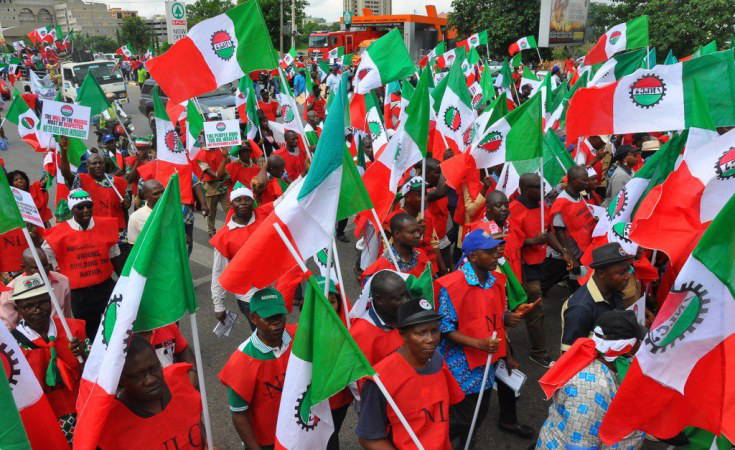
Public sector workers across Nigeria have commenced a three-day warning strike over what labour leaders described as worsening economic hardship and the Federal Government’s failure to address their demands.
The industrial action, directed by the Joint National Public Service Negotiating Council (JNPSNC), began at midnight on Friday, October 2, and is scheduled to end on Sunday, October 4, 2026.
The council directed workers across the federal, state and local government services, including employees of ministries, departments and agencies, to participate fully in the strike.
The action followed the failure of the Federal Government to respond to demands contained in a letter dated September 21, 2026, addressed to President Bola Tinubu by the JNPSNC.
Among the workers’ key demands is a reduction in the pump price of petrol to N500 per litre, alongside a nationwide wage award to cushion the impact of rising living costs.
The unions are also demanding the commencement of negotiations for a new national minimum wage ahead of 2027, as they argue that rising inflation and living costs have eroded the purchasing power of workers.
In a circular dated October 1 and signed by the council’s National Secretary on the Trade Union side, Olowoyo Gbenga, the JNPSNC directed its affiliate unions and officials at the federal, state and local government levels to ensure compliance with the strike.
The council said the action had become necessary because the economic and mental hardship confronting workers and other Nigerians was becoming unbearable.
It had earlier threatened the warning strike on September 29, saying it would proceed with the action if President Tinubu failed to address its demands in his Independence Day address.
However, the unions expressed disappointment that the President’s October 1 address did not announce a reduction in petrol prices or immediate measures specifically targeted at easing the economic burden on workers.
A JNPSNC leader told Vanguard that the unions were disappointed by what they described as the absence of concrete relief measures in the President’s address, despite his acknowledgement of the difficulties facing Nigerians.
The leader said the failure to address the workers’ demands had left the unions with no option but to proceed with the three-day warning strike as earlier planned.
The JNPSNC comprises several public-sector unions, including the Nigerian Civil Service Union, Medical and Health Workers Union, Association of Senior Civil Servants of Nigeria and National Association of Nigerian Nurses and Midwives.
Other affiliates include the Amalgamated Union of Public Corporations, Civil Service Technical and Recreational Employees, Nigeria Union of Public Service, Reportorial, Secretarial, Data Processors and Allied Workers, and unions representing workers in printing, agriculture and allied sectors.
Meanwhile, the Nigeria Labour Congress (NLC) has backed the workers’ demands, calling for an immediate reduction in petrol prices, a nationwide wage award and the commencement of negotiations for a new national minimum wage.
In its Independence Day message issued by its President, Joe Ajaero, the NLC said rising transportation, food, rent and education costs had continued to weaken workers’ purchasing power, particularly following the removal of the petrol subsidy in 2023.
The congress also demanded implementation of previously agreed tax relief measures, reduction in the cost of governance and greater investment in infrastructure, healthcare, education and domestic refining capacity. It further called for stronger action on unemployment, insecurity and economic inequality, while urging that workers be allowed to make independent political choices ahead of the 2027 elections.