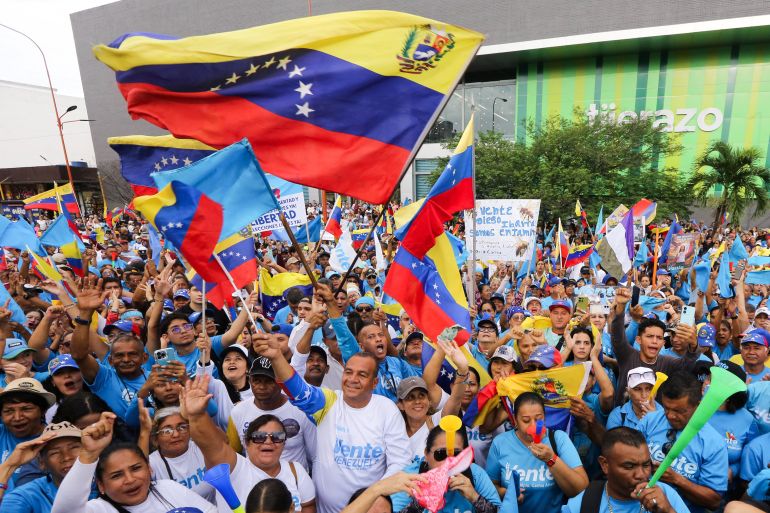
Thousands of Venezuelans have staged nationwide protests demanding free and credible elections, intensifying pressure on the country’s interim government to establish a clear timetable for a return to democratic rule following the capture of former President Nicolas Maduro by United States forces.
The demonstrations, held on Thursday 22nd October 2026 in the first nationwide opposition mobilisation in nearly two years, took place in Caracas and several other cities, including Valencia, Maracay, San Cristobal and Maracaibo, with protesters calling for political change and the restoration of democratic institutions.
The protests came amid growing uncertainty over the country’s political future, as US President Donald Trump and interim President Delcy Rodriguez have indicated that elections would eventually be held but have yet to announce a date for a vote to determine Maduro’s successor.
Maduro was captured during a US military operation in January, but his removal from office has not resulted in a change of government, with the ruling United Socialist Party of Venezuela (PSUV) retaining power under Rodriguez, who served as his vice president.
For many demonstrators, the delay in announcing elections has heightened concerns that the political transition could become prolonged, leaving the country’s leadership and electoral future unresolved.
Opposition leader Maria Corina Machado, a Nobel Peace Prize laureate who has spent nearly a year outside Venezuela after going into hiding following the disputed 2024 presidential election, has called for elections to be conducted by July 2027.
Her political movement, Vente Venezuela, organised Thursday’s demonstrations, which attracted supporters demanding a new leadership and an opportunity to determine the country’s future through the ballot box.
Among the protesters was 18-year-old cosmetology student Leosmary Hernandez, who said she remained hopeful that the demonstrations would help bring about meaningful change.
“Seeing this makes me happy because I know change is possible,” she said, describing the economic difficulties and educational challenges she had experienced.
Hernandez expressed confidence in Machado’s leadership, saying she hoped the opposition figure would emerge as the country’s next president.
She added that her willingness to protest had grown despite previous experiences of political unrest, insisting that she wanted her voice to be heard.
The demonstrations marked a significant moment for Venezuela’s opposition, which has faced years of political confrontation with the socialist government that has governed the country since 1999, first under the late Hugo Chavez and subsequently under Maduro.
Human rights organisations have accused Venezuelan authorities of suppressing dissent through arbitrary arrests, imprisonment and torture of political opponents. The government has faced sustained international criticism over its treatment of dissidents and the credibility of its elections.
Despite Maduro’s removal, the opposition has questioned whether the current political arrangement will deliver the democratic reforms many Venezuelans have demanded.
Rodriguez, who assumed interim leadership on January 3, continues to govern with the support of the ruling party and backing from the Trump administration, which has maintained substantial influence over Venezuela’s political and economic direction, including its oil resources.
The United States has pressed the interim government to implement reforms, even as Trump’s support for Rodriguez has drawn attention to Washington’s willingness to work with a figure who served in Maduro’s administration.
The demonstrations unfolded with a limited security presence at many protest locations, a contrast with previous opposition rallies that have frequently been met with a heavy deployment of security personnel.
In several smaller cities, protesters dispersed before nightfall, while the authorities did not appear to mount a widespread security crackdown during the demonstrations.
The ruling Socialist Party also organised a march in Caracas, with supporters directed to gather at Plaza Venezuela before proceeding towards an area near the presidential palace. The event was officially organised to commemorate Breast Cancer Awareness Month.
Interior Minister Diosdado Cabello, a prominent government figure with close ties to the country’s security apparatus, was shown on state television attending the ruling party’s march.
The competing demonstrations underscored the political divisions that continue to shape Venezuela, even as negotiations over a possible transition remain under way.
A faction of the opposition and the interim government have held US-backed talks aimed at reforming key institutions, including the Supreme Court and the electoral council, ahead of eventual elections. Their latest meeting took place this month though the negotiations are expected to face considerable challenges.
Machado’s political movement is not participating in the talks but the opposition leader has indicated that she would not obstruct efforts to advance the process.
The dispute over the 2024 presidential election remains central to Venezuela’s political crisis. Opposition candidate Edmundo Gonzalez Urrutia has maintained that he won the election, citing vote tallies collected by the opposition.
The government, however, declared Maduro the winner without releasing complete results to substantiate its position, while state institutions upheld his victory amid widespread allegations of electoral irregularities.
Machado has long sought US support for the opposition’s campaign against Maduro, aligning herself with influential figures in Trump’s political circle who accused the former president of links to criminal networks and regarded his government as a threat to US national security.
Maduro and his wife, Cilia Flores, are facing drug-related and torture charges in the United States. Both have pleaded not guilty.
With no election date announced and negotiations yet to produce a comprehensive political settlement, Thursday’s protests have renewed pressure on Venezuela’s interim leadership to move beyond promises of future elections and provide a concrete timetable for the country’s return to democratic governance.