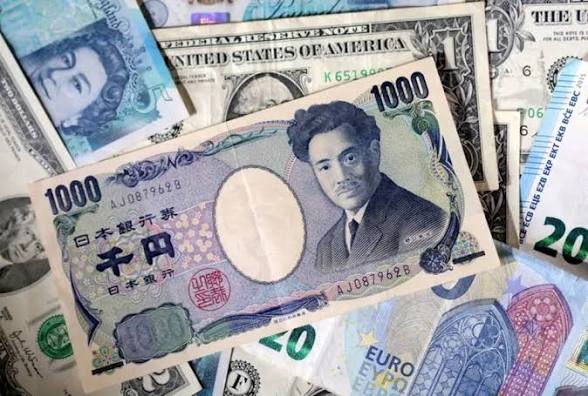
The U.S. dollar remains near multi-month lows against major currencies on Tuesday as investors scaled back expectations of an imminent Federal Reserve rate hike, while uncertainty over the Middle East conflict kept financial markets on edge.
The euro traded at $1.1581 in early Asian trading, holding close to its two-month high of $1.1614 reached on Monday. Sterling stood at $1.3548, also near a three-month peak recorded in the previous session.
Recent U.S. economic data have reinforced expectations that the Federal Reserve may be less inclined to tighten monetary policy in the near term. Retail sales fell in July for the first time in nine months, following unexpected job losses in June and relatively mild inflation readings.
According to the CME FedWatch tool, traders now see a 35% probability of a U.S. rate increase at the Fed’s September meeting, down sharply from 52.2% a week earlier.
However, analysts remain cautious about the inflation outlook, particularly as the Strait of Hormuz remains effectively closed and negotiations aimed at ending the U.S.-Iran conflict have stalled.
“Inflation has been above target for most of the past five years,” said Nohshad Shah, head of EMEA fixed income sales at Citadel Securities, warning that persistent supply shocks could leave the Federal Reserve with little room to manage inflation.
Iran has meanwhile said it would shift to a “fully offensive” military posture after negotiations with the United States stalled, while Washington has ruled out extending the June ceasefire agreement.
The uncertainty pushed global bond yields higher as investors assessed the potential impact of elevated oil prices and a prolonged disruption to shipping through the Strait of Hormuz.
Brent crude futures rose 0.3% to $91.14 a barrel on Tuesday, after reaching their highest level since July 30 in the previous session.
The yield on the 30-year U.S. Treasury remained near its highest level in almost 20 years, while Japan’s 10-year government bond yield climbed to its highest level since September 1996.
Investors have also been closely watching recent U.S. Treasury auctions, with concerns growing over the scale of government borrowing and the fiscal outlook.
“When it comes to longer-dated Treasury issuance, investors are increasingly focused and concerned about the growing amount of U.S. debt and America’s lack of fiscal discipline,” said Anthony Saglimbene, chief market strategist at Ameriprise Financial.
The yen, meanwhile, remained just below the 160-per-dollar level, with attention shifting to the Bank of Japan’s meeting next month. Sources said the central bank is expected to raise interest rates and is considering more aggressive increases thereafter.
The yen was last at 159.46 per dollar, having surrendered nearly half of the gains recorded after coordinated U.S.-Japan intervention at the end of July helped lift the currency from 40-year lows.
Elsewhere, the Australian dollar gained 0.11% to $0.71119, near its strongest level since early June, while the New Zealand dollar traded at $0.5902.