Prime Minister’s coalition advances legislation on military exemptions, judicial reforms and settlements in final days before parliament dissolves.
Israeli Prime Minister Benjamin Netanyahu’s coalition has passed a series of contentious bills in the final days of the country’s parliament before lawmakers dissolved the Knesset ahead of the October 27 general election.
The legislative push, completed this week, is widely viewed as an effort to strengthen Netanyahu’s alliance with his ultra-Orthodox and far-right coalition partners as he prepares for another closely contested election.
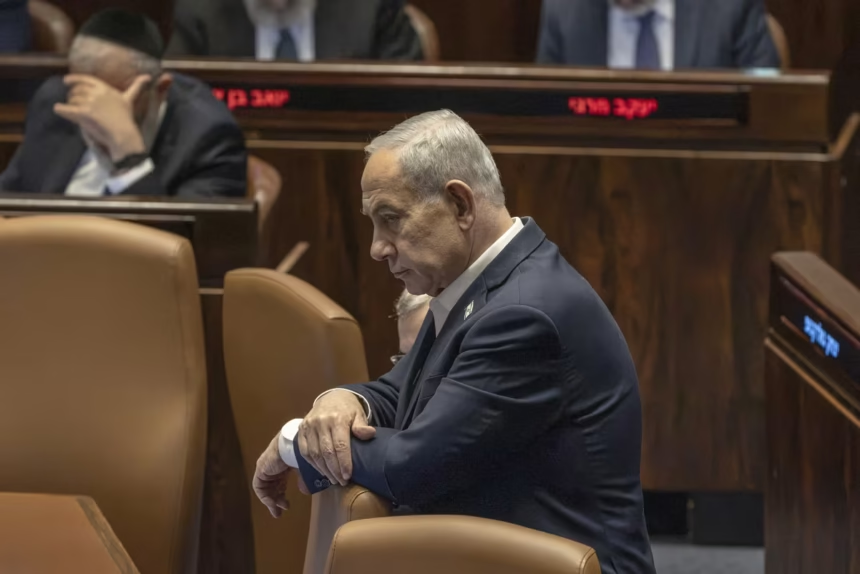
The final parliamentary session was marked by protests from opposition lawmakers, who shouted slogans demanding the prime minister’s resignation. Netanyahu was absent from the chamber during one of the key votes, although the legislation was approved by the governing coalition.
Political observers say the measures reflect Netanyahu’s long-standing strategy of maintaining support among coalition partners, a factor credited with helping his government complete a full term in office, the first Israeli administration to do so since 1988.
One of the most controversial measures concerns military service for ultra-Orthodox Jewish men. Although military service is compulsory for most Israeli citizens at the age of 18, many members of the ultra-Orthodox community have historically received exemptions, an arrangement repeatedly challenged in the courts.
The issue has become more sensitive during the ongoing conflict, with the Israel Defense Forces reporting a shortage of personnel while tens of thousands of eligible ultra-Orthodox men remain outside military service.
To address opposition from coalition partners, the government passed legislation recognising Torah study as a foundational value in Israel’s Basic Laws, a move critics argue could strengthen the legal basis for future military exemptions. A separate measure grants temporary protection from military service to thousands of ultra-Orthodox draft evaders until January 2027.
The legislation has generated significant criticism.
Israel Defense Forces Chief of Staff Lt. Gen. Eyal Zamir publicly warned that the measures conflict with the military’s operational needs and risk undermining morale among serving soldiers. Opposition parties have already challenged the law in court, and Israel’s High Court of Justice has temporarily suspended its implementation pending further legal review.
Beyond military service, lawmakers approved additional legislation affecting the country’s legal and media landscape.
The coalition passed a bill limiting the authority of the attorney general, a central element of the government’s wider judicial reform programme. The measure could give the government greater influence over legal interpretations and revive efforts to remove Attorney General Gali Baharav-Miara.
Another law restructures broadcasting regulation, a move opponents argue could increase government influence over the media and weaken press independence.
Lawmakers also approved legislation expanding gender-segregated academic programmes, drawing criticism from universities and women’s rights groups, which argue the policy undermines equality and academic standards.
Meanwhile, Finance Minister Bezalel Smotrich announced additional funding for Israeli settlements in the occupied West Bank. The package includes approximately 2.4 billion shekels for new neighbourhoods and supporting infrastructure, alongside confirmation that the government has approved the legalisation of 34 additional settlement outposts.
Public opinion surveys indicate many Israelis oppose key aspects of the legislative package. Recent polling suggests a majority rejects the proposed constitutional protection for Torah study and favours excluding ultra-Orthodox parties from the next governing coalition.
Opposition leaders have made the issue a central theme of their election campaigns.
Yashar Party leader Gadi Eisenkot criticised the government’s actions, arguing that political interests had been placed above national priorities. Former Prime Minister Naftali Bennett also condemned the legislation, saying it unfairly shifts the burden of military service onto those already serving.
Despite the criticism, Netanyahu’s allies believe the political fallout will be limited. Members of the ruling Likud Party argue that maintaining coalition unity is more important than the short-term unpopularity of individual policies and remain confident that their core support base will remain intact ahead of the October elections.