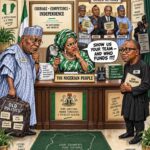
Nigeria’s democracy faces a troubling paradox: the ballot box is supposed to be the ultimate expression of the people’s will, yet election after election has shown that the courts can become the final arena in which political victories are determined.
At the 22nd All Nigeria Editors Conference (ANEC) in Enugu, former Catholic Archbishop of Abuja, John Cardinal Onaiyekan, and former Nigerian Bar Association (NBA) President, Mazi Afam Osigwe, SAN, drew attention to a problem that has become too familiar to Nigerians — an electoral system in which the announcement of results by the Independent National Electoral Commission (INEC) does not necessarily bring an end to the contest.
Onaiyekan’s warning that the quality of Nigeria’s elections appears to be declining rather than improving deserves serious consideration. His call for a review of the appointment of INEC commissioners, special election tribunals with strict timelines, independent candidacy and a 50 per cent threshold for presidential elections goes beyond technical amendments. It raises the larger question of whether Nigeria has built an electoral system in which the voter’s decision is sufficiently protected from political manipulation, institutional weakness and prolonged litigation.
One factor that has contributed to this problem is the country’s gradual movement away from the era of simultaneous elections. For many years, Nigeria conducted the presidential, governorship, National Assembly, state House of Assembly and local government elections at different times, but the presidential, governorship, Senate, House of Representatives and the 36 state House of Assembly elections were, at various points, held on the same general-election timetable. The arrangement was intended to reduce costs, simplify logistics and create a single national electoral cycle. Local government elections, however, have generally remained the responsibility of state independent electoral commissions and have not always been conducted alongside the federal and state elections.
The later separation of elections, particularly after the 2011 cycle and the staggered scheduling of governorship and other polls, was driven by constitutional, administrative and security considerations. Yet it also produced a more fragmented electoral calendar. Elections are now conducted in phases, with presidential and National Assembly elections often held separately from governorship and state assembly polls, while off-cycle elections arise from court judgments, deaths, resignations, impeachments or other constitutional circumstances. Rather than resolving disputes within one clearly defined electoral season, this scattered arrangement can prolong political contests, keep institutions in a near-permanent campaign mode and create repeated opportunities for litigation, realignment and administrative uncertainty.
Nigeria’s history provides uncomfortable evidence. In the 2003 Anambra State governorship election, INEC declared Chris Ngige the winner. Peter Obi challenged the result, and the election was subsequently nullified by the Election Petition Tribunal. The Court of Appeal upheld the decision, and Obi was eventually sworn in as governor on March 17, 2006. The Supreme Court later affirmed the legal consequences of the earlier proceedings in its judgment delivered on June 14, 2007. The record of the case states expressly that Ngige had been wrongly declared winner by INEC.
The 2007 elections produced even more dramatic examples. In Osun State, INEC declared Olagunsoye Oyinlola the winner of the April 14, 2007 governorship election. After a prolonged legal battle, the Court of Appeal sitting in Ibadan on November 26, 2010 nullified the result in the affected local governments and declared Rauf Aregbesola the winner. He was subsequently sworn in.
Edo State followed a similar pattern. INEC declared Osagie Osunbor of the PDP winner of the 2007 governorship election, but Adams Oshiomhole challenged the result. The election was eventually overturned by the election tribunal and the Court of Appeal in 2008, with Oshiomhole emerging as governor. Ekiti also witnessed the reversal of an INEC-declared result when the declaration of Segun Oni as winner of the 2007 governorship election was overturned by the Court of Appeal in October 2010 in favour of Kayode Fayemi. In Ondo State, the 2007 declaration of Olusegun Agagu was later overturned, with Olusegun Mimiko eventually declared winner in 2009.
The lesson from these cases is not that courts should never overturn electoral results. On the contrary, the constitutional right to challenge an election is indispensable to democracy. Where credible evidence establishes that an election did not reflect the lawful votes of the people, the judiciary must have the authority to provide a remedy. The deeper problem is that repeated post-election reversals indicate that the electoral process itself is failing to settle disputes at the ballot box.
The 2015 Rivers State governorship election illustrates the uncertainty particularly well. INEC declared Nyesom Wike winner of the April 11 and 12, 2015 election. The Rivers State Governorship Election Tribunal, in its judgment of October 24, 2015, nullified the election and ordered a fresh poll, after allegations including electoral violence, manipulation and non-compliance were presented. The Court of Appeal affirmed that decision on December 16, 2015. But on February 11, 2016, the Supreme Court allowed Wike’s appeal and restored his election.
Then came Imo State. INEC declared Emeka Ihedioha winner of the March 9, 2019 governorship election. On January 14, 2020, the Supreme Court nullified his election and declared Hope Uzodinma governor, holding that votes from 318 polling units which the lower court had failed to include should be added to Uzodinma’s total. The court consequently ordered the withdrawal of Ihedioha’s certificate of return.
The Bayelsa case was another extraordinary example. David Lyon was declared winner of the November 16, 2019 governorship election, but on February 13, 2020 — only a day before the scheduled inauguration — the Supreme Court nullified his election because of the disqualification of his running mate over forged credentials. The court directed INEC to issue certificates of return to the candidate with the next highest lawful votes who met the constitutional requirements.
These cases demonstrate different legal grounds — alleged electoral malpractice, non-compliance, nomination disputes and constitutional qualifications. They should therefore not be lumped together as proof that every INEC declaration was fraudulent. But collectively they demonstrate how often Nigerians have had to move from the polling unit to the tribunal, from the tribunal to the Court of Appeal and, in many cases, to the Supreme Court before knowing who will ultimately occupy an elected office.
The 2023 elections showed that the problem has not disappeared. In Kano State, the election tribunal and later the Court of Appeal overturned INEC’s declaration of Abba Kabir Yusuf and declared Nasiru Gawuna the winner. On January 12, 2024, however, the Supreme Court reversed the lower courts and restored Yusuf as governor. In Zamfara, the Court of Appeal overturned the tribunal’s decision and declared the governorship election inconclusive, before the Supreme Court on January 12, 2024 restored Dauda Lawal’s victory. Plateau produced another reversal, with the Court of Appeal sacking Caleb Mutfwang after the tribunal had upheld his election, before the Supreme Court subsequently restored him.
This is precisely where Afam Osigwe’s warning about the “judicialisation” of elections becomes important. When electoral disputes become almost as important as the elections themselves, democracy risks shifting the decisive moment from the polling unit to the courtroom. Osigwe correctly identified the quality of evidence, the independence of electoral institutions and the capacity of the courts to resolve disputes consistently and promptly as crucial components of electoral credibility.
But another question must be asked: after a court has established that an election was unlawfully conducted, where is the corresponding punishment for those responsible?
Nigeria’s electoral law does provide criminal sanctions. The Electoral Act 2022 criminalises a range of conduct, including bribery, undue influence, false declarations of results, destruction or snatching of election materials and other electoral offences. Some offences carry imprisonment, while others attract fines or both.
The problem, therefore, is not simply the absence of laws. It is enforcement.
INEC itself acknowledged in February 2025 that 774 alleged offenders from the 2023 general election were being prosecuted in collaboration with the Nigerian Bar Association, with successful prosecutions recorded in Kebbi and Kogi and vote-buying prosecutions producing results in Lagos, Kwara and Gombe. But the Commission also said many cases remained pending and complained that electoral offences were not subject to the same time limits applicable to election petitions.
There have nevertheless been convictions. On December 7, 2023, an Ikeja High Court sentenced Wahab Hammed to one year in prison for vote buying and bribery connected with the February 25, 2023 elections, following his guilty plea. That case demonstrates that the law can produce punishment when prosecution reaches conclusion.
But one conviction cannot answer the much larger question confronting the country: where are the consequences for the broader political machinery behind electoral manipulation?
A person caught buying a few votes may face prosecution, while allegations involving large-scale interference with the electoral process can spend years moving through litigation. Worse still, an election may be nullified without the legal process necessarily establishing criminal responsibility for every person who allegedly caused the irregularity. Election petitions are principally designed to determine whether an election was valid and who was entitled to win; criminal proceedings require separate proof of specific offences against specific individuals.
This distinction matters. A court cancelling an election is not automatically a criminal conviction for rigging. Likewise, a court upholding an election does not necessarily amount to a judicial declaration that every act surrounding the election was beyond criticism. The two processes serve different purposes and apply different standards of proof.
This brings us back to the judiciary. Has it been faithful to its constitutional responsibility? The answer cannot responsibly be reduced to either a blanket “yes” or “no.” The record shows instances in which Nigerian courts corrected or overturned electoral outcomes, sometimes against the candidate declared by INEC and sometimes restoring an INEC declaration that a lower court had overturned. The 2015 Rivers, 2018 Osun, 2019 Imo, 2019 Bayelsa and 2023 Kano, Zamfara and Plateau disputes demonstrate that judicial decisions can change dramatically from one level of court to another.
That variation does not, by itself, prove judicial disloyalty to democracy. It does, however, underline the importance of consistency, speed, transparency and clear evidentiary standards. Indeed, INEC’s own 2023 election report noted concerns about conflicting judgments from courts of coordinate jurisdiction on similar or related facts. The Commission also identified delays in investigating and prosecuting electoral offences as a continuing problem.
Nigeria may therefore need to stop treating election litigation as an inevitable second round of every election. The first objective should be to make the election itself sufficiently credible that litigation becomes exceptional rather than routine. That requires an electoral commission whose independence is beyond reasonable suspicion, transparent collation of results, reliable electronic evidence, effective protection of polling materials, professional security agencies and political parties willing to accept lawful rules.
The proposal for special election tribunals with strict timelines deserves particular attention. If disputes are to be resolved, they should be resolved quickly enough that the judgment still meaningfully relates to the mandate voters gave. A five-year judicial battle over a four-year elected office can produce an outcome that is legally correct yet democratically awkward: the winner may spend much of the mandate litigating for an office already occupied by someone else.
There is also a compelling case for separating the determination of an election’s validity from the prosecution of electoral crimes. Where a tribunal finds evidence suggesting vote buying, violence, falsification, intimidation or manipulation, such findings should not simply disappear with the judgment. They should trigger appropriate criminal investigation where the evidentiary threshold for prosecution is met.
The National Assembly has already considered proposals for an Electoral Offences Commission because the present system leaves electoral offences to ordinary law-enforcement agencies and regular courts. The proposal itself recognises the difficulty created when electoral crimes compete for attention with the enormous volume of ordinary criminal cases.
The ultimate question, therefore, is not whether Nigerians should have access to the courts. They must. Nor is it whether judges should correct electoral injustice. They should. The real question is why the ballot so frequently requires judicial rescue in the first place — and why those responsible for proven electoral offences do not consistently face consequences commensurate with the damage done to democracy.
A democracy cannot be healthy merely because its courts remain available to correct defective elections. It becomes healthier when its institutions prevent defective elections from occurring in the first place.
From ballot to court should be a constitutional safety valve, not the normal route to political power. The Nigerian voter deserves to know that the vote cast at the polling unit will count, the result announced by INEC will reflect the lawful votes, and anyone who deliberately subverts that process — whether through vote buying, violence, manipulation or falsification — will face timely and credible consequences.
Otherwise, Nigeria risks preserving the appearance of electoral democracy while transferring too much of the decisive power of the ballot from the voter to the courtroom.