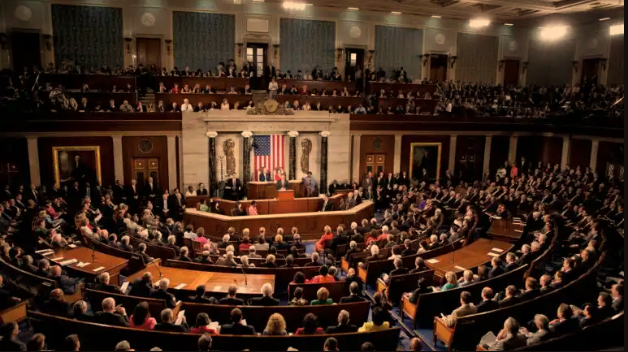
For the third time, members of the United States House of Representatives have voted to curtail President Donald Trump’s authority to continue military action against Iran without explicit approval from Congress.
The House on Tuesday approved a war powers resolution by 220 votes to 204, with seven Republicans joining Democrats in backing the measure. The vote marks the latest congressional challenge to Trump’s handling of the conflict, following similar efforts in June and July.
The repeated votes exposed a growing division between the White House and lawmakers over the scope of presidential authority to wage military action without a fresh mandate from Congress. Supporters of the resolution argued that the Constitution places limits on the president’s ability to sustain military operations without congressional authorisation.
However, the measure faces an uncertain future in the Senate, where Republicans hold the majority. The development comes only weeks before the November midterm elections, in which Democrats are seeking to regain control of Congress.
The Senate had previously approved a similar war powers resolution aimed at ending the conflict but Republican senators reversed course the following day after Trump reportedly criticised them during a closed-door lunch. The White House had also challenged the House’s June resolution, while the Senate has yet to act on the measure passed by the House in July.
Trump’s position is particularly significant because his political message during his campaign for a second term included a promise to avoid involving the United States in foreign wars. His continued defence of military action against Iran therefore places that pledge under renewed scrutiny.
The president has argued that the operation was necessary to weaken Iran’s military capabilities, maintaining that the conflict has significantly degraded the country’s ability to threaten US interests and allies.
But the repeated congressional attempts to invoke the War Powers Act underline a broader constitutional and political dispute: how far a US president can go in directing military operations abroad without securing explicit approval from lawmakers.
With the House voting for the third time to restrain the president, attention now shifts to the Senate and whether Republican lawmakers will maintain their support for Trump or assert Congress’s authority over decisions involving prolonged military action.