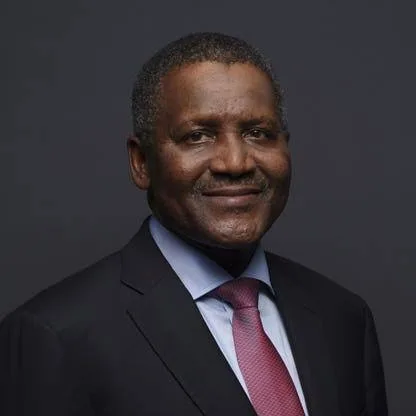
Africa’s richest man and President of Dangote Industries Limited, Aliko Dangote, has declared that his business empire is prepared to confront legal challenges to its investments across Africa, even as he signals a willingness to reduce his ownership of the Dangote Petroleum Refinery to as little as 25 per cent to allow more Africans to become shareholders.
The development is significant because Dangote’s position goes beyond one court dispute in Kenya; it reflects the increasingly complex relationship between large-scale African investment, community interests and the continent’s growing appetite for indigenous industrial ownership. While investors require certainty before committing billions of dollars, local communities equally expect their land and legal rights to be respected.
Dangote made the remarks during a fireside chat at the Nairobi Securities Exchange in Kenya, where he discussed his group’s planned investments across Africa, the proposed 700,000-barrel-per-day Lamu refinery and plans to give African investors greater ownership of the project.
His comments came against the backdrop of a legal dispute over the land earmarked for the refinery. The Malindi Environment and Land Court has ordered that the “status quo prevailing” on the land be maintained pending a hearing scheduled for October 14.
The order, dated September 25 and made public on Monday, followed a lawsuit filed by 133 residents of Chandavai in Lamu County. The residents reportedly contend that the land designated for the refinery constitutes their ancestral heritage and that their families have lived and farmed there for generations.
The Dangote Group, however, clarified that the court order had not stopped the planned groundbreaking ceremony, although activities at the project site could be affected because the parties had been directed not to undertake activities on the land until the matter is heard.
Dangote expressed confidence that the dispute would not derail the project, describing legal and administrative challenges as part of the realities of doing business in Africa.
“I’m sure some of you must have seen that one court has given an order that we shouldn’t do any construction? I said no, no. This is normal for us in Africa. In fact, this is even small,” he told investors.
He further warned those seeking to frustrate the company’s investments that his group was prepared for the legal battles.
“Anyone who wants to cause trouble, we are ready for them,” Dangote declared.
The businessman cited the experience of his group in Senegal, where, according to him, one of its factories was shut for a year. He said the company eventually went to the Supreme Court and obtained a judgment.
“In Senegal, it’s not even the court. They stopped our factory for one year. We went up to the Supreme Court to get a judgement. So anybody who wants to cause trouble, we are ready for them,” he said.
The proposed Lamu refinery is expected to have a production capacity of 700,000 barrels per day, making it a project of considerable significance to Kenya and the wider East African energy market. Dangote said the investment would cost between $15 billion and $16 billion and is targeted for completion by 2030.
He described Kenya as an important component of Dangote Group’s expansion strategy, stressing that the company sees Africa as its home and intends to deepen its investments across the continent.
“We’re taking Kenya as our home. It is home here, and that’s why we’re here to invest. Anywhere in Africa is home, because we understand the issues, we understand the problems,” he said.
According to Dangote, the Lamu project has progressed from discussions to implementation, with construction equipment already deployed to the proposed site.
The refinery is also expected to generate substantial employment opportunities. Dangote said more than 60,000 people would be required during the construction and development phases, with the company planning to train many local workers.
Beyond direct employment, he said the refinery would stimulate the growth of small and medium-sized enterprises and attract other industries to the area, creating an economic ecosystem around the project.
One of the more significant announcements was Dangote’s plan to list the Lamu refinery on the Nairobi Securities Exchange rather than the Nigerian Exchange.
“If there’s this kind of collaboration, it means that tomorrow, if we are going to have the refinery here in Lamu, it will be listed here in Lamu; we don’t have to list it in Nigeria. We shouldn’t list it in Nigeria. We should list it here,” he said.
The planned listing is also part of a broader strategy to increase African participation in Dangote’s businesses. The billionaire disclosed that the group was willing to sell additional shares if demand from African investors remained strong.
He said the original plan was to raise $2.5 billion through a private placement and an initial public offering, comprising $1 billion from the private placement and $1.5 billion from the IPO.
According to him, the private placement attracted demand worth $3.7 billion. After discussions with the Nigerian National Petroleum Company, which is also a shareholder, the company proceeded with the $2.5 billion transaction.
Dangote said another $1.6 billion offering was subsequently created to widen public ownership, describing the strategy as an effort to “democratise wealth-making.”
He said the company could go even further if demand from African investors increased.
“This $1.6bn that we have, I can tell you for nothing that we will sell more. We will go to the regulator and ask the regulator that, ‘Look, there is more demand; we want more Africans to own it.’ As we go along, we don’t mind, even if Dangote will end up having twenty or twenty-five per cent, we have nothing to hide,” he said.
The proposed structure means Dangote Industries could eventually reduce its controlling stake substantially, potentially leaving up to 75 per cent of the refinery in the hands of other shareholders if additional shares are sold and approved by regulators.
According to him, shareholders would have the power to influence the leadership of the company through corporate governance mechanisms if they became dissatisfied with its performance.
“If we go to an AGM, if we are not doing the right thing, then change the leadership. You can vote us out, and put anything that you think can do better, which I doubt very much,” he said.
The proposed model presents an interesting shift in the ownership philosophy of one of Africa’s largest industrial groups. Rather than keeping major industrial assets largely within a single corporate structure, wider public ownership could allow ordinary African investors to participate directly in the fortunes of strategic businesses.
Dangote maintained that his group remained committed to corporate governance and the protection of minority shareholders as more of its businesses enter African capital markets.
Ultimately, the Lamu refinery story is bigger than the construction of another petroleum facility. It raises fundamental questions about how Africa can attract large-scale investment while protecting community rights, how local investors can participate in wealth creation, and whether major African businesses can increasingly become institutions owned by Africans rather than simply businesses operating on African soil. The success of Dangote’s proposed model will therefore depend not only on the billions invested, but also on how transparently the projects navigate the courts, regulators, communities and shareholders.