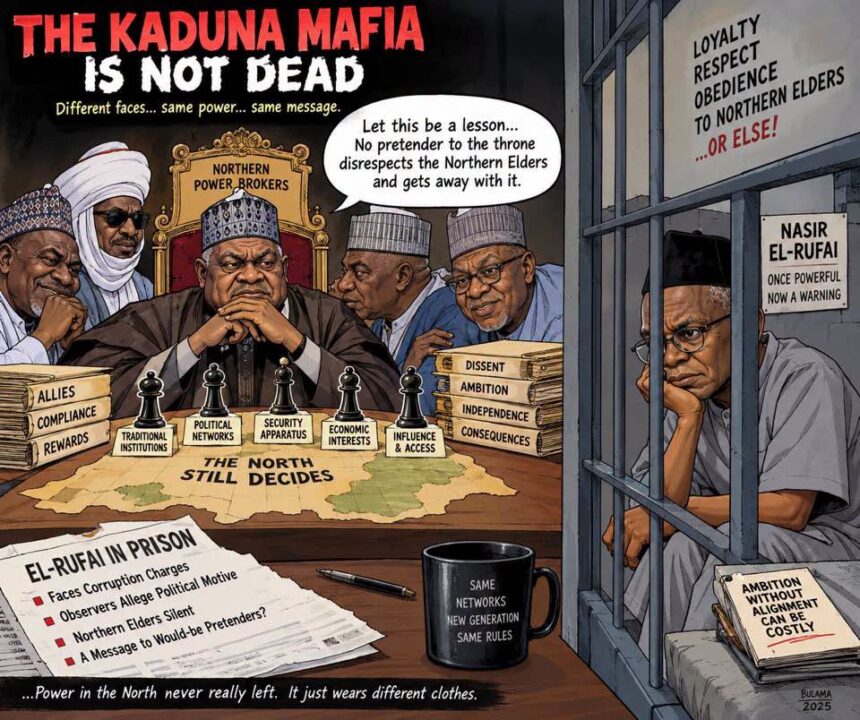
Anyone who believes that the Kaduna Mafia is dead and buried should take a trip to wherever Nasir El-Rufai is being detained and have a good look at a man who was once one of the most powerful politicians in Northern Nigeria.
I believe they will be looking at the latest casualty of a political establishment whose influence has survived military dictatorships, civilian administrations and successive changes of government.
The Kaduna Mafia was never a registered organisation with a membership card and a chairman. It was a description of the powerful network of Northern politicians, military officers, civil servants, intelligence figures and businessmen who exercised enormous influence over Nigeria’s political direction, particularly during the military era.
Its influence was associated with the old Northern establishment, the political networks surrounding Kaduna and the legacy of Sir Ahmadu Bello’s Northern political machine.
Its power was not simply in occupying government offices. It was in deciding who could occupy them, who could be trusted and who had become a political liability.
And I believe Nasir El-Rufai has discovered that there is a considerable difference between being a powerful Northern politician and being accepted by the Northern political establishment.
El-Rufai was no ordinary governor. He was Minister of the Federal Capital Territory under President Olusegun Obasanjo from 2003 to 2007, governor of Kaduna State from 2015 to 2023, and an important figure in the political coalition that brought Bola Tinubu to power.
He possessed considerable influence, political connections and a reputation for confronting powerful interests.
Yet today, the man who once commanded the machinery of government in Kaduna has spent more than seven months in detention without a criminal conviction.
On 29 September 2026, the Emir of Kano, Muhammadu Sanusi II, publicly questioned the circumstances of his continued incarceration, asking whether the proceedings were genuinely about corruption or political conflict.
Dele Momodu has gone further, describing El-Rufai as a prisoner of conscience and suggesting that his predicament is politically motivated.
Those interventions are significant because they demonstrate that influential Northern figures are not united in their response to his detention.
But I believe there is a deeper political question that Nigerians should examine.
Who has the authority to make or break a Northern political heavyweight?
My interpretation is that El-Rufai may have underestimated the enduring influence of the old Northern political networks. He developed his own political ambitions, challenged established relationships and appeared increasingly prepared to operate independently of traditional power centres.
In Nigerian politics, independence can be an expensive luxury.
I suspect that his detention is being watched very carefully by ambitious politicians across the North. The message they may take from his predicament is unmistakable: political influence does not necessarily protect a man once his alliances collapse.
That is not proof that Northern elders ordered his incarceration. No credible evidence I have found establishes such a conspiracy. But it is entirely legitimate to ask whether powerful political interests have chosen to stand aside rather than intervene on his behalf.
There is also the uncomfortable question of El-Rufai’s own record.
In May 2025, a Federal High Court awarded ₦900 million in damages against El-Rufai and others over the unlawful detention of nine Adara community elders in 2019.
He now faces serious corruption allegations, including proceedings involving an approximately ₦8.68 billion Kaduna surveillance contract. He has pleaded not guilty, and the allegations must be established in court.
I have written previously about the irony of a former governor accused of using state power against critics now demanding the protection of the same constitutional rights.
But two wrongs do not make a right.
A man cannot be punished merely because he has fallen out of political favour. Nor can prolonged detention become a substitute for conviction.
What interests me most about this affair is the continuing struggle over Northern political authority.
The Kaduna Mafia of the military era may no longer exist in its original form, but the networks of patronage, political loyalty, traditional influence and elite negotiation that sustained it have not simply vanished.
They have evolved.
Some operate through party structures. Others through relationships between former military officers, governors, traditional institutions, businessmen and influential political families.
El-Rufai’s predicament raises a question that goes beyond the fate of one former governor: how much of Nigeria’s political destiny is still determined by informal networks rather than accountable democratic institutions?
And how many ambitious politicians understand the rules of those networks only when they find themselves outside them?
I do not believe El-Rufai’s detention can be understood through corruption allegations alone. The political circumstances surrounding his prosecution deserve examination, just as the criminal allegations deserve a fair and transparent trial.
The government and the anti-corruption agencies maintain that their actions are lawful. His supporters allege political persecution. Neither political suspicion nor official assurances should replace evidence.
But Nigerians should not underestimate the significance of seeing a politician who once appeared almost untouchable reduced to fighting for his liberty.
The lesson is not necessarily that one secret organisation controls his fate. It is that political power in Nigeria remains dangerously dependent on alliances, patronage and the willingness of influential people to defend one another.
The old Kaduna Mafia may have changed its clothes, its membership and its methods. The question is whether the political culture that created it has ever really disappeared.
And somewhere in detention, Nasir El-Rufai has more reason than most to contemplate that question.