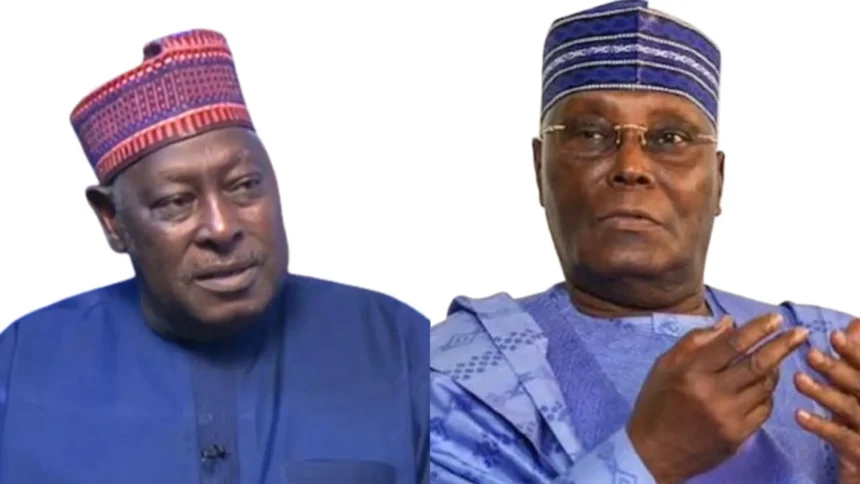
A man Atiku once trusted with the machinery of government says he’d rather watch Nigeria fail slowly under Tinubu than fail loudly under him. The quote is ugly. The more useful story is what’s underneath it.
“I’d rather go with Bola than Atiku because when Nigeria crashes with Bola, it might be an orderly crash, but with Atiku it would be a chaotic one.” Babachir Lawal delivered that line on the Naija Unfiltered Podcast this week with the flatness of a man who has said it before, in private, many times. Asked to explain himself, he didn’t reach for policy. He said simply: “Because he’s not a good man.”
That is a brutal thing for a former Secretary to the Government of the Federation to say about a man he once worked to install in that same government. It is also, on its own, close to worthless as evidence, and a newspaper that pretends otherwise is not being scathing. It is being lazy.
Consider who is saying it
Lawal’s own record is not a footnote here; it is the first fact a reader needs to weigh everything else. He was suspended as SGF in April 2017 and formally sacked that October after a presidential panel linked him to a ₦544 million contract, awarded through the Presidential Initiative for the North-East, for clearing “invasive plant species” from famine-hit IDP camps — the “grass-cutting” scandal that still follows his name. The EFCC prosecuted him and five others for five years. In 2022, a Federal Capital Territory High Court discharged and acquitted them all, Justice Charles Agbaza ruling that the EFCC’s own eleven witnesses never established Lawal sat on the panel that awarded the contract, the tenders board that approved it, or had any proven link to the procurement certificate that cleared it. That acquittal is real and belongs in this account. So does the fact that it took a court five years to say so.
A rebuttal is already circulating in Nigerian commentary today, arguing Lawal’s real grievance is personal: that he wanted control of party structure in his home state of Adamawa, where Atiku remains the dominant figure, and that this week’s podcast was less principle than payback. This newspaper cannot verify a man’s motives any more than Lawal can verify Atiku’s character over a podcast microphone. What we can verify is that a serving government official once removed over his own contract-award controversy is now asking Nigerians to take his word that another politician’s decision-making is untrustworthy. Readers should hold both facts at once, not pick the one that’s convenient.
What actually survives the skepticism
Strip out the character judgments and one part of Lawal’s account is not vibes — it’s a specific, checkable claim about opposition strategy, and neither camp has denied the particulars.
Lawal says Atiku asked him to persuade Peter Obi to accept the running-mate slot on an ADC ticket, offering a plan: serve one term, then pursue a constitutional amendment converting the presidency to a single six-year term, with the zoning rotation beginning in the South-East and then the North-Central. Obi, according to Lawal, declined, citing his own internal survey showing a pairing with Atiku was unlikely to win, and told Lawal he would rather sit out 2027 than join a ticket he believed would lose.
If that account holds up, it is a far more consequential story than anything about Lawal’s opinion of Atiku’s character. It means the opposition’s most-discussed unity ticket was offered and refused on the basis of private polling neither man has published. It means Atiku was prepared to trade away a second term for a constitutional restructuring of the presidency itself to get Obi’s name on his ticket — a proposal with real implications for power rotation in Nigeria that deserves scrutiny on its own terms, regardless of who leaked it or why. And it means that five months before a general election, the two biggest opposition figures outside the ruling party tried to merge, failed, and are now not even in the same conversation about how to beat Tinubu together.
The pattern that matters more than one podcast
Set this rupture beside what else surfaced the same week. Moghalu-aligned ADC figure Rhodes-Vivour told reporters he has “no issues with Obi” but considers Atiku his candidate, not Obi’s. Nyesom Wike continues, from inside the PDP he once led, to say he sleeps easier contemplating a Tinubu re-election than an opposition win. A peace committee chaired by former head of state Abdulsalami Abubakar has now felt compelled to publicly caution Tinubu, Atiku and Obi together over “inciting rhetoric” ahead of 2027 — a warning aimed at all three, not one.
None of that is Lawal’s doing. It is the broader picture his podcast appearance happens to fit inside: an opposition that cannot agree on a ticket, cannot agree on a sequence, and is now relitigating its internal arguments in public, one disgruntled former ally at a time. Tinubu’s government has given Nigeria’s opposition an enormous amount of material to work with over the past year — a sealed FBI file, an unpublished minerals framework, a month in Paris, a friend decorated with the nation’s second-highest honour. The opposition’s answer to all of it, this week, was a podcast fight over who insulted whom and whether Obi’s pollster was right.
What Atiku actually owes an answer to
Not “is Lawal telling the truth about your temperament.” A character dispute between two men who no longer work together is not this newspaper’s business to adjudicate, and Nigerians should be skeptical of anyone — on either side — asking them to decide an election on it.
What Atiku does owe Nigerians is a straight account of the single-term, six-year-term, zoned-rotation proposal Lawal says he personally carried to Obi. If it’s real, Nigerians deserve to hear it from Atiku directly, not leaked through a man he fired in all but name. If it’s false, he should say so plainly rather than let his campaign’s silence do the denying for him. A proposal to rewrite how the presidency itself rotates is not palace gossip. It is exactly the kind of structural promise a presidential candidate should be explaining in his own voice, in full, five months before Nigerians are asked to decide who gets to make it.
Lawal may or may not be a credible witness to Atiku’s character. He is, on the documented record, a man whose own judgment about public contracts was formally doubted by his own government once before. Nigerians weighing his verdict on Atiku this week would do well to remember that neither man in this fight has clean hands to point with — and to ask the only question that actually matters five months out: what, specifically, is the opposition’s plan, and who, specifically, still believes in it enough to say so without being provoked into a podcast first.
This is a United Continental Post editorial. It draws on reporting by Vanguard, Daily Post, Premium Times, TheCable, Arise News, Nigeria Info FM and Opinion Nigeria on Babachir Lawal’s October 2026 remarks, his 2017 removal as SGF, and his 2022 acquittal in the N544 million grass-cutting prosecution. Claims regarding internal ADC/PDP opposition negotiations and Peter Obi’s stated reasons for declining a running-mate role are attributed to Babachir Lawal’s account and have not been independently confirmed by Atiku Abubakar, Peter Obi, or their campaigns.