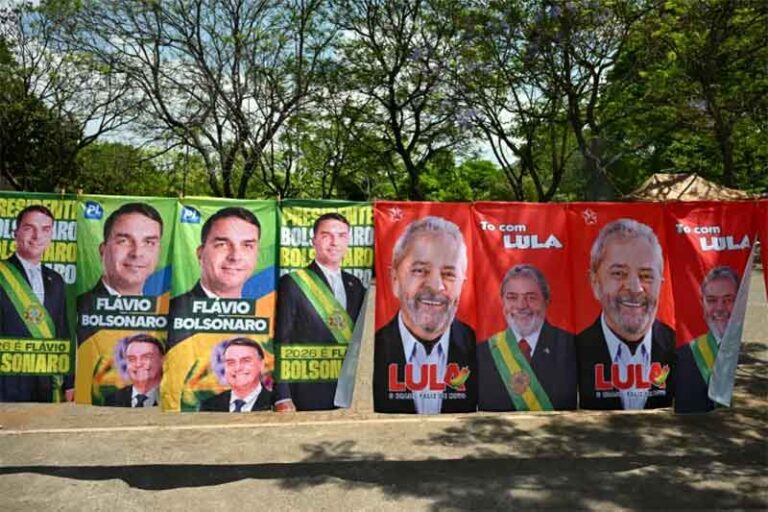
Brazil’s October 25 presidential runoff between incumbent President Luiz Inácio Lula da Silva and Senator Flávio Bolsonaro, son of former president Jair Bolsonaro, could reshape the country’s foreign policy, its economic relationship with China and its position in an increasingly polarised global order.
The first round exposed the strength of Brazil’s political divisions, with Flávio Bolsonaro securing 47.03 per cent of valid votes against Lula’s 45.16 per cent. Neither candidate obtained an outright majority, leaving the final decision to voters in a contest that extends beyond domestic politics to questions of national sovereignty, industrial development and international alignment.
The election comes amid renewed efforts by US President Donald Trump to strengthen Washington’s influence across Latin America and limit China’s strategic and economic presence in the region. As the continent’s largest economy, Brazil occupies a pivotal position in this competition, with its next president facing the challenge of balancing economic interests, diplomatic independence and domestic development priorities.
Lula, 80, is seeking a historic fourth presidential term. A member of the left-wing Workers’ Party, he previously governed Brazil from 2003 to 2011, helping lift millions of people out of poverty through social welfare programmes and economic expansion. After returning to power in 2023, he pursued policies aimed at reducing inequality, strengthening domestic industry, protecting the environment and expanding Brazil’s international partnerships.
His administration has also sought to restore Brazil’s influence in multilateral institutions, particularly through the BRICS grouping and closer cooperation with developing countries. His supporters argue that these partnerships provide opportunities to diversify trade, attract investment and reduce dependence on Western-dominated economic structures.
Flávio Bolsonaro, meanwhile, represents the continuation of the conservative political movement built by his father, Jair Bolsonaro, who was sentenced to 27 years in prison in 2025 for his role in a plot to overturn the 2022 election result. The former president is under house arrest, and his political legacy remains a central feature of his son’s campaign.
The younger Bolsonaro has pledged to pursue conservative economic policies, strengthen security operations, reduce public spending and expand Brazil’s critical minerals industry. He has also promised to seek an amnesty or pardon for his father and others convicted in connection with the January 2023 attacks on government buildings in Brasília.
Beyond their domestic differences, the candidates represent contrasting approaches to international relations. Lula has promoted closer ties with China and other emerging economies, while Flávio favours a stronger political and security partnership with Washington.
China and Brazil’s Industrial Ambitions
Brazil’s relationship with China has expanded considerably over the past two decades, with cooperation extending beyond commodity trade into infrastructure, finance, technology, industrial development and environmental protection.
Under Lula and Chinese President Xi Jinping, the partnership has become an important component of Brazil’s efforts to strengthen domestic productive capacity and expand its international influence.
During Lula’s May 2025 visit to Beijing, the two countries signed 36 agreements covering areas including infrastructure, finance, artificial intelligence, public health and industrial cooperation. The agreements complemented Brazil’s development initiatives, including Nova Indústria Brasil, the Growth Acceleration Programme and the Ecological Transformation Plan.
At the heart of this cooperation is Brazil’s longstanding challenge of moving beyond dependence on exporting raw materials towards producing higher-value industrial goods and advanced technologies.
China is one of Brazil’s principal trading partners, purchasing substantial quantities of soybeans, beef, iron ore and other commodities. Chinese investment has also become increasingly important in Brazilian infrastructure, energy and mining, including sectors associated with critical minerals.
However, the expansion of commodity exports has not automatically translated into the industrial transformation Brazil needs. Developing domestic processing capacity, advanced manufacturing and technological expertise remains essential if the country is to capture more value from its natural resources.
Lula’s approach seeks to use international partnerships to advance these objectives. His government has promoted cooperation in industrial development, scientific research and technology, while advocating a more multipolar international system in which developing countries have greater influence.
Flávio Bolsonaro has adopted a different political orientation, signalling stronger alignment with Washington while maintaining that economic relations with China would continue where Brazilian interests require them.
This position reflects a central contradiction in Brazil’s political economy. Sections of the country’s agricultural, mining and business communities depend heavily on Chinese demand for their products, even as some conservative political forces favour closer strategic alignment with the United States.
Consequently, a Bolsonaro presidency would not necessarily end trade with China. However, political disagreements could constrain cooperation in sensitive areas, particularly technology, industrial policy and strategic infrastructure.
Washington’s Renewed Push for Regional Influence
The election is unfolding against the backdrop of the Trump administration’s efforts to reassert US influence across the Western Hemisphere.
Washington has increasingly treated Latin America as a strategic arena in its competition with China, particularly regarding critical minerals, digital infrastructure, trade networks and security partnerships.
The Trump administration’s December 2025 National Security Strategy articulated a renewed commitment to US pre-eminence in the hemisphere through what it described as a Trump Corollary to the Monroe Doctrine.
This approach seeks to strengthen Washington’s regional position and limit the strategic influence of external powers, including China.
China, meanwhile, has advocated sovereignty, non-interference, regional cooperation and expanded economic partnerships through its engagement with Latin American countries.
The competing approaches have intensified pressure on regional governments to navigate the interests of the two major powers without sacrificing their own development priorities.
Brazil’s position is particularly significant because of its economic weight, industrial capabilities and diplomatic influence. The country accounts for approximately 31 per cent of Latin America and the Caribbean’s combined gross domestic product and plays a major role in regional institutions, including Mercosur, the South American trade bloc.
Under Lula, Brazil has resisted pressure to choose exclusively between Washington and Beijing, arguing that its economic interests require constructive relations with both.
That balancing strategy could become more difficult under Flávio Bolsonaro, whose political platform places greater emphasis on relations with the United States.
During a March 2026 appearance at the Conservative Political Action Conference in the United States, Flávio presented Brazil’s critical mineral resources as an opportunity to reduce American dependence on Chinese supplies.
The position raises questions about whether Brazil would prioritise building its own mineral-processing and manufacturing industries or focus primarily on supplying strategic resources to support US industrial and technological ambitions.
Brazil possesses significant mineral resources, including rare earths, but natural wealth alone does not guarantee technological independence. The country would need investment in processing facilities, advanced manufacturing, research, digital infrastructure and skilled labour to develop a more competitive industrial base.
The outcome of the election could therefore influence whether Brazil uses its resources to strengthen domestic production or becomes more deeply integrated into supply chains shaped by external strategic priorities.
Digital Sovereignty and Economic Independence
Technology is emerging as another important dimension of the political contest.
Brazil has developed domestic digital infrastructure, including Pix, its widely used instant-payment system, which has transformed electronic transactions and expanded access to digital financial services.
Debates over the future of such systems reflect broader questions about technological sovereignty, financial infrastructure and the influence of foreign governments and companies over essential national services.
Proposals associated with Flávio Bolsonaro’s campaign have raised concerns about Brazil’s future digital and economic relationships with non-Western partners, including the possibility of restricting connections between Pix and international payment networks outside Western-led systems.
Such proposals, alongside calls to reconsider aspects of Brazil’s regional trade commitments, could affect the country’s capacity to pursue an independent economic strategy.
The issue is particularly important as artificial intelligence, digital payments, satellite technology and advanced manufacturing become increasingly central to national competitiveness.
For Brazil, genuine technological sovereignty would require more than access to foreign equipment or investment. It would involve developing domestic expertise, supporting scientific research and ensuring that international cooperation strengthens rather than undermines local productive capacity.
Cooperation with China has also extended to agricultural technology and initiatives involving Brazilian popular organisations.
Brazil’s Landless Rural Workers’ Movement and other groups have worked with Chinese institutions on agricultural mechanisation, biological inputs and digital technologies for family farming.
These initiatives seek to improve agricultural productivity and support small-scale producers in a country where land ownership remains highly concentrated.
Their significance lies in the possibility of directing technological cooperation towards broader social and economic development rather than limiting its benefits to large corporations and commodity exporters.
BRICS and Brazil’s Global South Strategy
Brazil’s foreign policy under Lula has prioritised cooperation with developing countries and greater representation for the Global South in international institutions.
Through BRICS, Brazil has supported discussions on development finance, local-currency transactions and reform of global governance structures.
The New Development Bank, led by former Brazilian president Dilma Rousseff, represents one institutional effort to expand development financing beyond traditional Western-led arrangements.
Although BRICS cannot automatically eliminate economic dependency or guarantee equitable development, it offers participating countries additional opportunities to diversify partnerships and pursue shared interests.
A Flávio Bolsonaro presidency could alter Brazil’s approach to the grouping. He has indicated that he would reassess the country’s participation in BRICS, reflecting his preference for stronger bilateral relationships, particularly with the United States.
Such a shift could weaken Brazil’s role in efforts to strengthen South-South cooperation, although economic interdependence would make a complete withdrawal from major international partnerships difficult.
Brazil’s history illustrates the political challenges surrounding independent foreign policy. In 1961, Vice-President João Goulart became the first high-ranking Latin American government representative to visit the People’s Republic of China. Three years later, he was overthrown in a military coup that inaugurated a 21-year dictatorship.
The episode remains part of Brazil’s historical experience of political conflict over national development, social reform and relations with external powers.
Today, the international environment offers greater opportunities for cooperation among developing countries. However, whether Brazil can take advantage of those opportunities will depend on its domestic political choices and the strength of institutions committed to economic independence.
Security, Corruption and the Cost of Living
Despite the prominence of foreign policy, domestic concerns remain decisive for voters.
Organised crime, drug trafficking, corruption and the rising cost of living have emerged as major issues in the campaign.
A September survey cited in the election analysis found that 28 per cent of respondents identified violence as Brazil’s most pressing problem, ahead of corruption and the economy.
Flávio Bolsonaro proposed tougher security measures, including classifying criminal organisations as narcoterrorist groups and constructing maximum-security prisons modelled on those in El Salvador.
Supporters regard the proposals as evidence of a tougher approach to insecurity, while critics question whether punitive measures alone can address the institutional and socioeconomic conditions that sustain organised crime.
Corruption has also complicated the political contest, with investigations involving prominent figures from different political camps. Allegations against individuals must be established through due process rather than treated as proof of guilt.
Meanwhile, concerns about affordability persist despite improvements in some economic indicators during Lula’s presidency. Many households remain under pressure from living costs, while inequality, public debt and fiscal constraints continue to challenge the government.
These issues could determine the outcome of the runoff more directly than international alliances. Voters concerned about personal security, employment and household purchasing power may judge both candidates primarily on their capacity to improve everyday living conditions.
A Decisive Moment for Brazil
The October 25 runoff will determine more than who occupies the presidential palace. It will help establish the direction of Brazil’s economic development, its relationship with China and the United States, and its future role in regional and global affairs.
A Lula victory would likely sustain the current emphasis on multilateralism, cooperation with China and engagement with BRICS, alongside efforts to reduce inequality and strengthen domestic industry.
A Flávio Bolsonaro victory would likely bring a stronger political alignment with Washington and a reassessment of some existing multilateral commitments, although the importance of Chinese markets to Brazil’s commodity exports would continue to constrain any attempt to disengage economically from Beijing.
Neither outcome would remove the structural challenges facing the country. Brazil must still address inequality, organised crime, corruption, industrial weakness and the difficulty of converting abundant natural resources into broadly shared prosperity.
The central question is whether Brazil can maintain productive relations with competing global powers while retaining control over its strategic choices.
For Lula, that means demonstrating that international cooperation can deliver measurable improvements in employment, technology, infrastructure and living standards. For Flávio Bolsonaro, it means explaining how closer alignment with Washington would benefit Brazil without compromising its economic interests in China and other emerging markets.
Ultimately, Brazil’s future will depend not simply on which major power it chooses to partner with, but on whether its government can use those partnerships to build a more productive, technologically capable and socially inclusive economy.
The election is therefore a consequential test of Brazil’s capacity to defend its democratic institutions, preserve its diplomatic independence and translate its considerable economic potential into lasting benefits for its people.