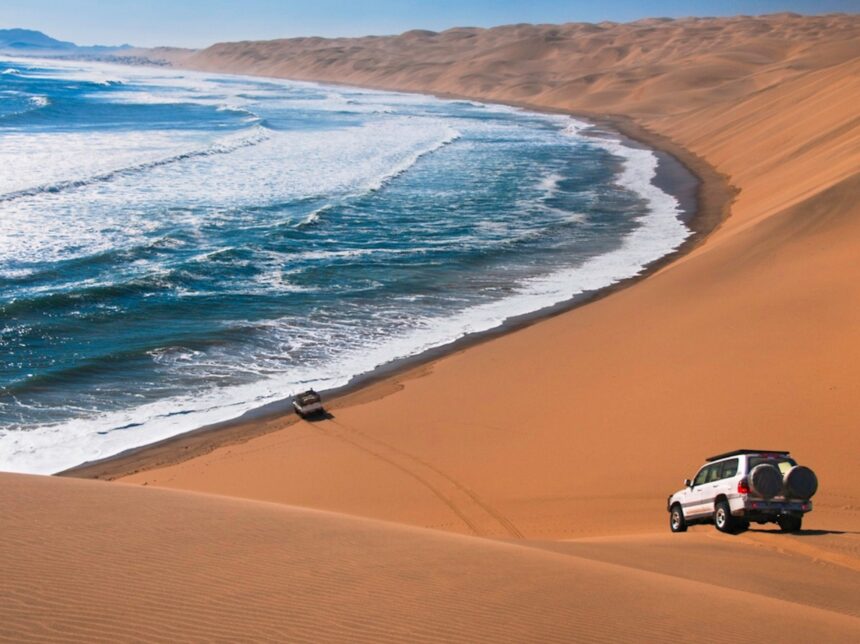
Namibia is strengthening its position as one of Africa’s fastest-growing offshore oil frontiers, advancing major discoveries in the Orange Basin while neighbouring South Africa continues to grapple with regulatory hurdles and legal challenges that have slowed exploration.
The Orange Basin, a deepwater petroleum province that stretches across the Atlantic waters of Namibia and South Africa, is estimated to contain more than 20 billion barrels of oil equivalent. Although South Africa controls about two-thirds of the basin, Namibia has made significantly faster progress in attracting investment and moving discoveries toward commercial production.
Among Namibia’s flagship developments is TotalEnergies’ Venus project, which is expected to produce approximately 150,000 barrels of oil per day when production begins around 2030. The Venus-1X discovery is estimated to contain about 1.5 billion barrels of light crude oil and 4.8 trillion cubic feet of natural gas.
TotalEnergies has also assumed operatorship of the large Mopane discovery, previously managed by Portugal’s Galp Energia, further strengthening its position in Namibia’s expanding offshore sector.
Shell also recorded a major breakthrough with the Merlin-1X exploration well in Petroleum Exploration Licence 39 (PEL 39), located roughly 290 kilometres offshore. The company estimates the first phase of the discovery contains approximately 750 million barrels of recoverable oil.
The discovery represents a significant turnaround for Shell after the company recorded a US$400 million impairment on its Namibian offshore portfolio in early 2025 due to engineering challenges associated with earlier discoveries, including Graff-1X and Jonker-1X, which presented complex geological conditions and high gas-to-oil ratios.
While Namibia advances toward commercial production, South Africa has struggled to unlock the potential of its larger share of the Orange Basin.
The country’s largest undeveloped offshore gas resource, the Ibhubesi Gas Field in Block 2A, contains an estimated 540 billion cubic feet of natural gas and 4.3 million barrels of condensate. However, exploration efforts have produced limited commercial success, while lengthy regulatory processes and legal disputes have slowed new investments.
Industry observers attribute much of Namibia’s success to its streamlined regulatory framework.
The country’s Ministry of Mines and Energy, working alongside the state-owned National Petroleum Corporation of Namibia (NAMCOR), operates a transparent licensing system with clearly defined fiscal terms and approval timelines. Exploration and appraisal permits are typically processed within three to nine months, allowing operators to advance projects quickly.
In contrast, South Africa’s regulatory system involves multiple approval authorities, with permitting processes that can extend for several years.
Environmental litigation has further complicated offshore development in South Africa.
Several proposed drilling projects have been delayed or suspended following court actions initiated by environmental organisations and coastal communities concerned about potential ecological impacts.
Recent court rulings have overturned environmental approvals for offshore drilling activities involving international energy companies, while additional legal challenges remain before the courts.
Industry executives argue that prolonged legal uncertainty discourages investment and delays the development of potentially significant energy resources.
TotalEnergies Chief Executive Officer Patrick Pouyanné recently warned that companies are reluctant to commit investment where exploration approvals become unpredictable and subject to repeated legal challenges.
South Africa’s Minister of Mineral and Petroleum Resources, Gwede Mantashe, has proposed the creation of specialised energy courts to accelerate the resolution of disputes involving strategic energy projects. He maintains that prolonged litigation has delayed offshore oil and gas developments and hindered efforts to strengthen the country’s energy sector.
As global competition for new energy supplies intensifies, Namibia’s rapid progress highlights how regulatory certainty, transparent licensing and investor confidence can accelerate resource development, while prolonged administrative and legal delays continue to constrain investment opportunities elsewhere in the region.