China is deepening its economic engagement with Nigeria with the approval of fresh financial support, as Beijing seeks to strengthen its strategic partnership with Africa’s most populous country following major infrastructure commitments estimated at $24.6 billion.
The Chinese Ambassador to Nigeria, Yu Dunhai, disclosed the latest funding during a meeting with the Permanent Secretary of Nigeria’s Ministry of Foreign Affairs, Dunoma Ahmed, on Wednesday.
Yu said the grant forms part of China’s broader commitment to supporting Nigeria’s economic development and deepening bilateral cooperation between the two countries.
The ambassador also highlighted the longstanding relationship between Nigeria and China, noting that both countries have maintained diplomatic ties for 55 years. He described the partnership as an important component of China’s broader engagement with Africa.
According to him, Beijing will continue to work closely with Abuja to ensure that the benefits of the expanding relationship translate into tangible improvements for citizens in both countries.
Responding, Ahmed commended the Chinese government for the latest financial assistance, describing it as further evidence of Beijing’s continued commitment to Nigeria’s economic and social development.
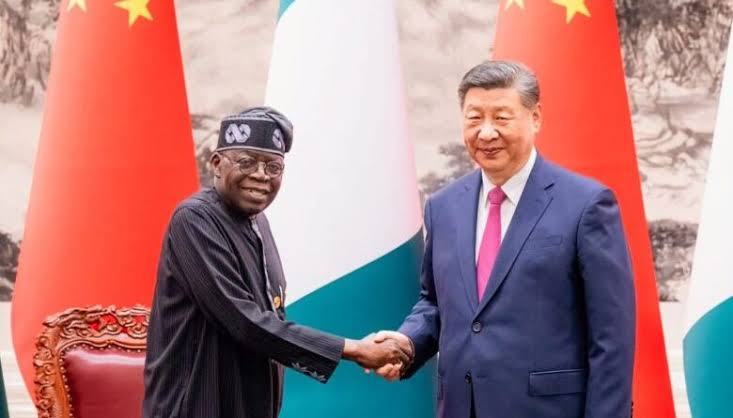
Nigeria and China elevated their relationship to a Comprehensive Strategic Partnership in 2024, building on decades of diplomatic and economic cooperation. Chinese direct investment in Nigeria reportedly reached $690 million in 2025, representing a 103 percent increase from the previous year.
Nigeria also emerged as the largest single beneficiary of China’s Belt and Road Initiative in 2025, following an estimated $24.6 billion construction commitment linked to the Ogidigben Gas Revolution Industrial Park in Delta State. The project ranks among the largest China-backed infrastructure commitments in Africa.
China has remained a major infrastructure partner to Nigeria, with Chinese-backed projects spanning transportation, energy and port development. The two countries have also expanded diplomatic and economic coordination through the China-Nigeria Intergovernmental Committee and commitments under the Forum on China-Africa Cooperation, FOCAC.
Earlier this year, at a seminar in Beijing attended by senior Nigerian government officials and media representatives, Nigeria was presented as one of China’s most important engineering and construction markets in Africa, with officials describing it as the continent’s largest engineering contracting market.
Nigeria has also been exploring a proposed $5.7 billion Chinese investment targeting the power, mining and manufacturing sectors, according to the Federal Ministry of Finance.
The government has separately disclosed that discussions with Chinese investors generated investment commitments exceeding $20 billion. Abuja has also explored Chinese participation in the rehabilitation of Nigeria’s aging refineries as part of broader efforts to revive the country’s refining capacity.
Despite the expanding cooperation, however, official data indicate that Chinese capital inflows into Nigeria have weakened in the short term. The National Bureau of Statistics reported that capital imports from China fell to $5.55 million in the first quarter of 2026, from $9.39 million recorded in the corresponding period of the previous year.
The figures represent a 40.89 percent year-on-year decline, highlighting a contrast between the large-scale investment commitments announced by both governments and the actual flow of Chinese capital into Nigeria during the period.
Nevertheless, the latest funding approval and the scale of ongoing infrastructure and investment discussions underscore Beijing’s growing economic footprint in Nigeria, while Abuja continues to position China as a key partner in its infrastructure and industrial development drive.