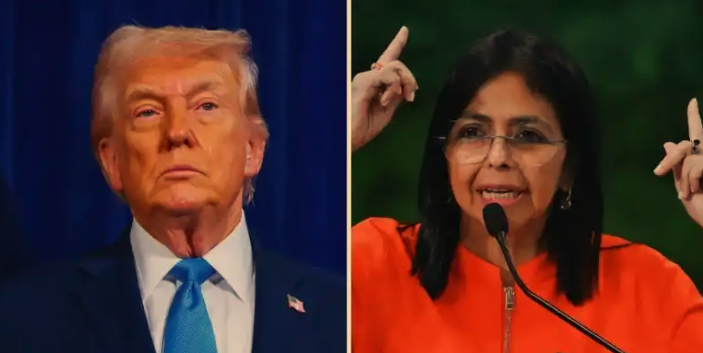
US President Donald Trump and Venezuela’s interim President Delcy Rodríguez have hailed a sweeping oil agreement between Washington and Caracas as a historic breakthrough, but critics warn that the deal could amount to a major transfer of Venezuela’s most valuable national asset to American interests.
The agreement follows the dramatic removal of former Venezuelan President Nicolás Maduro from power by elite US forces in January, an intervention after which Trump said the United States would “run” Venezuela and manage the sale of its oil for the foreseeable future.
At the centre of the new arrangement is a US-led company that has secured 100-year concessions over 17 Venezuelan oilfields containing an estimated 65 billion barrels of crude, equivalent to more than one-fifth of the country’s proven oil reserves.
The scale of the agreement alone makes it extraordinary. While Venezuela desperately needs capital and technology to rebuild its oil industry, handing foreign interests control over such a vast share of its reserves for a century inevitably raises questions about the price of economic recovery.
Both governments insist that the agreement will benefit their respective populations. Trump described it as “the biggest oil deal in world history”, while Rodríguez called it historic and said it could generate about $100 billion in investment and more than $200 billion in tax revenue.
Those figures could transform Venezuela’s battered economy if properly managed. But the crucial question is whether Venezuelans will receive a proportionate share of the wealth generated from their own natural resources or whether the arrangement will create a new form of economic dependence.
Former US special representative for Venezuela and Iran, Elliott Abrams, has strongly criticised the terms, arguing that Rodríguez has effectively given away about 20 per cent of Venezuela’s national patrimony for little in return.
Abrams nevertheless acknowledged the strategic logic of greater US-Venezuela energy cooperation, particularly as instability in the Middle East threatens global oil supplies. His criticism, however, goes to the heart of the controversy: an economically rational partnership can still become politically and strategically unequal.
According to a White House fact sheet, the US government will work alongside North American Blue Energy Partners, or Nabep, described as Venezuela’s second-largest private oil producer after Chevron.
More controversially, Washington will reportedly have veto power over the appointment of members of Nabep’s board, while a majority of the board must be US citizens. Such provisions raise legitimate concerns about how much control Venezuela will actually retain over the exploitation of its own resources.
The Trump administration argues that the arrangement has implications beyond Venezuela, particularly at a time when conflict involving Iran has disrupted global energy markets and contributed to higher fuel prices.
US Interior Secretary Doug Burgum said the agreement could shift the centre of global energy markets away from vulnerable Middle Eastern supply routes and towards the Western Hemisphere.
From Washington’s perspective, the calculation is clear: Venezuelan oil could provide a major alternative source of supply while strengthening American influence over a resource-rich country located within the Western Hemisphere.
For Venezuela, however, the calculation is more complicated. The country needs massive investment to restore production, but desperately needed foreign capital should not become a justification for surrendering strategic control over national assets.
The White House has described the agreement as part of the re-establishment of the Monroe Doctrine, a 19th-century principle associated with American influence across Latin America. The administration says the policy will remove hostile foreign influence from America’s “backyard” and reinforce US dominance in the hemisphere.
That language is particularly significant because it suggests that the oil agreement is not merely a commercial transaction. It appears to form part of a wider geopolitical strategy in which Venezuela’s energy resources become an instrument of American strategic power.
There are also serious doubts about how quickly the promised economic benefits can materialise. Trump has suggested that the agreement could generate profits within two or three years, but energy specialists believe rebuilding Venezuela’s devastated oil sector could take much longer.
Luis Pacheco of the Baker Institute at Rice University estimates that Venezuela needs roughly $100 billion over eight years to restore oil production to levels achieved about three decades ago.
The challenge therefore extends beyond securing investment. Venezuela must establish credible institutions capable of preventing corruption and ensuring that billions of dollars in oil revenue are invested transparently rather than disappearing into the same political and economic structures that contributed to the country’s collapse.
The opposition is also alarmed by the growing relationship between Trump and Rodríguez, a former vice-president under Maduro whom critics accuse of representing the same political establishment Washington previously condemned.
That reversal is difficult to ignore. Washington once portrayed Maduro’s government as an oppressive and corrupt regime requiring fundamental political change. It is now doing business with one of the figures who emerged from that same political system.
Venezuelan economist Ricardo Hausmann accused the Trump administration of choosing an asset-seizure arrangement with an allegedly illegitimate government instead of using American influence to restore constitutional order and democracy.
The criticism is not confined to Venezuela’s opposition. Some Venezuelan socialists also view the agreement as capitulation after decades of resisting US influence, while former PDVSA chief Rafael Ramírez has described it as opening the door to a new form of American colonialism.
That accusation may sound politically charged, but the unusually long concession period, the enormous volume of oil involved and the reported level of US influence make the question difficult to dismiss. The danger is that colonisation no longer needs to come through territorial occupation; it can emerge through economic control, strategic dependency and ownership of a nation’s most valuable resources.
The irony is striking. In 2008, Hugo Chávez proudly declared that Venezuela had taken control of its oil resources and would never again surrender the reins to foreign interests. Almost two decades later, a government emerging from Chávez’s political tradition has signed an agreement giving American interests extraordinary long-term access to the country’s oil wealth.
Venezuela undoubtedly needs investment, technology and international partnerships to rebuild its economy. But genuine partnership must preserve transparency, national sovereignty and a fair share of the benefits for the Venezuelan people. Otherwise, what is being celebrated as an economic rescue could ultimately be remembered as colonisation in disguise.