The signing of a new joint defence agreement by Saudi Arabia, Türkiye and Pakistan has highlighted growing concerns among key US partners in the Gulf about the reliability of Washington’s security commitments.
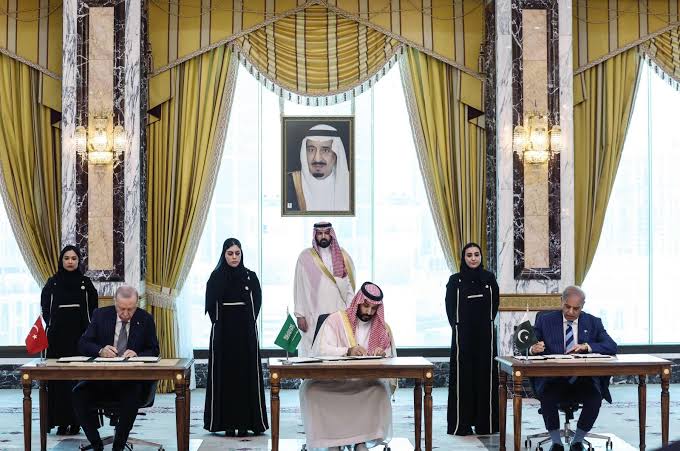
The Mecca Joint Defence Agreement, signed on August 7 in Mecca by Saudi Crown Prince Mohammed bin Salman, Turkish President Recep Tayyip Erdogan and Pakistani Prime Minister Shehbaz Sharif, commits the three countries to treat an armed attack against one member as an attack against all.
The agreement comes months after the 2026 war between the United States, Israel and Iran, which intensified regional concerns over the effectiveness and reliability of the existing US-led security arrangement.
Middle East analyst Kristian Coates Ulrichsen said regional states had been questioning the reliability of the US security partnership for more than a decade, adding that the Iran conflict had accelerated efforts to diversify defence and security relationships.
The concerns became more pronounced after Iranian missile and drone attacks targeted Saudi Arabia during the war, while Gulf states faced pressure over air-defence supplies and the prolonged disruption of shipping through the Strait of Hormuz.
Iran has since moved to strengthen its position over Hormuz. Its parliament is considering legislation that would establish a long-term legal framework for Tehran’s management of the strategic waterway and restrict the passage of vessels linked to countries it considers hostile.
The proposed measures have raised further concerns because the Strait of Hormuz is one of the world’s most important energy routes, carrying a significant share of global oil and liquefied natural gas shipments.
Iran has also responded to the Mecca agreement with warnings that any attack launched against it from the territory of the three member states would trigger a response.
The new pact is not, however, considered equivalent to NATO. Analysts say it provides a framework for consultation and collective security rather than an automatic military response to an attack.
The agreement also reportedly provides for a permanent Saudi-based secretariat and a ministerial committee, giving the arrangement an institutional structure that could allow it to develop over time.
The three countries bring different strategic capabilities to the partnership. Türkiye contributes a NATO-integrated military and a growing defence industry, Saudi Arabia provides financial strength and a strategically important Gulf location, while Pakistan brings significant military capabilities and a nuclear deterrent.
The development has also attracted attention in China, with Chinese analysts viewing the agreement as evidence of a changing regional security order and a possible weakening of the traditional US security umbrella.
Iran has responded on several fronts, including diplomatic statements, proposed legislation concerning Hormuz and changes within its national security leadership.
The appointment of former Islamic Revolutionary Guard Corps commander Mohsen Rezaei as secretary of Iran’s Supreme National Security Council has further signalled Tehran’s tougher approach to regional security.
Despite the growing regional defence cooperation, the three signatories have stressed that the agreement is intended to complement rather than replace their existing relationships with Washington.
Türkiye remains a NATO member, while Saudi Arabia and Pakistan maintain longstanding security ties with the United States.
Analysts therefore see the Mecca pact less as an immediate break with Washington and more as a sign that Gulf and regional powers are seeking additional security options in a rapidly changing Middle East.
The agreement could ultimately become an important component of a more independent regional security architecture, particularly if doubts over US commitments continue to grow.