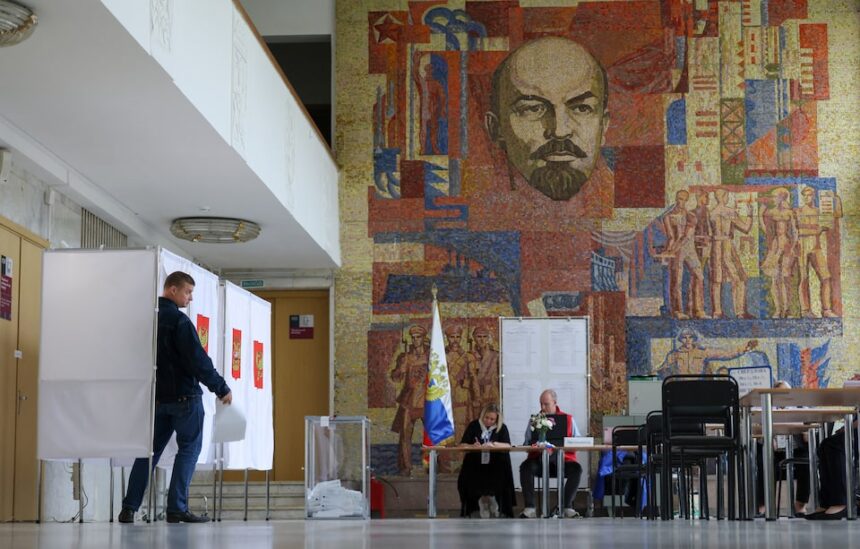
Russian authorities have reported a series of attacks targeting voting systems and communication networks as the country entered the second day of its three-day parliamentary election.
The September 18–20 State Duma election is the first parliamentary vote since Russia launched its full-scale invasion of Ukraine in February 2022, with the Kremlin treating the exercise as an indicator of public support amid the ongoing war.
The ruling pro-Kremlin United Russia party is widely expected to maintain its dominance in the tightly controlled political system, while most prominent anti-war candidates were excluded from the ballot before voting began across Russia’s 11 time zones.
Russia’s Central Election Commission (CEC) said its online voting system in Moscow came under a strong overnight attack on Saturday. CEC Chairwoman Ella Pamfilova, according to state media, said the attacks were continuing but had been successfully repelled.
The country’s Digital Development Ministry also reported an attempted sabotage of communication lines in Russia’s Far East. Authorities said the attack had been thwarted and communications restored.
President Vladimir Putin earlier accused Ukraine of attempting to interfere with the election though he did not provide evidence to support the allegation.
CEC figures cited by state media showed nationwide voter turnout at 32.58 per cent as of 2pm local time on Saturday.
The election has also generated a diplomatic dispute with Moldova over voting arrangements in the separatist region of Transdniestria, which is controlled by pro-Russian authorities.
Moscow plans to establish 15 polling stations in the region for Russian citizens, a move opposed by Chisinau. Russian authorities argue that the estimated 220,000 residents of Transdniestria who hold Russian passports are entitled to participate in the election.
The liberal Yabloko party, which has called for a ceasefire in Ukraine, was barred from contesting the election nationally after Russia’s Supreme Court ruled last month that it had violated electoral rules. The party denied the allegation.
Some Yabloko candidates, however, remain in contention in single-member constituencies, which make up half of the 450 seats in the State Duma.
The election is being closely watched as a measure of political participation and public sentiment in Russia more than four years after the start of the full-scale war in Ukraine, amid restrictions on opposition activity and growing reliance on electronic voting.