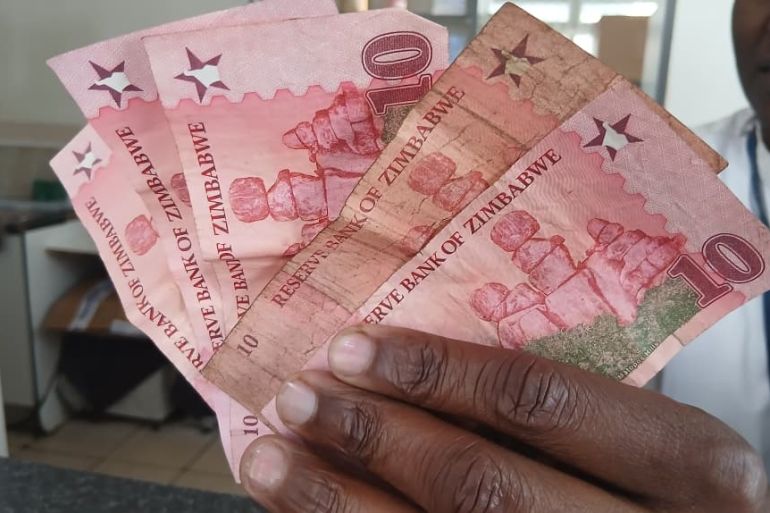
Zimbabwe’s latest attempt to restore confidence in its domestic currency is facing a major hurdle as businesses and consumers remain reluctant to embrace the Zimbabwe Gold (ZiG), preferring the US dollar after years of economic instability and repeated currency collapses.
Introduced in April 2024, the ZiG was designed to rebuild confidence in the country’s monetary system and reduce its dependence on the US dollar. The Reserve Bank of Zimbabwe (RBZ) says the currency is backed by foreign exchange and precious metal reserves, including gold.
However, the availability of gold reserves and official assurances about the currency’s backing have yet to convince many Zimbabweans that their earnings and savings are safe in the local currency.
The reluctance reflects the painful experiences of previous currency failures, which wiped out savings, eroded wages and weakened public confidence in successive monetary reforms.
Zimbabwe abandoned its domestic currency in 2009 following a period of hyperinflation and adopted a multicurrency system dominated by the US dollar. Although the government reintroduced a local currency in 2018, subsequent instability further undermined public trust.
According to a primary school teacher Charles Mbwandarikwa, the consequences of those failures remain fresh. He receives about one-third of his salary in ZiG but exchanges the money quickly rather than risk losing its value.
Mbwandarikwa said he lost his pension savings during the 2009 currency crisis. When the local currency returned in 2018, he recalled that the value of his salary plunged from the equivalent of $540 to just $40 by the end of that year.
His experience illustrates the challenge facing authorities: introducing a currency is one thing, but persuading people to trust it with their livelihoods is another.
In a bid to strengthen confidence, the RBZ introduced an upgraded series of ZiG banknotes on April 7, featuring revised designs and enhanced security features. The central bank has also reported improvements in inflation, with annual ZiG inflation standing at 3.7 per cent in September.
Nevertheless, lower inflation has not automatically translated into stronger demand for the currency or greater willingness among Zimbabweans to use it for daily transactions and long-term savings.
Economist Cornelius Dube said demand for the ZiG remained weak, arguing that the currency’s availability must reflect the level of demand for it.
“ZiG has to be available in a ratio relative to its demand. Demand for ZiG is currently very subdued,” Dube said.
The problem is particularly evident in the retail sector, where businesses continue to encounter a strong preference for the US dollar.
Clothing retailer Sesedzai Chigumira said she had recorded only a handful of sales in ZiG, highlighting the difficulties businesses face in encouraging customers to embrace the domestic currency.
The situation exposes a fundamental weakness in the government’s de-dollarisation drive. While authorities may introduce policies encouraging the use of ZiG, businesses have little incentive to rely on it if customers prefer to pay in dollars. Similarly, consumers may be unwilling to hold the local currency if they fear its purchasing power could decline.
This creates a cycle in which limited public confidence constrains demand, while weak demand further discourages businesses from adopting the currency.
Zimbabwe’s mineral wealth, including its gold resources, may provide a foundation for monetary stability, but it cannot guarantee public confidence on its own. The credibility of a currency ultimately depends on whether people believe it can retain its value and remain reliable for transactions, savings and future financial commitments.
Recognising the difficulties involved, the RBZ has moved away from its previous target of adopting a single currency by 2030. It now favours a gradual, market-led transition towards wider use of the ZiG, supported by sustained macroeconomic stability.
Authorities have also sought to expand the currency’s role in domestic transactions, including tax payments and public-sector dealings, alongside measures affecting foreign exchange and national payment systems.
However, increasing the currency’s use in payments does not necessarily mean that people trust it as a store of value. Consumers may use ZiG to meet certain obligations without choosing to retain it as savings.
For Zimbabwe, the distinction is critical. A currency that circulates because people have few alternatives is fundamentally different from one they willingly accept because they trust its purchasing power.
Dube said de-dollarisation remained achievable but warned that the process would require time and sustained policy efforts.
“History shows that it is possible to de-dollarise, though it’s not easy. It takes time,” he said.
He added that authorities should focus on creating conditions that encourage voluntary adoption rather than forcing people to abandon the US dollar.
“Policy should not try to force a conversion but should create the necessary incentives which will eventually see both businesses and consumers being indifferent to holding ZiG or US dollars,” Dube said.
Ultimately, the ZiG’s success will depend less on government declarations than on its ability to deliver lasting monetary stability. Zimbabweans who have repeatedly watched their savings disappear are unlikely to exchange the security they associate with the US dollar for renewed promises alone.
The government must therefore demonstrate that the currency can preserve earnings, support predictable business transactions and maintain its purchasing power over time. Without that evidence, efforts to reduce dollar dependence risk achieving wider official use without securing the public confidence necessary for lasting monetary reform.