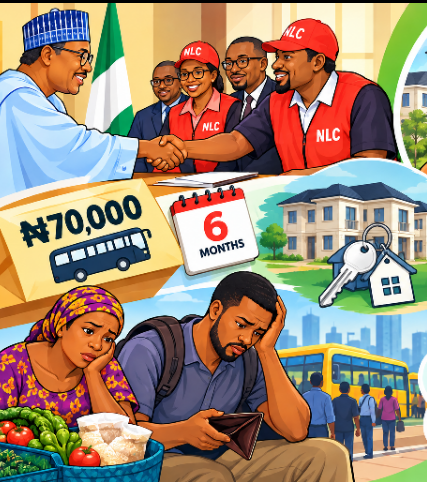
The Federal Government’s agreement to pay workers a ₦70,000 monthly transport allowance for six months, beginning in November 2026, raises questions about the sustainability of its interventions and the fate of millions of Nigerians excluded from the benefits.
While the agreement reached with the Nigeria Labour Congress (NLC) also covers outstanding allowances for health workers and other welfare measures, the recurring cycle of negotiations, promises and delayed implementation has continued to undermine public confidence in the government’s response to economic hardship.
According to report, the agreement, reached at a conciliation meeting convened by the Federal Ministry of Labour and Employment on October 27, provides for the transport allowance across all levels for six months. It also approves peculiar allowances with effect from May 1, 2026, with arrears to be paid in three monthly instalments, while 19 months of outstanding allowances owed to health workers are expected to be settled within three months from December. These commitments may offer temporary relief to affected workers, but Nigerians have heard enough promises to demand more than signed agreements and official assurances.
The Federal Government appears to have mastered the art of keeping organised labour at the negotiating table with promises that generate hope but do not always translate into timely relief though the latest agreement represents progress on paper, its real value will depend on implementation. Labour unions must therefore move beyond celebrating negotiated figures and insist on clear timelines, transparent payment schedules and consequences for default. Workers cannot continue to bear the burden of economic policies while being asked to wait patiently for benefits already agreed upon.
More fundamentally, the ₦70,000 transport intervention exposes the limitations of a policy approach that concentrates relief on public servants while leaving millions of other Nigerians to confront the same economic realities without comparable assistance.
Transportation is only one component of the rising cost of living. Food, housing, healthcare, education and electricity remain pressing concerns for households across the country. A government that addresses one expense for a limited category of citizens without a broader strategy for easing the cost of living risks treating the symptoms of economic hardship while neglecting its underlying causes.
This concern echoes the criticism raised by former Vice-President and African Democratic Congress (ADC) presidential candidate Atiku Abubakar, who questioned the fate of Nigerians outside the public service. What happens to those employed by private organisations, self-employed citizens, traders, artisans and millions of unemployed people who must equally pay for transportation, food and accommodation? Their economic struggles do not become less serious simply because they are not on the government’s payroll. Any intervention that overlooks these groups raises legitimate questions about whether public policy is designed to protect the wider population or primarily to appease organised constituencies.
The same questions arise from the Federal Government’s Renewed Hope Cities housing initiative, which has reportedly attracted more than 100,000 expressions of interest.
Rather than presenting this figure as an unqualified achievement, the government should examine what it reveals about the scale of Nigeria’s housing crisis and the barriers preventing millions of citizens from owning decent homes. Strong demand for affordable housing is evidence of a pressing social need; it is not, by itself, proof that the programme is affordable, accessible or capable of meeting that need on a meaningful scale.
The programme brings together the Federal Ministry of Housing and Urban Development, mortgage institutions and private developers to expand access to homeownership. More than 2,000 Nigerians are reported to have benefited from mortgages, while over 10,000 additional applications are being processed. Construction is also progressing in Abuja, Kano and Lagos, with further developments planned elsewhere. These are potentially important steps, but the government must distinguish between expressions of interest, firm subscriptions, approved mortgages and completed home purchases. They are different measures of progress and should not be presented as though they represent the same achievement.
The critical question is why a country of more than 200 million people, battling widespread poverty and a severe housing deficit, is celebrating participation figures that remain modest in relation to the scale of the need. The answer may lie partly in the purchasing power of ordinary Nigerians.
A family struggling to afford food, school fees and transport may desperately need a house but lack the income, savings or financial stability required to obtain a mortgage. The government must therefore establish how many applicants can genuinely afford the homes, what the repayment conditions are and whether the scheme accommodates low-income earners, informal workers and people without conventional employment records.
There is also an uncomfortable contradiction in the government’s economic approach. Private humanitarian and charitable initiatives intended to provide relief to vulnerable Nigerians can face restrictions justified by concerns about inflation, market stability or other economic considerations. Yet public-sector wage awards and transport allowances involving substantial public expenditure are not subjected to the same public debate over their potential economic consequences.
This is not to suggest that workers should be denied relief or that humanitarian interventions must be exempt from legitimate regulation. Rather, the government must explain its policies consistently and demonstrate why measures that benefit different groups are assessed by different standards. Economic management cannot inspire confidence when its principles appear selective.
A credible housing policy must equally go beyond the construction of estates and the announcement of ambitious targets. Roads, utilities and new residential units are necessary, but they will not solve the housing crisis if the intended beneficiaries cannot afford the purchase prices or mortgage repayments.
The Tinubu-led government should publish clear information on pricing, eligibility, interest rates, repayment periods and the number of completed homes actually occupied by beneficiaries. It should also consider rental housing, social housing and other arrangements for citizens who cannot realistically enter the mortgage market.
The ultimate measure of success is not how many people register their interest but how many Nigerians gain access to safe, decent and affordable accommodation.
Meanwhile,, the Federal Government must recognise that economic hardship does not discriminate between public servants and private-sector workers, between business owners and the unemployed, or between those seeking mortgages and those struggling to pay rent.
Also, a transport allowance that expires after six months cannot substitute for policies that create jobs, improve public transportation, stabilise food prices and expand access to essential services. Similarly, a housing programme that generates impressive headlines but remains financially inaccessible to ordinary citizens cannot be considered a comprehensive solution. Relief measures are necessary, but they must form part of a coherent national strategy rather than serve as isolated announcements.
A government that cannot devise and implement policies with meaningful benefits for the wider population risks being perceived as partisan, disconnected from ordinary citizens or incapable of meeting its responsibilities.
The Tinubu administration must therefore realize that Nigerians need policies that reach beyond government offices, political supporters and privileged applicants to improve everyday life for the majority. Until that happens, the celebration of limited interventions amid widespread hardship will continue to raise an uncomfortable question: who, precisely, is the government’s economic recovery designed to serve?