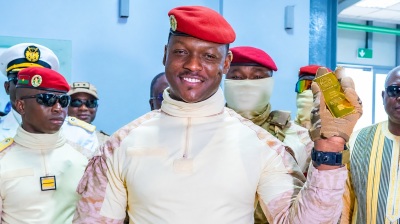
Captain Ibrahim Traoré has made control of Burkina Faso’s natural resources one of the defining features of his military government, seeking to turn gold from a predominantly foreign-operated export commodity into a strategic national asset.
The clearest symbol of that policy emerged on September 28, 2026, when Burkina Faso commissioned its first gold refinery, RAFFINOR-BF, in Ouagadougou. The facility represents an investment of more than XOF11bn ($19.1m) and has an initial theoretical refining capacity of 164 tonnes annually. The government says the capacity could eventually rise to 515 tonnes.
The refinery is more than another industrial project. It captures the central economic philosophy of Traoré’s rule since he seized power in the second military coup of 2022: Burkina Faso should exercise greater control over the resources it produces, retain more of their value at home and reduce dependence on foreign companies for strategic economic activities.
That philosophy has produced tangible changes. The 2024 mining code increased the state’s free-carried interest in mining projects to 15%, while allowing the government to acquire additional paid stakes. State-owned mining company SOPAMIB has moved from being largely dormant to becoming an instrument for direct government ownership of producing and prospective mines.
But the bigger question is whether this new model represents genuine national economic progress or simply a redistribution of ownership. The answer, so far, is mixed but significant.
From regulator to mining participant
Gold was already Burkina Faso’s dominant export before Traoré came to power. What has changed is the extent to which the state now seeks to participate directly in the industry rather than merely regulate and tax private operators.
Industrial gold production fell from 57.67 tonnes in 2022 to 53.38 tonnes in 2024. Including artisanal, semi-mechanised and recovered production, recorded output reached 60.77 tonnes in 2024.
IAMGOLD’s Essakane mine produced 14.13 tonnes in 2024, Endeavour Mining’s Houndé operation produced 8.94 tonnes and West African Resources’ Sanbrado mine produced 6.36 tonnes. Together, the three operations accounted for roughly 55% of industrial production.
The Traoré government has responded by increasing the state’s share in projects while encouraging the creation and expansion of state-owned mining operations.
SOPAMIB, established in 2014 but not fully operational before the current government, was given a broader mandate in July 2024. The state subsequently acquired interests in the Boungou and Wahgnion gold mines and transferred them to SOPAMIB in 2025.
In July 2026, the government approved an industrial mining licence for SOPAMIB Bouboulou SA, described as wholly state-owned. The project is expected to receive about XOF32bn in investment and produce an estimated 7.27 tonnes of gold over 15 years.
This is a major departure from the traditional model in which international mining companies supplied most of the capital, technology and operational expertise while the government relied principally on taxes, royalties and equity interests.
What has Traoré actually changed nationally?
The most important difference under Traoré may not be that Burkina Faso has suddenly become a prosperous country. It has not. Rather, his government has attempted to change the state’s relationship with the economy.
The state is becoming a more active owner of mines. It is tightening control over artisanal gold. It is seeking domestic processing rather than exporting raw gold. It has introduced a sovereign mining investment fund and has placed greater emphasis on agricultural self-sufficiency and infrastructure.
The economic figures provide some evidence that these policies are producing results.
The World Bank estimates that Burkina Faso’s economy grew by 5.3% in 2025, compared with 4.8% in 2024. Gold production rose to about 94 tonnes from 61 tonnes in 2024, while agricultural production also strengthened. Inflation fell to -0.5% in 2025, while real GDP per capita growth improved.
The IMF similarly reported 5.3% economic growth in 2025 and said the country’s external position improved sharply, with the current-account balance moving from a 3.5% of GDP deficit in 2024 to a 6.3% surplus in 2025. The fiscal deficit also narrowed substantially.
These numbers matter because they show that the economy has remained resilient despite the country’s severe security crisis.
But they should not be interpreted as proof that the military government has solved Burkina Faso’s structural problems. The IMF continues to describe the security and humanitarian situation as challenging, while the World Bank warns that economic resilience must translate into jobs and broader economic opportunities if it is to produce lasting improvements in living standards.
Agriculture and the search for self-reliance
Another major component of the Traoré government’s economic agenda has been food production.
The government has promoted an agropastoral and fisheries offensive, arguing that Burkina Faso must reduce its dependence on imported food. The World Bank reported that cereal production increased by 17.6% in the 2025 season, helped by favourable rainfall and government support.
This is important because economic sovereignty cannot depend entirely on gold. A country that controls its mines but remains heavily dependent on imported food, fuel, machinery and manufactured goods remains vulnerable.
Traoré’s economic programme therefore increasingly links mining, agriculture, industrialisation and infrastructure under the broader concept of national sovereignty.
The gold boom is also a statistical story
The dramatic increase in reported gold production requires some caution.
Burkina Faso recorded more than 94 tonnes of gold production in 2025, compared with about 61 tonnes in 2024. But the IMF has warned that reforms to the artisanal mining sector created a structural break in the country’s mining statistics, making comparisons with previous years more difficult.
In other words, part of the increase may reflect a greater ability to capture gold that was previously produced and traded outside official channels rather than an equivalent increase in physical extraction.
That distinction is important when measuring the success of Traoré’s reforms.
Nevertheless, formalising artisanal production has potentially significant consequences. The more gold that passes through official channels, the greater the government’s ability to collect revenue, monitor production, reduce illicit trading and direct resources towards national development.
The state moves downstream
RAFFINOR-BF represents the next stage of this strategy.
For decades, Burkina Faso’s economic role in the gold industry was largely concentrated on extraction. The new refinery introduces domestic processing into the equation.
The government says the refinery is intended to process gold from industrial mines and artisanal producers and eventually serve as a regional processing centre. Its first-phase capacity of 164 tonnes is already considerably higher than the government’s reported national output of more than 94 tonnes in 2025.
That creates both an opportunity and a challenge.
A refinery cannot prosper merely because the government builds it. It needs a reliable supply of gold, competitive operating costs, dependable electricity, financing and predictable regulation. If domestic production is insufficient, the facility will need imported feedstock or gold from neighbouring markets.
The success of RAFFINOR-BF will therefore depend on whether Burkina Faso can build the mining and trading ecosystem around it.
Private miners have not been pushed out
Despite the rhetoric around sovereignty, Traoré’s government has not nationalised the entire mining industry.
Foreign mining companies continue to operate and invest.
West African Resources brought its Kiaka mine into production in June 2025. In April 2026, the government authorised SOPAMIB to acquire an additional 25% of Kiaka SA for XOF70bn.
The proposed transaction illustrates the new model: international companies can continue providing capital and technical expertise, but the state expects to hold a larger share of the economic value.
West African Resources has continued to describe Kiaka as 85% owned by the company and 15% by the Burkinabè state pending completion of the proposed additional acquisition.
This suggests that Traoré’s approach is not simply state versus private sector. It is increasingly a model in which private capital operates alongside a much stronger state shareholder.
The cost of the new model
The risks, however, are substantial.
Greater state ownership means greater exposure to operational and financial risks. Mining requires enormous capital, technical expertise and long-term stability. A government that takes a larger stake also takes on a larger share of the consequences when commodity prices fall, projects underperform or costs rise.
There are also concerns about regulatory predictability. Sarama Resources, for example, is pursuing arbitration over the loss of an exploration permit, with its claim against Burkina Faso reportedly increased to $242m plus interest.
The challenge for Traoré is therefore not merely to obtain bigger stakes in mines. It is to create a mining system in which state participation produces more revenue and industrial capacity without discouraging the private investment needed to keep the sector expanding.
Security remains the ultimate test
For all the economic changes, Burkina Faso’s most fundamental national challenge remains security.
Traoré came to power amid frustration over the state’s inability to contain jihadist violence and regain control of territory. His government has made territorial reconquest and national defence central to its political legitimacy.
There have been claims of improved security conditions in some areas, and the World Bank has linked stronger services-sector activity partly to an improved security situation. But the international financial institutions continue to describe the country’s security and humanitarian environment as fragile.
This means the military government’s ultimate scorecard cannot be measured by gold production alone.
If increased mining revenue, agricultural production and state ownership can finance infrastructure, create jobs, strengthen public services and improve security, Traoré’s economic nationalism could represent a meaningful structural shift.
If, however, the benefits remain concentrated in government-controlled institutions while insecurity, displacement, poverty and weak accountability persist, the reforms will have changed ownership without fundamentally changing the lives of ordinary Burkinabè.