A Ukrainian hotel owner, Denys Katyukha, has secured a $5.1 million judgment against Russia after accusing Moscow of seizing his hotel resort and apartment in southeastern Ukraine following its full-scale invasion in 2022.
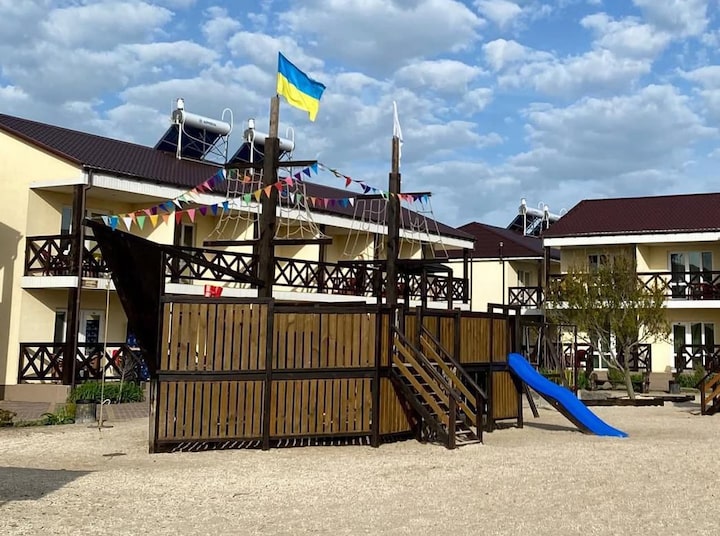
Katyukha, 49, lost control of the Admiral Hotel, a seaside resort he spent years developing in Kyrylivka, a village along the Sea of Azov in Ukraine’s Zaporizhzhia region. He also lost his apartment in the nearby city of Melitopol after Russian forces occupied the area.
His legal battle, which lasted 11 months, was pursued in a Ukrainian civil court that Russia does not recognise.
Although Moscow did not participate in the proceedings, the court eventually awarded him $5.1 million in damages, ruling that Russia’s actions amounted to “de facto expropriation”.
The case highlights the widespread seizure of Ukrainian businesses and properties in territories occupied by Russian forces.
A Reuters investigation into Russian and Ukrainian property records found that hundreds of hotels and resorts along the Sea of Azov have either been seized or identified for seizure since Russia launched its full-scale invasion.
Russian occupation authorities have reportedly identified more than 7,000 commercial and residential properties in the occupied Zaporizhzhia region as “ownerless”. The list includes 521 hotels and resorts, according to Reuters’ examination of published notices.
At least 77 of the hotels and resorts are now controlled by Russian businesses, including 20 operated by Russian state entities, corporate and tourism records show. However, newsmen could not establish the fate of all the affected businesses.
The seizures reflect what analysts describe as Moscow’s broader effort to consolidate control over occupied Ukrainian territories while transforming them economically and politically into Russian-controlled regions.
Karolina Hird, a national-security fellow at the Washington-based Institute for the Study of War, said the property seizures allow Russia to strengthen its control over occupied areas and generate revenue that could support its war effort.
Ukraine’s Ministry of Foreign Affairs has accused Russia of introducing restrictive property laws to legitimise the confiscation of Ukrainian assets. It described the measures as a “legal smokescreen” for state-sponsored theft, arguing that Ukrainians risk losing ownership rights unless they acquire Russian citizenship.
However, Kremlin spokesman Dmitry Peskov defended the policy, saying property owners had been given the opportunity to re-register their assets under Russian jurisdiction, maintaining that properties not re-registered subsequently became ownerless. Meanwhile, Russian-backed occupation authorities in Zaporizhzhia did not respond to questions about the seizures.
Katyukha’s ordeal began in September 2022, when he was living in Germany after fleeing Ukraine. He said his father, who remained behind, informed him that armed men had entered the Admiral Hotel and declared it ownerless.
The occupation authorities reportedly gave him three days to establish ownership of the property while his father subsequently submitted the necessary documents, but the authorities refused to recognise Ukrainian passports and property deeds.
According to Katyukha, officials told his father that the documents came from “a nonexistent country” though newsmen could not independently verify every detail of his account.
The Admiral was more than a business investment for Katyukha. It represented years of personal ambition, memories and determination to build a successful hospitality destination along Ukraine’s Black Sea-adjacent coastline.
Although his permanent home was in Melitopol, his childhood memories were closely connected to Kyrylivka, where he spent summers with his grandfather because the seaside environment helped ease his respiratory problems.
He eventually decided to establish his own hotel in the village, spending years searching for a suitable location before breaking ground in August 2014 on a 3.7-acre plot of undeveloped land.
What began as a modest collection of bungalows gradually developed into a 100-room resort featuring three bars, a restaurant, a shop, a swimming pool and a children’s water-play area. During the winter, Katyukha even organised Christmas celebrations on the beach.
Before the Russian occupation, Kyrylivka was a major tourist destination, attracting approximately two million visitors in 2021, according to Ukrainian authorities. That same year, the Admiral received the local “Hospitality of the Year” award and maintained a 4.7-star rating on Google.
However, the resort’s fortunes changed dramatically after Russian forces occupied the area. On September 28, 2022, nine days after armed men reportedly seized the property, a Russian-controlled commission appointed a new owner for the hotel alongside more than 100 other businesses.
Corporate records identified the new owner as Resorts of Zaporizhzhia Region, a Russian state entity. The organisation reportedly generated net revenue of 65.7 million roubles, approximately $800,000, in 2023.
The entity was renamed the Zaporizhzhia Region Investment Development Agency in April but did not respond to request for comment by newsmen.
While Katyukha attempted to rebuild his life in Germany and remotely teach hospitality courses at a Ukrainian university, the hotel continued operating under its new management.
Satellite images showed vehicles in some hotel parking areas, umbrellas around swimming pools and activity along sections of the beach by 2023. Russian social media influencers also began sharing videos of their visits to the resort.
One video published in 2025 showed a woman in a pink-striped bikini walking through the Admiral, displaying hotel rooms, beach cabanas and landscaped gardens.
Katyukha said he was not particularly upset that people were enjoying the facilities he had built, but he was shocked to discover that the resort’s relaunched website was almost identical to the original version he had created, with the language changed from Ukrainian to Russian.
Despite the apparent return of tourism activity, the region’s hospitality industry remains severely weakened.
A tourism development plan published by the Russian-backed Zaporizhzhia authorities in March indicated that only 150,000 people visited the Azov region in 2025, representing about five per cent of the combined visitor numbers recorded for Kyrylivka and Berdiansk in 2021.
The document attributed the decline to deteriorating hotel facilities, inadequate public utilities and the continuing conflict.
Determined to seek compensation, Katyukha began documenting his losses in mid-2023. Working with his lawyer, he assembled approximately 3,000 pages of evidence, including receipts, bank statements and detailed inventories of everything he had invested in the resort.
His calculations covered virtually every item, from microwaves costing $40 and chandeliers valued at $41 to oak bedside tables costing $31 each and even a can opener worth just 20 cents.
The documentation also included construction materials, machinery, furniture and other equipment purchased during the development of the hotel.
The legal proceedings took nearly a year, with Russian representatives refusing to participate. Some hearings were also disrupted or delayed by air raid sirens and bombings amid the continuing war, according to report.
On April 30, presiding Judge Mykhailo Smokovych awarded Katyukha $5.1 million in compensation, concluding that Russia had effectively expropriated his property.
Beyond the Ukrainian court judgment, Katyukha has submitted a separate claim to the EU-backed Register of Damage for Ukraine, headquartered in The Hague. The register collects evidence of losses, damage and injuries arising from Russia’s invasion.
He is among more than 195,000 people who have submitted claims, while the register estimates that it could eventually receive between six million and eight million applications. However, no funding mechanism has yet been established to compensate successful claimants.
For Katyukha, the judgment represents a measure of legal recognition rather than an immediate financial victory. He acknowledges that Russia is unlikely to pay the compensation during his lifetime but hopes his grandchildren may eventually benefit from his pursuit of justice.
Describing himself as a victim fighting an almost impossible battle, he likened his struggle to that of Don Quixote fighting windmills. Yet, despite the enormous odds against him, he remains determined to hold Russia accountable for the business and home he lost.
REUTERS