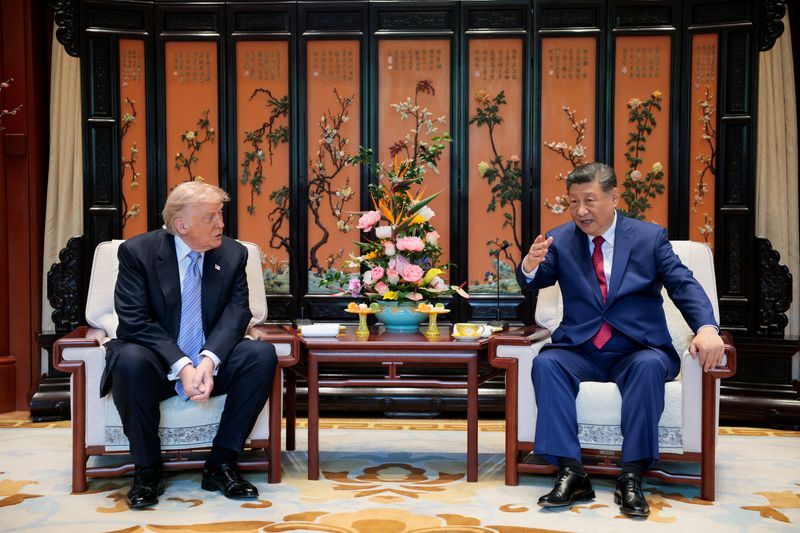
China’s President Xi Jinping is expected to press US President Donald Trump to halt American arms sales to Taiwan when the two leaders meet in Washington this week, arguing that such sales violate the understanding reached between Washington and Beijing in 1982. But the demand confronts the United States with a longstanding policy dilemma: balancing its commitment to Taiwan’s self-defence with the need to manage relations with China.
Three sources familiar with US-China discussions told Reuters that Xi is likely to invoke the August 17, 1982, US-China Joint Communiqué, under which Washington said it intended gradually to reduce the quantity and quality of arms sales to Taiwan and did not seek a long-term policy of supplying weapons to the island. Beijing has consistently interpreted that language as a commitment by Washington eventually to end arms sales to Taiwan.
The US interpretation, however, has never been identical to Beijing’s. The Reagan administration linked any reduction in arms sales to China’s continued commitment to resolving differences with Taiwan peacefully. The US State Department’s historical record notes that the two sides deliberately left room for different interpretations of the communiqué, allowing Washington and Beijing to maintain diplomatic relations despite their disagreement over Taiwan.
That distinction is central to the current dispute. The United States subsequently maintained its relationship with Taiwan under the Taiwan Relations Act, while the Six Assurances issued by President Ronald Reagan in 1982 stated that Washington had set no date for ending arms sales to Taiwan and had not agreed to consult Beijing before making such sales.
Beijing nevertheless regards Taiwan as part of China and considers the issue one of its most sensitive sovereignty questions. China has sharply increased military activity around Taiwan in recent years, while Taiwan rejects Beijing’s sovereignty claim and maintains its own democratic government. Reuters reported that Chinese forces now operate around Taiwan on an almost daily basis.
The disagreement therefore goes beyond the sale of military equipment. For Beijing, ending US arms supplies would remove what it regards as external support for Taiwan and could reduce one of the most persistent sources of tension in US-China relations. For Washington, however, accepting China’s interpretation without corresponding assurances could raise questions about the durability of its existing Taiwan policy.
What Would Washington Gain?
There are arguments for considering Xi’s demand as part of a broader diplomatic bargain rather than treating the issue in isolation.
A reduction in tensions over Taiwan could help Washington stabilise its increasingly competitive relationship with Beijing. The two governments are also negotiating over trade, advanced technology, artificial intelligence and China’s relationship with Iran. Reuters reported that Beijing may offer cooperation in putting pressure on Iran as part of the wider negotiations.
A negotiated limitation on future arms transfers could also provide Washington with leverage if it produced reciprocal Chinese commitments, particularly concerning military activities around Taiwan and the avoidance of coercive changes to the status quo.
But such an arrangement would depend heavily on what Beijing offered in return. The historical record of the 1982 negotiations shows that Washington was unwilling to make arms-sale reductions unconditional; the Reagan administration tied them to China’s peaceful approach toward Taiwan.
Why Washington May Resist
The principal difficulty is that ending or suspending arms supplies could be interpreted as weakening a long-standing US commitment to Taiwan’s ability to defend itself.
The Taiwan Relations Act has been a central component of US policy toward Taiwan since 1979, while the Six Assurances explicitly stated that Washington had not agreed to establish a timetable for ending arms sales or to consult Beijing in advance about them.
The issue also carries implications for US relationships with other Asian partners. Reuters reported this week that senior US officials reaffirmed Washington’s defence commitments to Japan, South Korea and Taiwan ahead of the Trump-Xi summit, while concerns have emerged among US allies about the possibility of concessions to Beijing.
US Senator Pete Ricketts has urged Trump to maintain existing Taiwan policy, while Representative John Moolenaar has argued that Chinese objections to US arms sales and security cooperation should not dictate American policy. These are political positions of US lawmakers, rather than evidence of a settled consensus.
A Potential Bargaining Chip
Trump himself has previously described the proposed additional arms package for Taiwan as a negotiating tool. Reuters reported that his administration approved an $11 billion package in December, while another package worth about $14 billion has remained on hold for months.
That gives Trump several possible negotiating variables: future arms sales, existing deliveries, China’s military activity around Taiwan, trade concessions and Beijing’s cooperation on other international disputes.
The question facing Washington, therefore, is not simply whether to accept or reject Xi’s demand. It is whether the 1982 understanding can be reinterpreted or renegotiated without undermining the separate US legal and policy commitments toward Taiwan.
Xi arrives in Washington on Wednesday, with formal talks with Trump scheduled for Thursday 24 September 2026, and a visit to the US National Archives expected on Friday. The Archives setting could carry particular symbolism because the 1982 communiqué is part of the historical record Xi is expected to invoke.
The summit could consequently turn Taiwan into one of the clearest tests of whether Trump and Xi can exchange concessions without either side believing it has surrendered a core national interest.