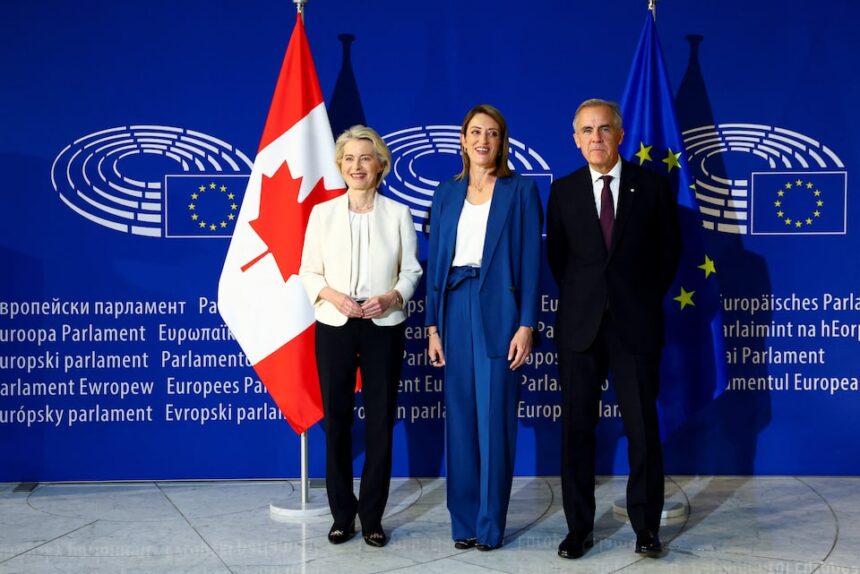
BRUSSELS — European Commission President Ursula von der Leyen has proposed opening the door for Canada to become the European Union’s first-ever associate member, in what could mark a significant shift in how the 27-nation bloc builds strategic partnerships outside its formal membership structure.
The proposal comes at a time when the EU and Canada are facing mounting pressure from an increasingly confrontational global trading environment, particularly tensions involving U.S. President Donald Trump and growing economic competition from China. Beyond symbolism, the initiative could become a practical attempt by both sides to strengthen their economic and strategic options.
Von der Leyen made the proposal on Wednesday during her annual State of the Union address at the European Parliament in Strasbourg, where Canadian Prime Minister Mark Carney was present. European lawmakers responded with a standing ovation before von der Leyen embraced Carney.
“I would like to work with you on opening the door for Canada to be the first associate member of the EU,” she told lawmakers.
She said Europe and Canada shared common interests on issues ranging from artificial intelligence and climate change to the Arctic, geopolitics, defence, critical raw materials and supply chains.
“Europe and Canada believe in democracy,” von der Leyen said, describing the proposed relationship as part of a broader effort to “reimagine” Europe’s partnerships in what she called the “cold fragility” of the current international environment.
Carney welcomed the prospect of a much stronger alliance between Canada and Europe, saying Canada and Europe should pursue deeper cooperation across strategic capabilities. However, his office did not specifically endorse the associate-membership proposal.
The idea remains largely undefined, raising questions about what rights, obligations and institutional access an associate member would actually receive. Ultimately, any formal arrangement would require the support of EU member states, rather than being decided by the European Commission president alone.
An EU diplomat expressed surprise at the proposal, saying that “nobody really knows what it means,” while also warning that the Commission could be promising more than it can deliver.
Chief executive of the European Policy Centre Fabian Zuleeg, similarly argued that the economic benefits might not be substantial, but said closer cooperation could help Europe and Canada respond collectively to economic pressure and strengthen economic security.
The proposal is particularly significant because Canada is already attempting to reduce its dependence on the United States. Carney’s European visit follows the collapse of Canada-U.S. trade talks last month and a subsequent exchange of tariff measures between Ottawa and Washington.
According to report, Carney has pledged to double Canada’s non-U.S. trade over the next decade as Ottawa seeks to diversify its international economic relationships.
Von der Leyen said the EU and Canada would pursue cooperation in intelligent manufacturing, technology, defence industries and Arctic development.
“We will work on intelligent manufacturing. We will create a tech alliance. We will integrate defence industrial bases. We will make the Arctic a flagship joint project,” she said.
She stressed that the partnership was “not against anyone else”, but acknowledged that stronger alliances were becoming increasingly important as the international rules-based system faces growing pressure.
Ukraine has also welcomed closer EU-Canada ties, with its Foreign Ministry saying Kyiv would closely monitor what the proposed arrangement would mean in practice.
However, would associate membership become a meaningful new model of international cooperation or remains a powerful diplomatic announcement without equally powerful institutional substance. For Canada, deeper European integration could offer another avenue for trade and strategic cooperation; for the EU, bringing a major non-European ally closer could strengthen its economic and geopolitical reach. But until the terms are defined and EU governments agree on them, the proposal remains an ambitious idea rather than a new membership reality.