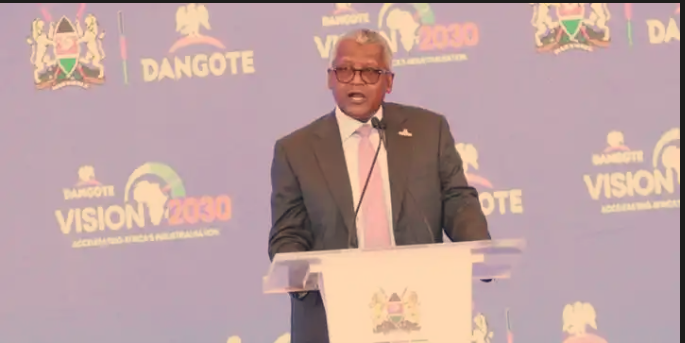
Africa’s leading industrialist, Aliko Dangote, has announced plans to invest an additional $50 billion across the continent, as the Dangote Group expands its industrial footprint and seeks to widen African ownership of its businesses.
Dangote, President of Dangote Industries Limited, disclosed the plan in Nairobi, Kenya, ahead of the groundbreaking ceremony for the proposed Dangote East Africa Petroleum Refinery and Petrochemicals project in Lamu.
The latest investment commitment comes after the conglomerate had already invested more than $25 billion in businesses across Africa.
Speaking during an engagement with the Chief Executive Officer of the Nairobi Securities Exchange, Frank Mwiti, at the Dangote Petroleum Refinery IPO High-Level Investor Engagement, Dangote said Africa must embrace large-scale investments if it is to compete effectively in the global economy.
He said the Group’s expansion would not only focus on industrial production but also on creating opportunities for Africans to own stakes in major businesses through the capital markets.
Dangote said, “We have already invested more than $25 billion, but right now, we are going ahead to invest an additional $50 billion.”
He added that the objective was to create wealth for Africans and strengthen the continent’s capacity to defend its markets through large-scale industrialisation rather than incremental investments.
The Lamu refinery project, however, is facing a legal challenge over portions of the proposed project land. The Malindi Environment and Land Court has ordered parties to maintain the status quo on the disputed property until October 14, following a petition by 133 residents claiming rights to the land.
The court order did not halt the planned groundbreaking ceremony.
Dangote, who said he became aware of the legal dispute through a media report shortly after arriving in Kenya, described land-related disputes as part of the challenges that could arise when executing major projects.
Kenyan President William Ruto’s Chief Economic Adviser, David Ndii, said the Lamu refinery emerged from discussions among African policymakers, financiers and business leaders on how to turn the continent’s natural resources into industrial wealth rather than simply exporting them as raw materials.
According to Ndii, the discussions identified petroleum refining as a major opportunity for East Africa and subsequently led to engagements involving Dangote, Ruto, Ugandan President Yoweri Museveni and other regional stakeholders.
He said a closed-door meeting in April assessed the regional market for finished petroleum products at about 20 million metric tonnes annually, with demand potentially increasing to 30 million tonnes.
Ndii recalled that Ruto subsequently posed three questions: whether there was a market for the products, whether African capital was available to finance the investment and whether an entrepreneur with the capacity to execute a refinery of such magnitude could be found.
With all three questions receiving affirmative answers, Ruto reportedly asked, “Why would we fail?” to which the participants responded: “We cannot fail.”
Beyond the Lamu project, Dangote is also pursuing a broader strategy aimed at increasing African participation in the ownership of major industrial enterprises.
He said the ongoing public offer of Dangote Petroleum Refinery was not primarily intended to raise funds, but to give ordinary Africans an opportunity to participate in the wealth generated by industrialisation.
According to him, the Group intends to progressively release more equity in its businesses as demand from investors increases.
Dangote said the ultimate objective was to “democratise wealth-making” by ensuring that the prosperity generated by Africa’s industrial growth is not concentrated in the hands of a few investors.