Germany is confronting a deepening economic and geopolitical dilemma as China’s growing dominance in global manufacturing threatens its industrial competitiveness, while Beijing’s support for Russia’s war in Ukraine raises questions about Berlin’s dependence on a country increasingly viewed as a strategic challenge to European security.
The twin pressures are forcing Chancellor Friedrich Merz to reconsider Germany’s longstanding relationship with Beijing, as mounting trade imbalances, intensifying industrial competition and concerns over Russia expose the limitations of a foreign policy that has traditionally placed considerable emphasis on commercial interests.
For decades, Germany benefited from China’s emergence as a global manufacturing powerhouse. Following Beijing’s accession to the World Trade Organisation (WTO) in 2001, German manufacturers expanded their access to the Chinese market, particularly in the automotive, machinery and chemical industries, while German investment and technology supported China’s industrial development.
However, the relationship has changed considerably. China has evolved from a major destination for German exports into a formidable competitor in high-value industries, challenging German manufacturers within China, across international markets and increasingly in Germany’s domestic market.
The deterioration in bilateral trade reflects this shift. Germany recorded a trade surplus of nearly €20bn with China in 2020, but subsequently moved into deficit. An analysis by the International Centre for Defence and Security (ICDS) puts Germany’s trade deficit at €90bn in 2025, when bilateral trade reached €251.8bn, making China the country’s largest trading partner.
The growing imbalance has intensified concerns about Germany’s exposure to Chinese economic influence. The Global Public Policy Institute found that Germany’s exposure to China had increased significantly since 2013, moving the country from 10th to third among the nations most exposed to Beijing’s economic influence, behind South Korea and Russia.
Economists Sander Tordoir and Brad Setser, writing for the Centre for European Reform, describe the latest phase of Chinese industrial expansion as “China Shock 2.0”, arguing that its effects could rival the disruption following China’s entry into the WTO.
China’s manufacturing surplus has expanded sharply in recent years, intensifying competition across industries that previously formed the backbone of Germany’s export-led economy. Unlike the first wave of Chinese industrial expansion, which affected several lower-value manufacturing sectors, the current challenge increasingly involves sophisticated products and technologies.
This shift has serious implications for Germany, whose prosperity has long depended on engineering expertise, technological innovation and the export of high-quality manufactured goods. As Chinese companies move into advanced manufacturing, electric vehicles and industrial equipment, German firms face growing pressure to defend their market positions.
The automotive industry illustrates the scale of the transformation. German manufacturers dominated important segments of the global car market for decades, but Chinese companies have rapidly strengthened their positions, particularly in electric vehicles and hybrid technology.
Analysts had previously expected China’s annual car exports to reach 10 million units by the end of the decade. However, according to the first report, Chinese exports had already reached that level on an annualised basis during the final three months of 2025.
Jessie Yin, associate director at the Atlantic Council’s Geoeconomics Centre, identified China’s emergence as a leading manufacturer of electric and hybrid vehicles as a turning point in the global automotive competition.
Chinese manufacturers are also benefiting from their expanding technological capabilities, competitive pricing and strong positions in battery production. These advantages are increasing pressure on established European carmakers, including Volkswagen, BMW and Mercedes-Benz, which have invested billions of euros in China and remain heavily exposed to its market.
Germany’s broader economic performance has weakened alongside these industrial pressures. Its exports have declined since 2018, falling by approximately five per cent last year, while industrial production has contracted over the past six years. Economic output also remains about six per cent below its pre-pandemic trajectory.
Tordoir and Setser identify Chinese competition as a major factor behind Germany’s industrial difficulties, warning that the pressure could intensify as Beijing expands into sectors traditionally associated with German technological leadership.
A report published by the French prime minister’s planning office has similarly warned that Chinese competition could threaten as much as 70 per cent of Germany’s manufacturing output over the medium term. The assessment underscores the potential scale of the challenge facing Europe’s largest economy.
Beyond trade, Germany’s dependence on China extends to critical raw materials, particularly rare earth elements used in electric vehicles, electronics and other advanced industrial products. Beijing’s dominant position in these supply chains gives it considerable leverage over manufacturers that cannot easily obtain alternative supplies.
The vulnerability became particularly evident when Chinese restrictions on rare earth supplies during a confrontation with the United States last year threatened to disrupt Germany’s automotive industry. The episode reinforced concerns that geopolitical disagreements could quickly translate into industrial disruption.
These economic risks have coincided with growing anxiety about China’s relationship with Russia and the implications for European security.
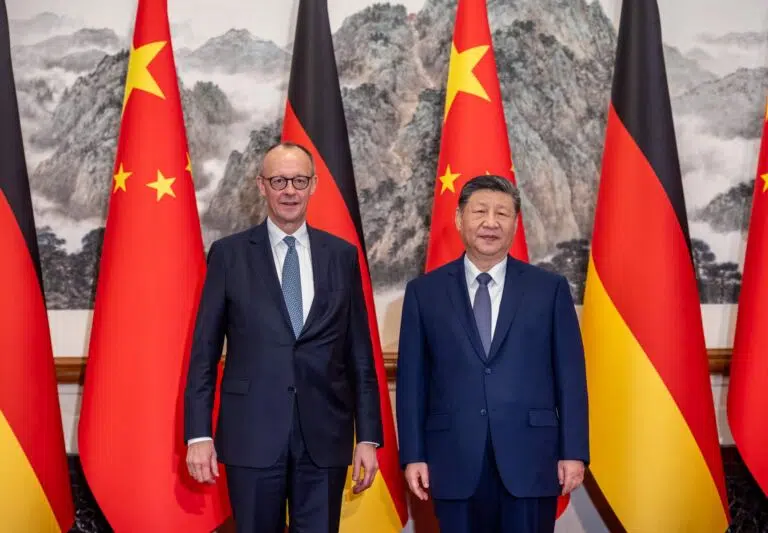
During his first official visit to China as chancellor in February 2026, Merz urged President Xi Jinping to use Beijing’s influence over Moscow to help secure a ceasefire in Ukraine. He argued that China’s position carried considerable weight with Russian President Vladimir Putin.
However, the joint statement issued after the meeting devoted substantially more attention to economic relations than to the war, highlighting the difficulty Berlin faces in reconciling its commercial interests with its security objectives.
China maintains that it is neutral in the conflict and supports a political settlement. Nevertheless, Western governments have accused Beijing of supplying Russia with goods and technologies that strengthen its defence-industrial capacity and help sustain its military campaign.
In May 2026, Reuters reported that Chinese military facilities had been used to train Russian servicemen in November 2025. European Union officials subsequently said they had verified reports that Chinese military personnel trained Russian soldiers who were later deployed to Ukraine, including in advanced drone operations and electronic warfare.
The allegations have intensified concerns in Berlin that Beijing’s relationship with Moscow is undermining European security even as Germany remains economically dependent on China.
A German Foreign Ministry spokesperson said in July that China’s growing support for Russia’s war directly affected Germany’s security, arguing that assistance enabling Moscow to continue its aggression also posed a threat to Europe.
The European Union has similarly strengthened its criticism of Beijing, with officials increasingly describing China as an enabler of Russia’s war effort. The bloc has imposed measures targeting Chinese companies accused of supplying critical components to Russia’s defence sector, while discussions continue over additional action.
Despite these developments, Germany has struggled to translate its security concerns into sustained pressure that could persuade Beijing to reconsider its relationship with Moscow.
The ICDS analysis argues that Berlin’s response reflects the continuing influence of economic considerations on its foreign policy. Although Germany has committed substantial financial and military assistance to Ukraine, its willingness to confront China over Russia has remained constrained by the potential costs to German businesses.
The contradiction is becoming more difficult to manage as China’s industrial expansion threatens the same companies whose commercial interests have traditionally encouraged closer economic engagement with Beijing.
Under Merz, Germany has begun moving towards a tougher approach, emphasising strategic competition, supply-chain resilience and the reduction of economic risks. The government is reviewing its China strategy, building on the de-risking policy introduced under former Chancellor Olaf Scholz in 2023.
During his February visit, Merz also warned that Germany’s deteriorating trade balance with China was unhealthy and raised concerns about possible Chinese currency manipulation. His remarks reflected growing frustration over what Berlin regards as an increasingly unbalanced economic relationship.
Germany has also taken steps to restrict Chinese involvement in strategic infrastructure. Last week, Berlin blocked Chinese state-owned shipping company Cosco from acquiring a logistics group at Germany’s largest seaport, signalling increased scrutiny of investments considered sensitive to national economic security.
Earlier this month, Merz and French President Emmanuel Macron jointly urged European Commission President Ursula von der Leyen to establish a mechanism that would enable the European Union to impose restrictions more quickly on countries engaging in harmful trade practices.
However, a tougher policy faces resistance from German companies that continue to regard China as essential to their growth. Volkswagen, BMW and Mercedes-Benz maintain substantial operations in the country, leaving them exposed to regulatory changes, supply-chain disruptions and possible Chinese retaliation.
China’s commercial relationships with German businesses also complicate Berlin’s efforts to establish a common European response. China specialist Sari Arho Havrén of the Royal United Services Institute has warned that Beijing has spent years cultivating relationships with German companies and investing in infrastructure, creating economic connections that could translate into political influence.
According to Havrén, some major German businesses remain reluctant to support tougher measures because of their commercial interests in China. Their influence, she argues, can extend into government policy and European Union decision-making, potentially weakening efforts to coordinate a firmer response.
Havrén also noted that German companies increased their investments in China by approximately one-third in the first half of this year, illustrating the difficulty of separating commercial decisions from the government’s strategic objectives.
The German Chamber of Commerce and Industry called on Merz in August to adopt a firmer position towards Beijing. Meanwhile, the Federation of German Industries has advocated reducing dependence on China and diversifying supplies of critical materials, while urging the government to strengthen Germany’s domestic investment climate and industrial competitiveness.
The European Union is considering safeguard measures to protect its industries from Chinese competition. However, recent trade discussions have produced limited progress, with Beijing rejecting European requests for commitments to restrain certain exports, particularly hybrid vehicles.
Havrén has warned that further restrictions could provoke countermeasures from China, potentially triggering a wider trade conflict between Beijing and the European Union. Such a confrontation could expose the costs of European dependence on Chinese industrial supplies while threatening businesses on both sides.
For Germany, the challenge extends beyond correcting a trade imbalance or protecting its automotive industry. Berlin must determine how to preserve its industrial base while addressing the security consequences of China’s relationship with Russia.
A more coordinated European strategy could link trade safeguards, industrial investment, critical-material diversification and diplomatic pressure over the war in Ukraine. Such an approach would also require Germany to work with European partners to reduce vulnerabilities that could limit its freedom of action during future geopolitical confrontations.
Nevertheless, reducing dependence on China will not be straightforward. German companies have invested heavily in the country, while alternative sources of critical materials and manufacturing inputs may take years to develop. Abrupt restrictions could raise costs, disrupt production and provoke retaliation against German exporters.
The central dilemma is therefore whether Germany can continue to prioritise the commercial benefits of its relationship with China while expecting Beijing to respond to European security concerns over Russia. As Chinese manufacturers challenge German industrial leadership and the war in Ukraine continues to shape European security calculations, the two issues are becoming increasingly inseparable.
Unless Berlin translates its warnings into practical measures that strengthen domestic industry, diversify supply chains and coordinate European policy, its efforts to defend German manufacturing and protect European security could remain constrained by the very economic dependence it is attempting to overcome.