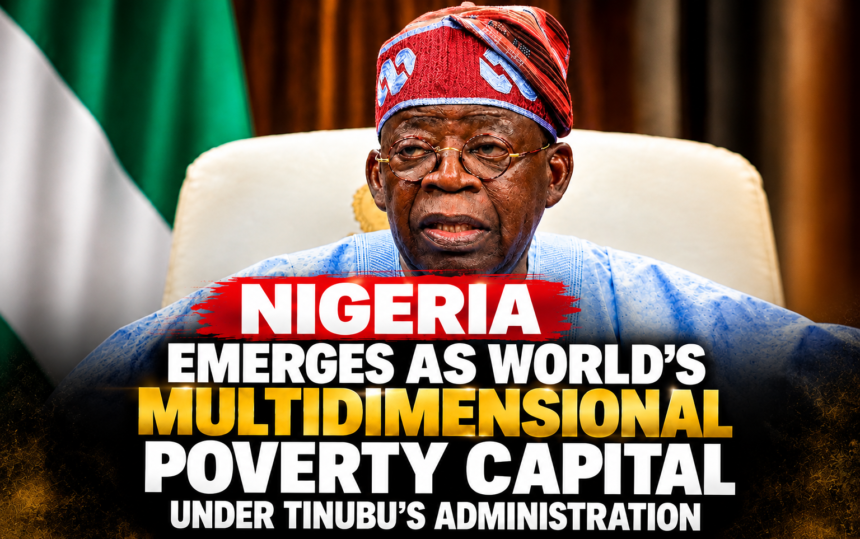
The UN says Nigeria added more people to multidimensional poverty than any other country measured. Five days earlier, the Presidency had already admitted the poor were growing in number.
On Wednesday, October 7, on Channels Television, President Tinubu’s Special Adviser on Policy Communication, Daniel Bwala, was asked whether more Nigerians had been pushed into poverty under this administration. “More people went down to poverty,” he said. He blamed the reforms and added that no reform comes with convenience.
On Sunday, October 11, a statement from the Presidency said the poverty rate had stabilised for the first time since 2019, citing the World Bank.
On Monday, October 12, the United Nations Development Programme and Oxford University’s poverty institute, OPHI, published the 2026 Global Multidimensional Poverty Index. It found that between 2021 and 2024, Nigeria’s multidimensional poverty rate rose from 33 percent to 38.7 percent, and that 17.9 million more Nigerians became poor, bringing the total to 90.1 million. Of every country measured, the report states, Nigeria saw the largest increase in the number of poor people. The next largest was Afghanistan, at 5.3 million.
Nigeria’s slogan is “Renewed Hope.” This is what it looks like when the United Nations counts it.
What the report actually measures
Multidimensional poverty is not about income. The index checks ten indicators across health, education and living standards: nutrition, child mortality, years of schooling, school attendance, cooking fuel, sanitation, drinking water, electricity, housing and assets. A person counts as poor if they are deprived in at least a third of them. It is a measure of whether a family can eat, learn, stay healthy and keep the lights on.
Nigeria had been doing better. The report’s comparable series shows the rate falling from 42.3 percent in 2013 to 37.2 percent in 2018 and 33 percent in 2021. Then it turned. The index value rose from 0.175 to 0.208. The average poor Nigerian is deprived in 53.6 percent of the weighted indicators, up from 52.9 percent. Another 28.7 percent of Nigerians live in severe multidimensional poverty, and 18.1 percent more are vulnerable to falling into it.
The national average hides a country split in two. Across Nigeria’s subnational regions, the poverty rate runs from 3.7 percent to 88.3 percent. Kebbi, Yobe and Sokoto are the poorest, followed by Jigawa, Zamfara, Gombe, Borno and Bauchi. Lagos is the least poor. Several of the poorest names on that list, Zamfara, Sokoto and Borno, also fill the monthly casualty reports. Deprivation and violence are neighbours.
Some Nigerian outlets, including Tribune and The Whistler, have reported a higher headline figure from the same report: 48.7 percent, about 113 million people, as the latest overall estimate. We could not confirm that figure against the UNDP document and treat 38.7 percent and 90.1 million, the report’s harmonised trend, as the safe numbers.
Elsewhere, the story is different. The report found that 33 of 89 countries with trend data halved their poverty index in under 15 years, six of them in sub-Saharan Africa. Globally, the number of multidimensionally poor people rose for the first time since the index began in 2010, to 1.2 billion. Poverty can be cut fast. Nigeria went the other way.
What the number does not say
This editorial will not hand the government an easy rebuttal by overstating it.
The 2021 to 2024 window covers two presidents. Muhammadu Buhari was in office until May 2023, and Bola Tinubu has been in office since. The UN does not divide the damage between them. UNDP also cautions that the Nigerian estimate rests on household survey data collected in 2024 and is not a measurement of poverty in 2026. And this is a different yardstick from the ones you may have seen: the World Bank put income-based poverty at 63 percent in 2025, up from 56 percent in 2023, and Nigeria’s own statistics bureau, using a broader national definition, found 63 percent multidimensionally poor in 2022. The UN’s figure is lower because its definition of acute poverty is narrower. That should comfort no one.
But look at what the 2024 reading is. It is the first international measurement taken after the fuel subsidy was removed and the naira floated in the first weeks of this administration. The Presidency’s own adviser has now said, on television, that those reforms pushed more people into poverty. When a government’s own spokesman concedes the direction, a UN report documenting its scale is not an ambush. It is confirmation.
The cushion that never came
The reforms were not the scandal. The absence of a floor under them was.
The World Bank’s own country diagnostic, the document behind its 2026 to 2032 partnership framework for Nigeria, found social protection spending at 0.14 percent of GDP in 2021, far below peers. It found that 84 percent of children aged five to fourteen cannot read an age-appropriate text. It recorded 17.1 million children out of school. Life expectancy sits around 54 years. Those are health, education, and living-standard deficits, the exact categories the UN index counts. They were not created by this administration. They were the shape of the cliff it chose to walk the country off in the first month, without a transition plan, without cash transfers ready and without a refinery to soften the import bill.
The Presidency’s reply is that no reform comes with convenience. Convenience is not what 90 million people are short of. They are short of food, school fees, safe water, a clinic and electricity.
What the government says, and where it falls short
The government’s case deserves a fair hearing. The statement issued on Sunday cites the World Bank’s October Nigeria Development Update, which it says projects poverty will decline gradually as growth outpaces population growth. It says federation revenues rose 69 percent in real terms between 2023 and 2025, and that states raised capital spending by 151 percent in real terms, much of it on roads, agriculture, energy and housing. It says public debt will fall from 40 percent of GDP to 38.1 percent this year.
Take those claims at face value, and they make the case against the administration worse, not better. If revenues rose 69 percent in real terms, the money to protect the poor existed. If states are spending 151 percent more, the question is why the poorest states are where the poverty is deepest. And “stabilised” describes a plateau. A poverty rate that stops rising at a record height is still a record. The World Bank’s own projection of a decline is a forecast. The UN’s finding is a count.
Nor has the government shown that its expansion of cash transfers since 2021 reaches the 90 million people the UN is counting. The burden of proof is on the administration to publish coverage figures, not on Nigerians to take them on trust.
The debate Nigerians should have
Is Tinubu’s economic reform agenda delivering prosperity to ordinary Nigerians, or has the human cost become too high?
Nobody can answer that for you. But you can demand the information to decide. Ask your governor what share of the extra revenue went to social protection in your state. Ask your senator why the poorest northern states have waited longest for the cushion. Ask the Presidency to publish how many of those 17.9 million people are on any cash-transfer roll today. And ask the National Bureau of Statistics to publish a new national poverty measurement before the election, not after it.
A nation does not get 17.9 million poorer by accident, and it does not get 17.9 million richer by slogan. The UN has counted. The Presidency has conceded. What remains is the part only voters can do.
This is a United Continental Post editorial. It draws on the 2026 Global Multidimensional Poverty Index statistical update published by UNDP and OPHI on October 12, 2026, as reported by TheCable, BusinessDay, Daily Trust, The Moment, First Daily News and Economy Post; Daniel Bwala’s October 7 remarks on Channels Television as reported by Vanguard, Naija News and allAfrica; the Presidency’s October 11 statement as reported by The Whistler; the World Bank’s Country Partnership Framework for Nigeria FY26-32 and Streamlined Country Diagnostic; and the World Bank’s April 2026 Nigeria Development Update. UNDP states that Nigeria’s figures reflect 2024 household survey data and are not a direct measure of poverty in 2026. The 48.7 percent and 113 million figures are reported by Tribune and The Whistler and were not independently confirmed by UCP. The 2021 to 2024 period spans the administrations of Muhammadu Buhari and Bola Tinubu.