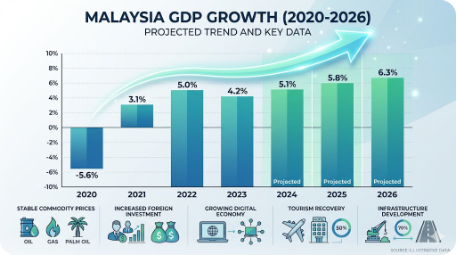
Malaysia’s economy has defied expectations, recording an estimated 5.3 per cent growth in the third quarter of 2026 despite global economic uncertainty and the ongoing US-Iran conflict.
The advance gross domestic product (GDP) estimate, released by the Statistics Department, represents a moderation from the six per cent growth recorded in the preceding quarter but exceeds the 5.2 per cent recorded in the corresponding period last year.
Economists attributed the performance to resilient domestic demand, targeted government interventions, stronger technology-related investments and sustained foreign investor interest.
Bank Muamalat Malaysia Bhd chief economist, Dr Mohd Afzanizam Abdul Rashid, said targeted fuel subsidies introduced through the MyKad identification system had helped cushion households against external shocks.
Efforts by national oil company Petronas to secure fuel supplies from outside the Strait of Hormuz also helped limit disruptions to economic activities, he added.
Malaysia’s services sector remained the principal growth driver, expanding by 5.4 per cent on the back of wholesale and retail trade, information and communication, and financial and insurance services.
Manufacturing growth accelerated to 7.5 per cent, supported by export-oriented industries, particularly electrical, electronic and optical products, as well as petroleum, chemicals, rubber and plastics.
The construction sector expanded by six per cent, supported by non-residential projects, including data centres, while agriculture rebounded by 1.3 per cent after contracting in the previous quarter. Mining and quarrying, however, contracted by 4.9 per cent following declining crude oil and condensate production.
For the first nine months of 2026, Malaysia’s economy grew by 5.5 per cent, compared with 4.8 per cent during the same period last year.
Despite the encouraging figures, economists warned that the country remains vulnerable to external shocks, particularly disruptions to global trade, rising oil prices and a potential slowdown in technology spending.
Dr Mohamad Idham Md Razak, a senior lecturer at Universiti Teknologi MARA, said weaker global demand for technology products could affect semiconductor exports, manufacturing and data centre investments.
He also cautioned that higher energy prices could increase business operating costs and erode household purchasing power, particularly if wages fail to keep pace with the cost of living.
Idham urged the government to strengthen domestic economic resilience by improving productivity, supporting small and medium-sized enterprises, attracting higher-value investments and diversifying export markets.
Malaysia’s latest performance underscores the resilience of its economy amid mounting international pressures. However, sustaining growth will depend not only on headline GDP figures but also on the government’s ability to protect household purchasing power, deepen domestic investment and reduce exposure to external shocks.
The official third-quarter GDP figures are scheduled for release by Bank Negara Malaysia on November 18.