Angola is stepping up efforts to attract regional investors into its $6.6bn Lobito oil refinery, inviting Namibia to acquire an equity stake as it seeks to close a multibillion-dollar financing gap, reduce dependence on imported petroleum products and establish a stronger foothold in Southern Africa’s energy market.
President João Lourenço extended the invitation on October 19 during talks in Luanda with his Namibian counterpart, Netumbo Nandi-Ndaitwah, who was on a two-day state visit to Angola. The proposal offers Namibia an opportunity to participate in one of Africa’s most ambitious downstream energy projects, although the size of any potential investment and the terms of participation remain undecided.
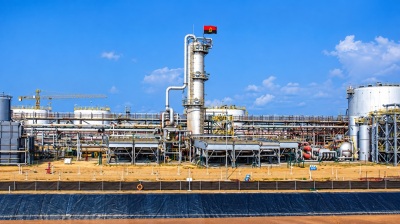
The 200,000-barrel-per-day refinery, located in Benguela province, is expected to begin producing refined petroleum products in December 2027, with full completion scheduled for 2029.
Designed to process crude oil into diesel, petrol, liquefied petroleum gas, aviation fuel and other products, the facility is central to Angola’s strategy to expand domestic refining capacity and reduce its dependence on imported fuel. Construction was reported to be about 25 per cent complete in August.
Lourenço said neighbouring countries that acquire stakes in the refinery would receive priority access to its petroleum products, presenting the project as both an investment opportunity and a potential source of long-term energy security for participating countries. He also argued that oil-producing African nations must move beyond exporting crude oil and importing finished products by developing domestic processing capacity.
For Namibia, the invitation comes as the country prepares for the possible commercial exploitation of its significant offshore oil discoveries.
Although Namibia has yet to begin commercial oil production, energy companies are advancing plans to develop major discoveries, including TotalEnergies’ Venus field, with first oil targeted around 2030. A stake in Lobito could therefore give Windhoek access to refining capacity and regional petroleum supply arrangements without immediately committing billions of dollars to constructing a refinery at home.
Namibia’s participation would also deepen existing petroleum cooperation between the two countries. Angola has been sharing its experience in oil exploration, production and marketing with its neighbour, while Nandi-Ndaitwah has emphasised the need for African countries to process more of their natural resources locally instead of exporting them in raw form. The two presidents also witnessed the signing of eight bilateral cooperation instruments covering areas including fisheries, tourism, sports and culture.
However, Namibia is not the first country Angola has approached to share the financial burden of the project. Botswana has also been courted, with President Lourenço raising the possibility of its participation during a visit by President Duma Boko in September. Botswana’s energy minister had earlier informed parliament that the country had been offered an opportunity to acquire up to 30 per cent of the refinery, although the government was still considering the extent of its participation.
Reuters had in April reported that Angola’s state-owned oil company, Sonangol, had entered high-level discussions with Botswana Oil over a possible equity stake. The company’s refining division chief executive, Joaquim Kiteculo, confirmed that negotiations had taken place and said a shareholders’ agreement would be signed once the discussions were concluded. He did not provide a timetable for finalising the arrangement.
Meanwhile, Zambia has maintained an outline agreement with Angola since 2018 covering potential participation in the refinery. Kiteculo said Zambia was the first country to express interest in an equity stake, although Angola remains open to bringing in additional partners. Sonangol has indicated that Angola will retain a 51 per cent majority shareholding in any restructuring, preserving its control of the strategic asset.
The growing interest from neighbouring countries reflects the refinery’s potential importance to regional fuel markets, but it also underscores the scale of the financing challenge confronting Angola. Sonangol has estimated the project’s total cost at $6.6bn and has been seeking external partners to help develop, own and operate the facility. The company said in February that it was negotiating with Chinese financial institutions to secure approximately $4.8bn for the next phase of construction.
The financing discussions have since continued, with Angolan officials travelling to China to seek support. According to Reuters, Sonangol expects the negotiations to focus initially on $2.2bn, followed by a further $2.6bn. The company has already invested about $1.4bn in the first phase, including road and water infrastructure, and has said construction will continue with or without additional partners.
The refinery’s financial requirements are closely linked to Angola’s growing fuel-import burden. Despite being a major crude oil producer, the country remains heavily dependent on imported refined petroleum products because of its limited domestic processing capacity. Figures reported by PetroAngola showed that Angola spent $1.79bn importing 1.74 million tonnes of refined petroleum products in the first half of 2026. Expenditure increased by 36 per cent compared with the corresponding period, even as import volumes declined by 0.6 per cent.
The country’s fuel-import dependence stood at 82.7 per cent in the first quarter, according to the fuel-sector regulator, IRDP. Meanwhile, the government is projecting fuel subsidy expenditure of up to 3.8 trillion Angolan kwanzas, equivalent to about $4.16bn, for 2026 — more than twice the amount originally budgeted. The figures highlight the economic cost of relying on foreign refineries to meet domestic demand despite Angola’s substantial crude oil production.
The Lobito refinery is intended to help reverse this imbalance by processing more crude oil locally, reducing the need for imported finished products and potentially supplying neighbouring markets. Securing regional shareholders could also give Sonangol a broader customer base, improve the project’s investment appeal and strengthen commercial relationships across Southern Africa.
Nevertheless, the project’s prospects depends on whether Angola can secure the outstanding financing, sustain construction and meet its production targets. The refinery has experienced delays linked to funding difficulties, and the proposed participation of Namibia, Botswana and Zambia has yet to translate into a fully disclosed regional shareholding arrangement.
For Namibia, an investment in Lobito might provide sufficient commercial returns and reliable access to petroleum supplies to justify the financial commitment. For Botswana and Zambia, the attraction lies partly in diversifying fuel sources and strengthening energy security, particularly as landlocked countries face additional logistical challenges in accessing international petroleum markets.
Angola’s regional investment drive therefore represents more than an attempt to finance a refinery. It is also an effort to build an integrated petroleum market in which neighbouring countries share ownership, secure supplies and retain a greater proportion of the value generated by Africa’s natural resources.
Yet the invitations alone will not guarantee success. Until financing is secured, binding shareholder agreements are concluded and construction advances towards completion, the $6.6bn Lobito refinery will remain a major regional ambition whose economic benefits depend on overcoming substantial financial and operational hurdles.