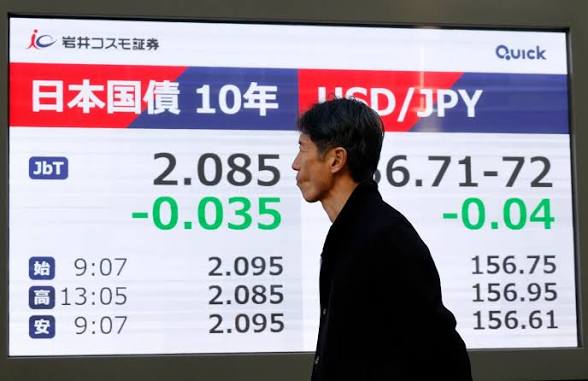
Japanese bond exchange-traded funds have attracted a record $1.5 billion in net inflows so far this year, as rising government bond yields make Japan’s debt increasingly attractive to global investors.
The Morningstar data, released on Tuesday, 25th August 2026 shows that inflows have nearly tripled the $550 million collected by Japanese bond ETFs during the whole of 2025.
The surge signals a growing appetite among international investors for Japanese fixed-income assets, particularly as uncertainty over the US dollar encourages investors to diversify their portfolios.
“Rising Japanese government bond yields have coincided with growing demand for fixed income assets from European investors,” said Shannon Kirwin, senior principal for fixed income strategies at Morningstar.
Japanese government bonds have gained attention after years of exceptionally low yields. The Bank of Japan’s prolonged monetary easing and large-scale bond purchases had previously kept borrowing costs near historic lows.
That environment has changed as inflation has returned and the central bank has moved away from its ultra-loose monetary policy. Higher interest rates have pushed JGB yields sharply upward, creating a more attractive income opportunity for investors.
According to LSEG data, the benchmark 10-year JGB yield reached 2.93% earlier this month, its highest level since the mid-1990s. The yield stood at about 2.1% at the beginning of the year and just 0.1% at the start of 2022.
The jump in yields has weighed on existing bond prices but has simultaneously improved the potential returns available to new investors entering the market.
BlackRock said its Europe-domiciled Japanese government bond ETFs had attracted about $1.4 billion in inflows this year, driven mainly by large wealth investors. The same funds recorded a $58 million outflow in 2025.
Foreign demand has also been reflected in direct purchases of JGBs. BNY data showed that non-Japanese accounts invested $4.7 billion in Japanese government bonds this year, with July recording $2.8 billion in net inflows, the strongest monthly figure in more than a year.
Currency considerations are also influencing investor decisions. For European investors, hedging the yen exposure can make Japanese bond returns more competitive because of differences in interest rates between Japan and other major markets.
The changing market has broadened the investor base for Japanese government debt, with insurance companies, government institutions and central banks also showing greater interest.
However, the latest inflows do not necessarily represent a broad conviction that JGB prices will rise. Japan’s government bond market is worth roughly $8 trillion, meaning the latest foreign inflows remain relatively small compared with its overall size.
Investors are also aware that the forces making Japanese bonds more attractive could drive yields higher still, potentially creating further losses for holders of existing longer-dated securities.
Vanguard’s Ales Koutny remains positioned for higher yields in shorter-dated JGBs, expecting the Bank of Japan may need to raise interest rates further. At the longer end of the market, however, yields above 4% on 30-year bonds are beginning to look more attractive.
Pictet Wealth Management remains underweight on Japanese government bonds because of the risk of further yield increases though it could reconsider that position if the yen stabilises and markets price in additional Bank of Japan rate hikes.
The central bank’s September meeting will therefore be closely watched by global bond investors. Any indication of further tightening could determine whether the record inflows mark the beginning of a sustained shift towards Japanese debt or simply reflect investors responding to the sharp rise in yields.