A fresh allegation that some ministers in Nigeria pay billions of naira to secure appointments has raised troubling questions about the integrity of public office, with the spokesperson of the All Progressives Congress (APC) Presidential Campaign Council, Alwan Hassan, claiming that the practice cuts across administrations.
According to Daily Post, Hassan made the allegation on Thursday 22nd October 2026, during an interview on Arise Television’s Prime Time, where he suggested that some political appointees enter government with the expectation of recovering the money allegedly spent to secure their positions.
According to him, the practice is neither new nor exclusive to the APC, insisting that it predates the ruling party’s emergence.
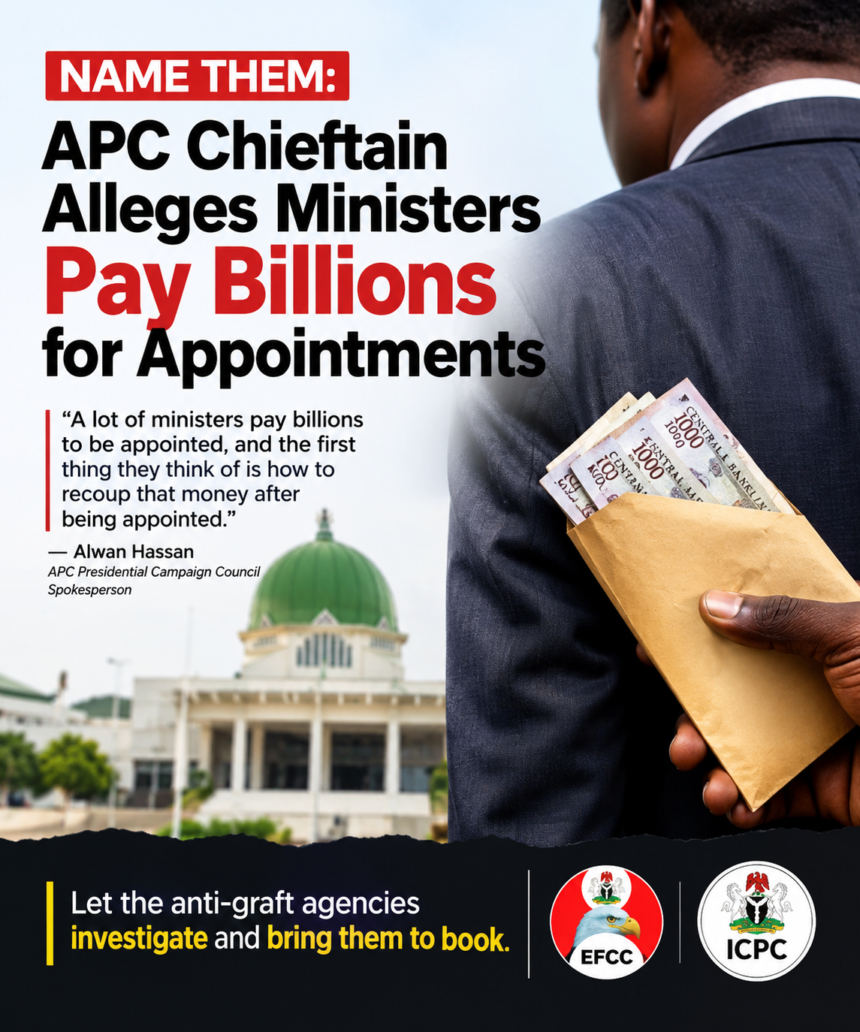
“A lot of ministers pay billions to be appointed, and the first thing they think of is how to recoup that money after being appointed,” Hassan said.
“It is the truth about our country and not just APC ministers; it started before the APC,” he added.
Hassan identified the alleged practice as one of the factors fuelling corruption in public office, arguing that appointees who spend enormous sums to obtain positions may regard their appointments as investments from which they must generate returns.
But if Hassan knows that ministers allegedly pay billions of naira to secure appointments, the obvious question is: why stop at making the allegation? Why not name them?
An allegation of this magnitude should not be allowed to become another sensational television revelation that generates public outrage for a few hours before disappearing into the country’s crowded archive of unresolved corruption claims. If the claim is based on credible information, Nigerians deserve more than generalisations and sweeping references to unnamed officials.
The issue is particularly serious because ministerial appointments are public responsibilities, not commercial transactions to be auctioned to the highest bidder. Anyone who allegedly pays billions of naira to secure a government position raises legitimate questions about the source of the money, the circumstances surrounding the appointment and the means through which such an enormous expenditure would supposedly be recovered.
If public appointments are indeed being traded for money, the implications extend beyond the individuals involved. Such a system would threaten public procurement, government contracts, regulatory decisions and the allocation of public resources, while undermining the principle that public office exists to serve citizens rather than private interests.
Hassan must therefore go beyond his television appearance and provide the names of the alleged beneficiaries, the individuals who supposedly collected the money and any available evidence to substantiate his claims. If he has credible information, he should make it available to the appropriate authorities rather than leave Nigerians guessing about the identities of those he accuses.
The Economic and Financial Crimes Commission (EFCC) and the Independent Corrupt Practices and Other Related Offences Commission (ICPC) should also take note of the allegation and determine whether it provides sufficient grounds for preliminary inquiries. Any investigation must be evidence-based, impartial and consistent with due process.
Those found to have solicited or paid bribes in connection with public appointments should face the full weight of the law, regardless of their political affiliations, positions or connections. Equally, anyone making allegations that cannot be substantiated should be prepared to answer questions about the basis of their claims.
It is not enough to tell Nigerians that corruption exists. Those who claim to know how it operates, particularly individuals with access to political circles, have a responsibility to provide actionable information to the relevant authorities.
If you know the ministers paying billions to secure appointments, name them. If you know those collecting the money, name them too. Let the anti-graft agencies investigate, follow the evidence and bring anyone found culpable to book without submitting to conscience merchandise. Nigerians deserve accountability, not another allegation without consequences.