Opposition leaders join victims’ families in demanding independent inquiry into security failures as Israel heads to crucial elections
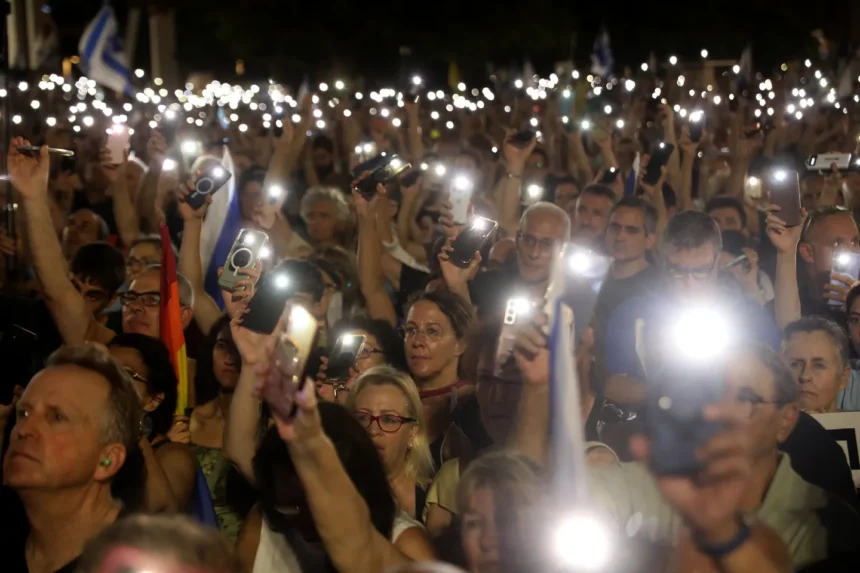
Thousands of Israelis took to the streets of Tel Aviv on Saturday, demanding an end to Prime Minister Benjamin Netanyahu’s leadership and renewed efforts to establish accountability for the security failures surrounding the October 7, 2023, Hamas-led attacks.
The demonstration, held just days before parliamentary elections, underscored the growing political pressure on a government that yet disagree to an independent state inquiry into one of the gravest security breaches in Israel’s history.
Organised by the October Council, a civic group representing families affected by the attacks, the rally drew former hostages, relatives of victims and prominent opposition figures. Demonstrators marched from Rabin Square to Hostages Square, a longstanding focal point for protests over the hostages taken to Gaza and the government’s handling of the crisis.
Under the slogan, “After three years of struggle, we begin the repair,” protesters demanded answers about how Hamas militants were able to breach Israel’s defences, kill about 1,200 people and take 251 others hostage. The attacks triggered Israel’s devastating military campaign in Gaza, where more than 74,000 people have been reported killed, according to the territory’s Hamas-run health ministry.
The central grievance is not merely that the attacks occurred, but that the government has resisted an independent investigation capable of establishing who knew what, which warnings were ignored and where responsibility lies. Netanyahu has argued that a formal inquiry should wait until the war is over, while proposing an alternative committee whose membership would be divided between government and opposition appointees.
Critics contend that the arrangement would compromise the independence needed to investigate the conduct of the political leadership. The government’s position has also deepened suspicions among victims’ families that accountability could be subordinated to political calculations. For an administration that has repeatedly emphasised national security, its reluctance to establish an independent inquiry remains a major unresolved question.
The controversy has intensified following reports that foreign leaders may have warned Netanyahu of an impending Hamas offensive before October 7. Israeli journalists Shlomi Eldar and Ruth Yuval reported that United Arab Emirates President Mohammed bin Zayed allegedly spoke with Netanyahu about the threat approximately 10 days before the attacks. Other reports have pointed to possible warnings from Egyptian officials. Netanyahu’s office has denied the allegations, describing the claims as fabricated, while the reporting has been defended by its publishers.
The allegations have further complicated Netanyahu’s efforts to attribute responsibility to Israel’s security establishment. Former military chief of staff Herzi Halevi accepted responsibility for the military’s failures and resigned in January 2025, while the government’s subsequent dismissal of Shin Bet chief Ronen Bar generated another dispute over accountability. Bar accused Netanyahu of seeking to deflect blame and prevent scrutiny, allegations the prime minister has rejected.
At Saturday’s demonstration, opposition leaders Gadi Eisenkot, Yair Lapid, Avigdor Lieberman and Yair Golan joined the protesters, making accountability a central issue in the final stretch of the election campaign. Golan pledged that a change of government would be followed by efforts to establish a state commission of inquiry capable of uncovering the truth and delivering justice to affected families.
The October Council, however, stressed that the rally was a civic demonstration rather than an endorsement of any political party. It also warned police of possible attempts by pro-government supporters to disrupt the event.
Separately, Netanyahu’s Likud party sought to prevent major television channels from broadcasting the rally, arguing that it amounted to election propaganda. However, the chairman of the Central Elections Committee, Justice Noam Sohlberg, rejected the request, finding insufficient factual grounds to support it.
Netanyahu’s political difficulties nevertheless extend beyond the inquiry controversy. His critics argue that his repeated rejection of personal responsibility, combined with allegations that warnings were ignored, has weakened public confidence in his leadership. The prime minister has countered that accusations against him are politically motivated and has pointed to the role of security officials in the failures. Yet, while military and intelligence officials have faced investigations and leadership changes, the question of political accountability remains unsettled.
The dispute comes against a background of deep national trauma, the destruction in Gaza and mounting international scrutiny of Israel’s military conduct. Netanyahu retains a loyal political base, with analysts suggesting that the public’s security fears and the country’s increasingly right-wing political climate continue to strengthen his appeal among some voters. His opponents, however, argue that the same security crisis that has defined his leadership demands a more transparent examination of the government’s decisions.
With Israelis preparing to elect a new Knesset on October 27, the protest has placed a fundamental question before the electorate: can a government credibly claim to prioritise national security while resisting an independent investigation into the most consequential security failure of its tenure?
For the families of those killed and captured on October 7, the demand for answers goes beyond electoral competition. Their insistence on an independent inquiry reflects a broader principle of democratic accountability: national security failures must be investigated on the strength of evidence, not shielded by political office.
It is only wise and considerate when a government prevents a war that would have killed and displaced innocent people, destroy national treasures among others. But the reverse is the case in most of the countries where war has almost deserted.
If a government decides conflicts with another country, it doesn’t go to the war front, it only relying on it’s military capacity, notwithstanding. a brilliant leader thinks of peaceful resolution that does not stake the life of the lead rather than solving violence with violence.