The world is waking up to a reality Nigeria has struggled to confront: trade is not merely about cheap prices; it is also about who controls production, distribution and the wealth generated along the value chain.
On May 19, in Kansas City, US Vice President J.D. Vance told factory workers that America had spent decades borrowing from Chinese workers to buy what China produced. His remarks reflected a broader American concern that imports had contributed to the erosion of domestic manufacturing. Across Europe, countries such as France and Italy have also sought to preserve local value through domestic processing and content requirements. Nations protect their long-term economic interests.
Nigeria must ask whether it is doing the same.
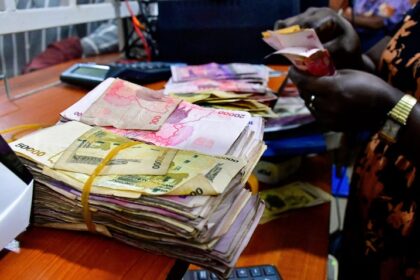
In 2025, Nigeria imported goods worth N19.79 trillion from China while exports to the country stood at N2.78 trillion, leaving a trade deficit of N17.01 trillion. China accounted for about 39 per cent of Nigeria’s total imports. By the first half of 2026, the imbalance remained striking: for every N1 Nigeria sold to China, it bought about N10.11 worth of goods. That imbalance is no longer confined to customs statistics. It has entered Nigerian markets, shops and businesses.
LETS TAKE A FEW STEPS BACKWARD
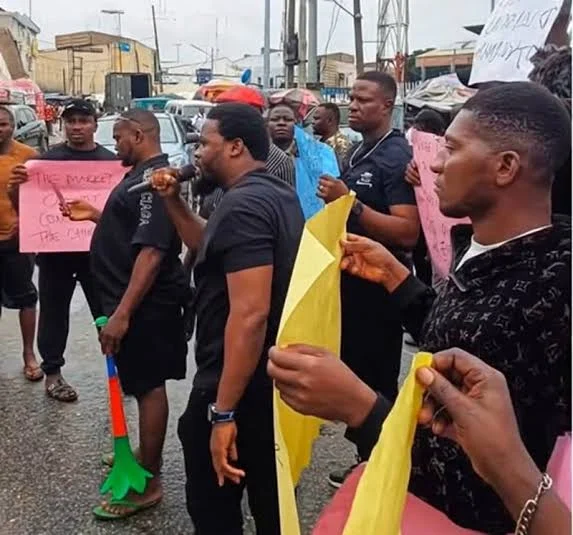
Trade Fair Complex along the Lagos-Badagry Expressway on Monday protested against the alleged expansion of Chinese merchants into retail trading in the market.
The traders expressed concern that the growing involvement of Chinese merchants in retail business could threaten the survival of local businesses and displace Nigerian traders from the market.
However, the protest was later suspended following interventions by the leadership of the Traders Association, local government officials and the police.
Speaking with newsmen on Tuesday, the Secretary of the Traders Association in the complex, Juventus Okpala-Okaka, said the protesters acted despite steps already taken by the market leadership to address their concerns
However, to understand the deeper problem, we must return to Chika Onyeani’s Capitalist Nigger and his much-discussed Spider Web Doctrine. Onyeani used the spider’s web as a metaphor for economic networks within communities, describing how groups can create interconnected systems of finance, insurance, legal services, distribution and commerce that keep wealth circulating among their members. His broader warning was that Black communities often fail to build comparable economic structures. The lesson for Nigeria is straightforward: when a Nigerian trader makes money and immediately sends it abroad to purchase finished goods, much of that money leaves the domestic economic cycle instead of strengthening local production and distribution.
That brings us to the Chinese trader operating next door. The question is not simply why his products are cheaper; it is why the system behind him allows him to compete at prices that many Nigerian traders struggle to match. Access to relatively cheaper financing, large-scale manufacturing, export incentives, extensive logistics infrastructure and more reliable electricity can reduce the cost of production and distribution. China’s enormous manufacturing scale also means that producing millions of units can drive unit costs dramatically lower than those faced by a small Nigerian importer or assembler.
There is also the question of reciprocity. Nigeria has generally maintained a relatively open environment for foreign participation in many areas of commerce, while some countries impose restrictions on foreigners participating in certain forms of domestic retail. The result can be an uneven playing field when foreign manufacturers or traders are able to move directly from production to wholesale and retail in Nigeria, bypassing the Nigerian middlemen who traditionally occupied those stages of the value chain.
The Nigerian trader, meanwhile, operates under a very different cost structure. Electricity remains unreliable, forcing businesses to depend on diesel and generators. Credit is expensive, infrastructure is inadequate, logistics can be slow and the naira’s volatility makes it difficult to predict the cost of goods that may spend weeks in transit. Add customs charges, taxes, standards compliance, transportation and rent, and the Nigerian trader enters the market carrying costs that his foreign competitor may not face to the same extent.
For decades, Nigeria’s trading ecosystem nevertheless created a form of economic ladder. A manufacturer or importer supplied the wholesaler; the wholesaler supplied the retailer; the retailer served consumers. Along that chain were transporters, warehouse operators, artisans and apprentices. The Igbo Nwa Boy apprenticeship model, in particular, created a pathway through which young people learned commerce and eventually established their own businesses. The system was imperfect, but it circulated knowledge, capital and opportunity.
What is emerging in some Nigerian markets is a different model: the foreign manufacturer, foreign-backed trader, warehouse and retailer can increasingly operate as parts of a single chain. When production, shipping, warehousing, distribution and retail are controlled within one network, the independent Nigerian middleman becomes vulnerable. The issue, therefore, is not that Chinese traders are inherently wrong for competing. It is whether Nigeria has allowed a foreign-controlled value chain to develop faster than its own domestic industrial and commercial ecosystem.
The protests at Trade Fair in Lagos on September 15, 2026, brought that anxiety into the open, with traders displaying placards demanding that Chinese traders leave. Similar concerns have been raised by traders in other commercial centres, including Computer Village and Alaba. Although many of those protesting traders are Igbo, the underlying economic issue is broader than ethnicity. If the Nigerian middleman disappears, the consequences extend to transporters, apprentices, warehouse operators, landlords, tax authorities and consumers across the country.
Competition also creates another difficult question. Electronics and many other consumer goods are highly price-sensitive markets. If two traders sell similar products and one can offer them substantially cheaper, consumers will naturally gravitate towards the cheaper option. The answer cannot simply be to ask consumers to pay more out of patriotism. Nigeria must instead examine why domestic businesses face such high operating costs and whether its regulatory system creates a genuinely level playing field.
There are additional complaints that deserve proper investigation, including allegations of waybill cloning, customer poaching and profit repatriation. Such allegations should be investigated by the relevant authorities rather than treated as established facts without evidence. There are also conflicting figures concerning Chinese investment in Nigeria, with different datasets reportedly producing substantially different estimates. The existence of such discrepancies itself demonstrates the need for stronger investment and capital-flow data.
The danger extends beyond physical shops. If Nigeria struggles to regulate foreign-controlled retail networks operating in places such as Ojo and Trade Fair, the challenge becomes even greater when digital platforms sell directly to Nigerian consumers from overseas. E-commerce can bypass traditional importers, wholesalers and retailers altogether. Without appropriate rules, the domestic value chain could face pressure from both physical and digital channels at the same time.
Some Nigerians have responded to the protests by arguing that Chinese traders are simply doing what Nigerians have done for generations: coming to Lagos to trade. On X, broadcaster Do2dtun described the reaction as selective outrage, while Lere Olayinka, an aide to FCT Minister Nyesom Wike, argued that Nigerians came to Lagos to trade and Chinese traders have also come. Such arguments raise a legitimate point about consistency. But they do not settle the larger question of whether the rules governing foreign participation in domestic retail are fair, reciprocal and economically sustainable.
Nigeria must also resist the temptation to turn an economic debate into an ethnic contest. The fact that many of the affected traders are Igbo does not make the issue an Igbo problem. If the Nigerian trading ecosystem weakens in Trade Fair today, similar pressures can emerge tomorrow in Yoruba-dominated commercial centres or Hausa trading hubs. Economic institutions should therefore be designed around national interest rather than ethnic sentiment.
This is where the idea of the “one strand” becomes important. A community may tolerate the weakening of one part of its economic web because of ethnic rivalry, political resentment or personal interests. But economic webs do not stop at ethnic boundaries. A transporter does not ask whether the goods he carries were purchased by an Igbo, Yoruba or Hausa trader. A federal tax authority does not collect VAT according to ethnicity. When one part of the domestic value chain collapses, other parts eventually feel the pressure.
The Nwa Boy apprenticeship system deserves particular attention. Its greatest contribution is not simply that it produces traders; it transfers business knowledge, relationships and capital from one generation to another. If established Nigerian businesses lose the margins required to train apprentices and establish new outlets, the damage may not appear immediately. It may emerge years later as a shortage of locally trained entrepreneurs and business owners.
There is also a difficult moral question surrounding landlords and property owners. A landlord who rents a commercial space to a foreign operator for a higher price is acting according to an understandable private economic incentive. But if the resulting arrangement violates market rules or undermines domestic participation, government must decide whether the public interest requires restrictions. The solution should come through clear laws and enforceable regulations, not arbitrary discrimination.
Ghana provides one example of a more restrictive approach. Its legal framework has reserved certain forms of retail and petty trading for Ghanaian citizens and imposes investment requirements on foreigners seeking to participate in specified commercial activities. Nigeria could study such models without simply copying them. The important question is what degree of foreign participation Nigeria wants in strategic retail markets and what obligations should accompany that participation.
Protection of domestic industry is also no longer an unusual policy position globally. The United States under President Donald Trump has pursued substantial tariffs and other trade restrictions against Chinese goods in selected sectors, arguing that domestic industries and strategic supply chains require protection. Whatever one’s view of those measures, they demonstrate that even major economies do not necessarily treat unrestricted access to cheap imports as an unquestionable virtue.
Nigeria, however, cannot protect its traders indefinitely without transforming them. Protection without productivity eventually produces higher prices and complacent businesses. The long-term objective should therefore be to move Nigerian traders from import dependence towards assembly, manufacturing, distribution and eventually export. That requires affordable credit, reliable electricity, industrial infrastructure, predictable taxation and access to technology.
The government could consider amending relevant company and trade laws to reserve specified retail activities in designated markets for Nigerians, while allowing foreign investors to participate in manufacturing, warehousing, technology transfer and distribution under clearly defined rules. It could also consider establishing an industrial-transition financing scheme that enables businesses in markets such as Trade Fair and Computer Village to move gradually from importing finished products to assembling and manufacturing locally.
Market associations also have responsibilities. They can develop transparent membership rules, prevent unlawful subletting, improve internal accountability and create cooperative financing mechanisms. Traders who have spent decades building commercial networks should not only demand protection; they should also be prepared to invest collectively in the next stage of their businesses.
Nigeria’s objective should not be to drive Chinese traders out simply because they are Chinese. Nor should it be to defend inefficient Nigerian businesses merely because they are Nigerian. The objective should be to build a commercial environment in which foreign investment contributes to Nigerian production, employment, technology and value creation rather than allowing domestic businesses to become permanently dependent on imported finished goods.
Africa does not need to choose between foreign investment and domestic enterprise. It needs rules that make the two reinforce each other. The Chinese trader should be able to participate in Nigeria’s economy, but Nigeria must also build its own economic web — one strong enough to retain capital, develop entrepreneurs, train apprentices, create industries and circulate wealth at home.
The real question before Nigeria is therefore not whether the Chinese shop next door should exist. It is whether, decades from now, Nigerians will still be importing what they could have learned to make, distribute and export themselves. If Nigeria continues to neglect the web, someone else will build one around its market. And when that happens, the country may discover too late that the cheapest product on the shelf was not necessarily the cheapest price to pay for the future.
THE REALITY
Nigeria still has a long way to go. The problem is not only the presence of Chinese traders or the availability of cheaper goods; it is the failure of leadership to build an economy in which Nigerians can compete, produce and prosper. Our current economic reality is made worse by a leadership pattern that too often surrenders to limitations instead of confronting them, while selfish interests are placed above the national good.
Nigeria has the population, talent, market and entrepreneurial energy to build a stronger economic web. What it lacks is consistent leadership, disciplined policy and the political will to protect the public interest without protecting inefficiency. Until leaders stop treating national resources as private opportunities and begin creating systems that reward production, accountability and long-term planning, the country will remain a market for other nations rather than a serious producer in its own right.
The Chinese shop next door is therefore only a symptom. The deeper crisis is Nigerian: weak institutions, poor infrastructure, expensive credit, unreliable power, policy inconsistency and leadership that often chooses convenience over transformation. If these problems remain unresolved, Nigerians will continue to blame foreign competitors for weaknesses created at home.
The future cannot be secured by protest alone, nor by empty nationalism. It requires a deliberate national strategy that combines fair regulation, domestic investment, industrial development, technology transfer and responsible leadership. Nigeria must stop surrendering to its limitations and begin building the capacity to compete. Otherwise, the country will continue to watch others control the value chains created by its own enormous market.