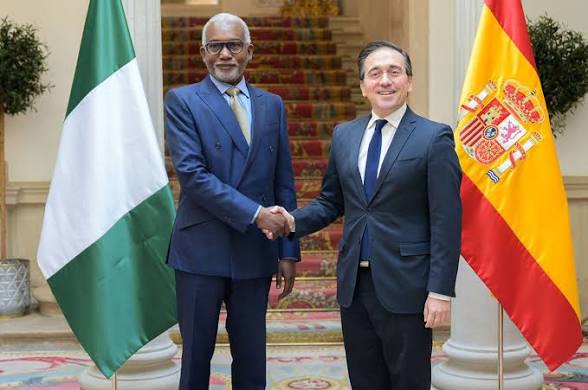
Nigeria’s renewed efforts to deepen bilateral relations with Spain should be welcomed, but they also expose a longstanding weakness in the country’s economic strategy: an excessive dependence on oil while other sectors with enormous potential remain underdeveloped. The proposed cooperation in tourism, agriculture, renewable energy, education, trade and critical minerals offers Nigeria an opportunity to begin correcting this imbalance.
For decades, crude oil has occupied an outsized position in Nigeria’s economic imagination. Governments have repeatedly spoken about diversification, yet the country has struggled to translate those promises into sustained investment in productive sectors capable of generating employment, foreign exchange and broad-based prosperity.
The discussion by Nigeria’s Ambassador to Spain, Dr. Okezie Ikpeazu, therefore comes at an important time. His emphasis on tourism, direct air connectivity, trade and investment points to sectors that could significantly expand Nigeria’s economic base if properly developed.
Tourism, in particular, remains one of Nigeria’s most underutilised economic assets. A country with diverse cultures, historical sites, festivals, beaches, wildlife and rich traditions should not have an economy in which tourism receives comparatively little attention when measured against its potential.
Nigeria does not need to manufacture a tourism identity from nothing. What it needs is to properly package, protect and promote the attractions it already possesses. Spain itself demonstrates how tourism can become a major economic pillar when infrastructure, security, marketing, hospitality and transportation work together.
This is why the Ambassador’s call for the restoration of direct air services between Nigeria and Spain deserves serious consideration. Connectivity is not merely a tourism issue; it is an economic infrastructure issue. Direct flights can facilitate business travel, investment, cultural exchanges, education and diplomatic engagement.
But Nigeria must not mistake connectivity for development. Direct flights will only produce meaningful economic benefits if visitors find a country where transportation is reliable, tourist destinations are accessible, public spaces are safe and hospitality services meet international expectations.
Security remains perhaps the biggest obstacle. As Ikpeazu correctly observed, tourism cannot flourish where people feel unsafe. Investors, tourists and businesses require confidence that their lives, property and investments will be protected.
Nigeria should consequently view security not simply as a military responsibility but as an essential component of economic policy. A safer country will attract more tourists, encourage investment and enable businesses to operate more efficiently.
The proposed cooperation with Spain in maritime security and naval defence could therefore have benefits beyond the security sector. Protecting Nigeria’s waterways, ports and coastal communities can support trade, fisheries, tourism and other legitimate economic activities.
Agriculture is another area where Nigeria has consistently failed to realise its full potential. With vast arable land, a large population and a substantial domestic market, agriculture should be a major engine of economic growth rather than an afterthought overshadowed by petroleum.
What is needed is a transition from subsistence-oriented production to modern, commercially driven agriculture supported by irrigation, storage, processing, technology, research and efficient transportation. Nigeria should seek Spanish expertise and investment where it can help achieve this transformation.
Renewable energy offers another avenue for diversification. Nigeria’s persistent electricity challenges have constrained industries, small businesses and households for years. Greater cooperation in solar, wind and other renewable technologies could help address the energy deficit while creating new industries and jobs.
The reference to lithium and other critical minerals is equally significant. Nigeria must resist the temptation to repeat the mistakes of the oil era by exporting raw resources while importing finished products at much higher prices.
Critical minerals should instead form part of a deliberate industrialisation strategy. Where economically and environmentally feasible, Nigeria should encourage processing, refining, manufacturing and technology partnerships so that more value is created domestically.
The same principle should apply to agriculture. Exporting raw agricultural commodities while importing processed food products represents a missed opportunity for employment, industrial growth and foreign exchange earnings.
Education and human-capital development should also occupy a central place in the Nigeria-Spain relationship. The proposed education hub could be useful if it goes beyond certificates and focuses on practical skills linked to real economic opportunities.
Nigeria needs technicians, engineers, agricultural specialists, renewable-energy professionals, entrepreneurs, digital workers and other skilled personnel capable of driving a modern economy. International partnerships should therefore be judged by how effectively they transfer knowledge and build local capacity.
The proposed digitisation of consular services is another welcome development. Efficient public services are part of a country’s investment and international reputation. Nigerians abroad should not have to endure unnecessary bureaucratic obstacles when seeking legitimate government services.
Migration also deserves a more constructive approach. Rather than treating migration largely as a problem, Nigeria should develop policies that enable its citizens to acquire skills, gain international experience and contribute productively both abroad and at home.
The Nigerian diaspora represents a substantial reservoir of expertise and capital. Encouraging Nigerians in Spain and elsewhere to participate in domestic development can help bridge skills gaps and create business networks between Nigeria and international markets.
However, bilateral agreements must not remain at the level of diplomatic speeches and ceremonial meetings. Nigeria has heard diversification promises for years. What is required now is measurable implementation, clear timelines and accountability.
The Federal Government should develop specific Nigeria-Spain economic targets covering tourism arrivals, investment commitments, agricultural partnerships, renewable-energy projects, educational exchanges, trade volumes and direct air connectivity. Such targets would make it possible to determine whether the relationship is producing tangible results.
Most importantly, Nigeria must stop treating oil as the automatic answer to every economic challenge. Petroleum remains important, but dependence on one dominant commodity exposes the country to international price shocks and makes public finances vulnerable to developments beyond Nigeria’s control.
The opportunity presented by closer ties with Spain should therefore be viewed as part of a much larger national conversation. Nigeria has the population, natural resources, entrepreneurial energy and cultural diversity to build an economy that does not depend disproportionately on crude oil.
What is missing is sustained political commitment to diversification. Tourism must be developed, agriculture modernised, manufacturing strengthened, renewable energy expanded, critical minerals responsibly exploited and human capital given the priority it deserves.
Nigeria-Spain relations can become a practical vehicle for some of these ambitions, but only if both countries move from declarations to investment and implementation. For Nigeria, the real lesson is clear: oil may remain an important part of the economy, but it must no longer be allowed to define the economy.
Nigeria-Spain Ties, Urgent Need to Look Beyond Oil.

Leave a Comment