President Donald Trump’s proposal to rename New Mexico “New America” has sparked opposition across the state, with Democratic and Republican politicians rejecting the idea and the Albuquerque Journal dismissing it as an immature attempt to provoke residents.
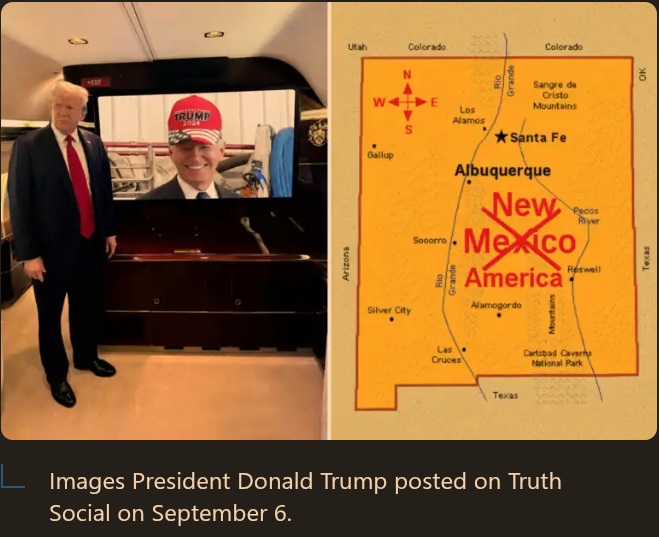
Trump floated the proposal on September 6 in posts on Truth Social, sharing an image of a New Mexico map in which “Mexico” was crossed out and replaced with “America.” The White House later amplified the post on X.
Trump also shared an AI-generated video showing himself placing an “America” sticker over the word “Mexico” on a “Welcome to New Mexico” sign.
“Many people suggested changing the name of New Mexico…to NEW AMERICA,” Trump wrote, calling the proposed name “more prestigious and beautiful.” He also referred to New Mexico as one of the “great vote cheating states,” linking the proposal to his broader political criticism of the state.
Trump does not have the legal authority to unilaterally change the name of a U.S. state. Any formal change would have to originate within New Mexico and follow the state’s constitutional process.
Politicians Push Back
According to report, New Mexico’s political leaders, from both parties, said the state’s name is inseparable from its history and identity.
Governor Michelle Lujan Grisham, a Democrat, said on September 7 that the name was not open for debate and noted that New Mexico’s identity predates the United States. She accused the White House of focusing on symbolic distractions while her administration addressed childcare, education, healthcare and housing.
Former U.S. Interior Secretary Deb Haaland, the Democratic nominee seeking to succeed the term-limited governor, said New Mexico was “not for renaming” and “not up for sale.”
Representative Melanie Stansbury said the name represented generations of history, culture and family identity. Senator Martin Heinrich said he would continue using the established names of New Mexico, the Gulf of Mexico and Lake Ontario.
Representative Gabe Vasquez said Trump could not erase New Mexico’s name, history or culture by proposing a new one.
Republican leaders also rejected the idea. Republican gubernatorial nominee Gregg Hull, the former mayor of Rio Rancho, pointed to the state’s Native American and Spanish heritage and the generations of families that shaped its identity.
State Senator Pat Woods, the Republican minority whip, also disagreed with Trump despite supporting several of his policies. Woods cited New Mexico’s Indigenous civilizations, Spanish settlements, centuries of trade and role in the Civil War. Residents, he said, could be proud Americans while remaining deeply proud of their New Mexican identity.
Albuquerque Journal Criticises Trump
The Albuquerque Journal, New Mexico’s largest newspaper, criticized the proposal in an opinion article published after Trump’s posts.
Journalist Ryan Boetel described the idea as an elementary and predictable attempt to provoke New Mexicans. He urged residents not to be drawn into what he portrayed as a deliberate effort to generate outrage.
Boetel placed the proposal within wider political frustrations, including the conflict involving Iran, the rising cost of living and concerns about Trump’s approval ratings. The newspaper’s position was that New Mexicans should ignore the provocation rather than provide the reaction it appeared designed to produce.
A Name Older Than Modern Mexico
Trump’s proposal has revived debate over the history of the name New Mexico.
The state was named Nuevo México by Spanish explorers in the 16th century, centuries before the modern Republic of Mexico became independent. The territory later became part of Mexico before coming under United States control and eventually becoming a state.
That history challenges the suggestion that the name reflects an attachment to a foreign country. Instead, it represents a centuries-old identity shaped by Indigenous peoples, Spanish settlers, Mexican rule and the state’s incorporation into the United States.
Trump’s Broader Renaming Drive
The proposal is the latest in a series of efforts by Trump’s administration to promote changes to geographical names.
In January 2025, Trump ordered the federal government to use “Gulf of America” instead of “Gulf of Mexico” in official U.S. government usage. Mexico rejected the change, and the traditional international name remains widely used outside the United States.
In August 2026, Trump ordered the use of “Lake America” for Lake Ontario following tensions with Canada over trade and tariffs. On September 2, he reportedly suggested renaming the Strait of Hormuz the “Trump Strait.”
Changing the name of New Mexico, however, would require action within the state itself. For now, “New America” remains a presidential proposal and political talking point rather than a legally viable name change.
The backlash has shown that the issue goes beyond a name. In New Mexico, it touches a historical identity that political leaders across party lines say they are unwilling to surrender.
MSN