The United States is seeking greater access to Venezuela’s mineral wealth, including gold and other strategic resources, as the Trump administration expands its efforts to reshape the South American nation’s resource sector beyond oil.
Three sources familiar with discussions between Washington and companies in the critical-minerals industry said the administration was considering measures that could increase U.S. involvement in Venezuela’s mining sector and encourage American companies to invest in the industry.
Again the latest development raises a bigger question about Venezuela’s future if it becomes reality: will the opening of its vast natural resources to American capital become the beginning of an economic recovery, or could it gradually turn the resource-rich nation into an economic dependency of Washington? For a country emerging from years of political instability, sanctions, economic decline and institutional weakness, the distinction could determine the character of Venezuela’s next decade.
The proposed expansion of U.S. involvement could give American companies access to minerals considered important to national security, while providing Caracas with much-needed foreign investment and technical expertise.
According to Reports, the Trump administration is considering several options to deepen U.S. participation in Venezuela’s mining industry, including a possible executive order focused on critical minerals. However, the proposed order remains under discussion and the administration’s strategy could still change.
U.S. officials have also met with companies to assess their interest in investing in or participating in Venezuela’s mining industry.
“We are all watching the oil situation closely and recognize there could be a parallel track with critical minerals,” one executive from a critical-minerals company familiar with the discussions said.
White House spokeswoman Taylor Rogers said the United States and Venezuela were benefiting from renewed cooperation between their governments and fresh investment by Western companies in key Venezuelan industries.
Meanwhile, a White House official, however, said there was currently no need for a new executive order, arguing that existing laws already provide an adequate framework for investment.
The move forms part of President Donald Trump’s wider attempt to strengthen U.S. influence across Latin America while countering China’s growing economic presence in the region.
Venezuela has maintained close economic and diplomatic relations with China, particularly during the government of former President Nicolás Maduro. Following Maduro’s removal from power in January, interim President Delcy Rodríguez has moved towards greater cooperation with Washington.
With some of the world’s largest oil reserves and potentially substantial deposits of gold, iron ore, bauxite and nickel, Venezuela presents the United States with an opportunity to combine commercial interests with broader geopolitical and national-security objectives.
Washington has already taken steps to facilitate American participation in Venezuela’s minerals sector. In March, the U.S. Treasury Department’s Office of Foreign Assets Control authorised certain transactions involving Venezuelan-origin gold, including activities connected to state-owned gold producer Minerven.
Later that month, the authorisation was expanded to cover Venezuelan-origin minerals, including gold, while permitting certain mining-related services and negotiations concerning possible investment agreements.
These measures could pave the way for Western companies to return to Venezuela’s mining industry after years of political and economic uncertainty.
It would be recalled that the US last week made a move to reshape Venezuela’s oil industry a Trump announced a deal under which the United States would take majority control of more than 65 billion barrels of Venezuela’s proven oil reserves though the precise legal structure of the arrangement has not been made public.
That development has intensified concerns among some Venezuelans and experts that their country could be moving from political crisis into a new form of resource dependency, with foreign powers gaining increasing influence over strategic national assets.
GOING BACK TO HISTORY
Despite its enormous natural-resource potential, Venezuela’s mineral wealth remains difficult to quantify accurately.
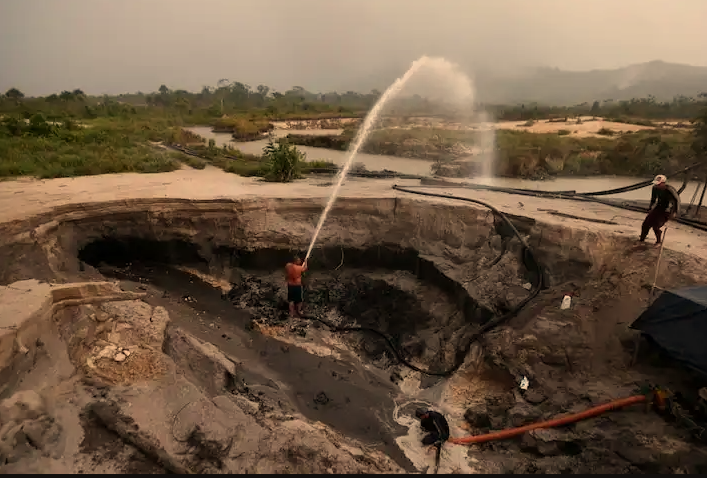
Much of the country’s geological information is outdated, while illegal mining groups control significant gold-producing areas in the Orinoco Mining Arc, a huge mineral-rich region close to the borders with Guyana and Brazil.
Research reveals that Venezuela has historically produced gold, iron ore, bauxite and nickel. However, potential investors are likely to demand updated geological surveys before committing substantial capital because of uncertainty surrounding reserves, poor infrastructure and widespread illegal mining.
The country’s mining history also demonstrates the challenges facing foreign investors. In 2012, Venezuelan authorities refused to renew Anglo American’s concession for the Loma de Niquel nickel mine, which was then estimated to contain more than four million metric tonnes of nickel reserves.
The Venezuelan government subsequently took control of the assets and has struggled to restore the mine to full operation.
A 2018 Venezuelan government report estimated the country’s resources at 644 tonnes of gold, 14.68 billion tonnes of iron ore, 321.5 million tonnes of bauxite and 407,885 tonnes of nickel.
However, the report used the terms “reserve” and “resource” interchangeably, making it difficult to establish how much of the estimated wealth can actually be extracted profitably.
A Venezuelan government map published in 2021 and based on data compiled in 2009 also identified deposits of copper, nickel, coltan, uranium and tungsten, although it did not provide estimates of their volumes.
Despite its wide mineral potential, Venezuela does not appear to possess sizeable reserves of rare earth elements, which are increasingly important in magnets, electronics and advanced technologies.
WHAT WILL VENEZUELA LOOK LIKE IN FIVE YEARS?
The next few years could therefore be decisive for Venezuela. If American and other Western investment brings modern technology, infrastructure, employment, transparent contracts and higher government revenues, the country could begin converting its enormous natural wealth into sustainable economic growth.
But if resource agreements are structured primarily around foreign control, with weak institutions unable to protect national interests, Venezuela could find itself wealthy in resources but poor in economic sovereignty.
The danger is not foreign investment itself. Venezuela desperately needs capital, expertise and infrastructure. The real question is who controls the resources, who receives the benefits and what remains for Venezuelans after the contracts are signed.
For decades, Venezuela’s natural wealth has been both its greatest opportunity and one of its greatest vulnerabilities. The coming years will show whether the latest American involvement marks the beginning of Venezuela’s economic reconstruction—or the emergence of a new era in which control of the country’s resources increasingly determines who controls its future.
Venezuela may have survived a political storm, but its greatest test may now be economic: whether it can use its oil and minerals to rebuild a nation without surrendering the power to determine its own destiny.