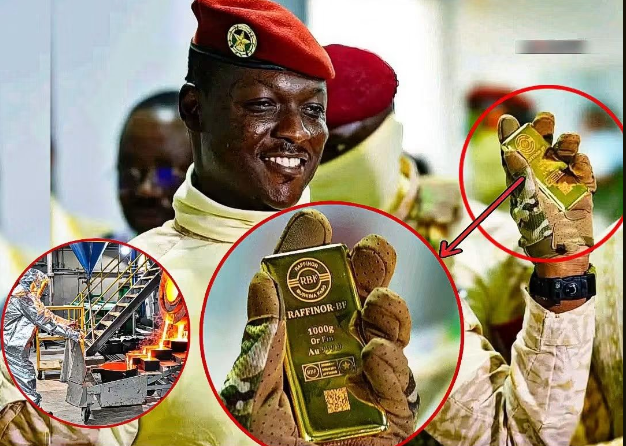
Burkina Faso’s production of its first nationally branded gold bar has been celebrated as a landmark achievement in the country’s quest to exercise greater control over its mineral wealth. The 1,000-gram bar, marked Au 999.9 and bearing the RBF and Raffinor-BF seals, represents an attempt to move the country beyond simply extracting gold and sending it abroad for processing.
The significance of the development lies not merely in the appearance of a gold bar carrying Burkina Faso’s national identity, but in what domestic refining could mean for the country’s place in the international mineral economy. For a nation endowed with substantial gold resources, the ability to refine and certify part of its production at home offers the possibility of retaining more value within its economy.
For years, resource-rich African countries such as Ghana, Nigeria, Zambia, Zimbabwe, Tanzania and the Democratic Republic of Congo have faced the familiar dilemma of exporting raw or minimally processed commodities while importing finished products at considerably higher prices. The result is that much of the economic value generated from natural resources is captured outside the producing country. Burkina Faso’s move, therefore, speaks directly to the broader African debate about resource nationalism, local processing and economic independence.
The first RBF-branded bar is consequently more than a piece of refined metal. It is a statement of intent. It suggests that Burkina Faso wants greater control over the journey of its gold—from the mine to the refinery and eventually to the international market.
That could have important economic implications. Domestic refining can create opportunities in assaying, security, logistics, bullion trading, financial services and other areas associated with the gold industry. It could also provide the government with greater oversight of production and potentially strengthen its ability to combat smuggling and improve revenue collection.
However, the first gold bar should not be mistaken for the completion of that journey. Refining gold domestically is one stage in a much larger value chain. True resource sovereignty requires a country to develop capacity across exploration, mining, processing, refining, certification, financing, trading and, ultimately, manufacturing.
This is where Burkina Faso’s experiment will face its real test.
The country will have to demonstrate that its refinery can operate at meaningful scale, meet internationally recognised standards and attract buyers beyond the symbolism of its national branding. International confidence will remain essential because gold is a globally traded commodity whose value depends not only on purity but also on provenance, certification, security and the credibility of the institutions handling it.
The development could also alter the commercial interests of foreign refineries, traders and intermediaries that have historically benefited from processing or handling African gold outside its country of origin. If Burkina Faso eventually processes a substantial proportion of its production domestically, some of those businesses could lose part of their existing market.
But that should not be interpreted as meaning that Burkina Faso can simply cut itself off from the international economy. Even domestically refined gold requires international buyers, financial institutions, insurance, logistics, technology and access to global markets. Economic sovereignty, therefore, should not be confused with economic isolation.
The development also raises a broader question about Burkina Faso’s position in Africa. The country is already a significant gold producer, but becoming a major producer is different from becoming a major gold-processing and trading centre. Other African countries, including South Africa, Ghana, Tanzania and Zimbabwe, have developed more established capacities and markets around gold.
Burkina Faso’s challenge will therefore be to turn its new refining capacity into a sustainable industrial ecosystem rather than allowing the first nationally branded bar to remain primarily a symbol.
There is also the question of what happens to the revenue. A country can refine its own gold and still remain economically vulnerable if mineral income does not translate into productive investment. Roads, electricity, schools, healthcare, technology, manufacturing and human capital development ultimately determine whether natural resources produce broad-based prosperity.
That is why the most important question surrounding Burkina Faso’s first RBF gold bar is not how much the bar is worth. The bigger question is what Burkina Faso will build around it.
If domestic refining expands, if more of the value chain is brought into the country, if gold revenues are transparently managed and if the proceeds are invested in diversifying the economy, the first bar could indeed become the starting point of a much wider transformation.
But if the development stops at national branding while the country continues to depend heavily on external actors for technology, financing, trading and other critical components of the value chain, its practical impact will remain limited.
Burkina Faso has not got it all. But it may have taken an important step towards getting more of what it needs.
The first RBF gold bar should therefore be viewed neither as proof that Burkina Faso has achieved complete economic sovereignty nor as a mere publicity exercise. Its true significance will be determined by what follows.
The real test is not the first gold bar. It is what Burkina Faso does with the next hundred thousand.