President blames far-left groups for violence as authorities halt marches in major cities
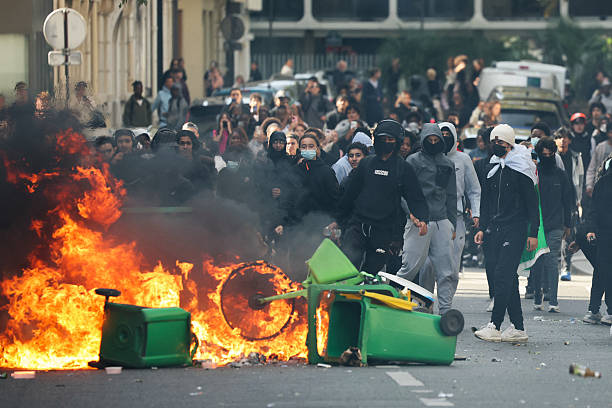
French President Emmanuel Macron’s decision to outlaw what he describes as “illegitimate” demonstrations has intensified the debate over the limits of civil liberties and the government’s response to mounting public anger, as France struggles to contain street violence that has accompanied weeks of protests over living costs and deteriorating public services.
While the government has a legitimate responsibility to protect lives, businesses and public infrastructure, a sweeping approach to protest restrictions risks treating the symptoms of France’s discontent rather than confronting its underlying causes. The challenge for Macron is not simply to empty the streets but to demonstrate that his administration can respond to citizens’ grievances without undermining the democratic freedoms that distinguish a republic from the disorder it seeks to prevent.
Speaking on Thursday 22nd October 2026, after a meeting with intelligence chiefs and senior ministers, Macron said demonstrations organised by recognised groups could proceed though authorities might alter their routes. However, protests requested by individuals or groups deemed to lack “legitimate authority” would be prohibited.
Requests from organisations such as trade unions would be assessed in accordance with the law, although alternative routes could be imposed. Macron said the restrictions were necessary to protect city centres, commercial establishments and public buildings, while recommending that demonstrations should generally not take place over the coming days.
Blaming much of last weekend’s looting on individuals who had deliberately joined the protests to commit crimes, the president accused what he described as ultra-left groups of engaging in political and seditious activities aimed at destabilising the republic.
“The priority is a return to calm,” Macron said, announcing that he would chair another defence council meeting on Friday to determine further measures ahead of nationwide demonstrations scheduled for Saturday and subsequent days.
The government’s position, however, faces a difficult test as authorities seek to distinguish peaceful protesters from those responsible for violence. An initial police ban on a student demonstration planned in Paris for Thursday was overturned by a court, highlighting the legal limits of executive efforts to control public gatherings.
Marches scheduled for Thursday in Grenoble, Rouen, Le Havre and Toulon were halted, while authorities imposed a blanket ban on protests in central Lyon for Saturday. The city, France’s third-largest, was among the worst affected by last weekend’s violence, when between 200 and 300 shops were reportedly ransacked and looted, while its tourist office was set ablaze.
Similar restrictions were announced for Saturday in Marseille, Nice and Toulon. In Paris, authorities authorised a planned march beginning at Place de la Bastille in the eastern part of the capital but prohibited participants from proceeding into the city centre.
A separate demonstration organised by students and some members of the Gilets Jaunes, or Yellow Vests, movement was also banned. The movement shook France in 2018 and 2019 with protests against fuel prices and economic pressures, exposing deep-seated resentment over the cost of living and perceptions that government policies disproportionately burden ordinary citizens.
France’s main student union, UNEF, has also called for rallies on Saturday, raising concerns about further confrontations. Businesses in central Paris and other cities have reportedly begun boarding up windows and engaging private security personnel in anticipation of possible violence.
The security crackdown has been accompanied by a growing judicial response. Justice Minister Gérald Darmanin said 174 of the 2,500 people arrested since the latest wave of rioting began had been remanded in custody, while more than 900 were facing prosecution.
Two people were also arrested following a fire at the town hall in Limoges. Meanwhile, Prime Minister Sébastien Lecornu was holding consultations with representatives of major political parties on Thursday in an effort to secure cooperation, with further discussions planned with mayors of several major cities.
Additional security measures include partial night-time curfews in parts of several cities, including Paris, and restrictions on gatherings around sensitive locations such as the Élysée presidential palace, parliament and major railway stations.
The unrest began last month at a high school in Créteil, south-east of Paris, where students protested against staff shortages and deteriorating school facilities. What started as a dispute over educational conditions subsequently spread nationwide, triggering strikes, blockades and demonstrations by secondary-school students.
The protests have since broadened into a more general expression of anger over soaring living costs, placing the government under growing pressure barely six months before France’s next presidential election, which will determine Macron’s successor.
The political implications are significant. By framing the unrest primarily as a security problem, the government risks overlooking the economic frustrations and failures in public services that have helped fuel the demonstrations. Although looting, arson and attacks on businesses cannot be excused as legitimate expressions of dissent, neither should the misconduct of some participants become a justification for indiscriminately restricting peaceful assembly.
Macron must therefore strike a difficult balance between restoring public order and preserving the right to protest. The courts must remain free to scrutinise restrictions, trade unions and student organisations must be allowed to express legitimate grievances within the law, and those responsible for violence must face due process.
France cannot police its way out of a crisis rooted partly in economic hardship and public frustration. A temporary ban may keep demonstrators away from strategic locations, but it cannot lower household bills, improve dilapidated schools or restore public confidence on its own.
If Macron’s government wants lasting calm, it must pair proportionate security measures with credible action on the grievances driving people into the streets. Otherwise, the apparent restoration of order could prove little more than a pause before the next eruption of public anger.