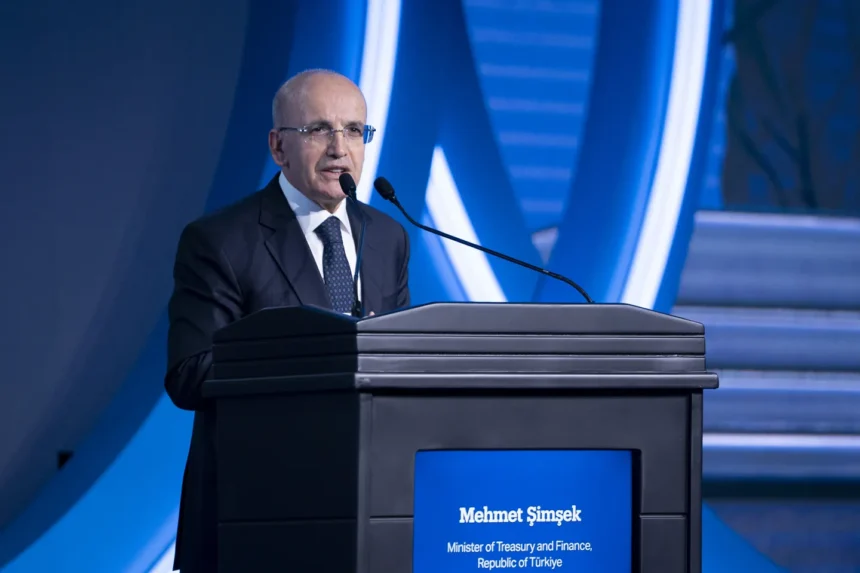
Türkiye’s Treasury and Finance Minister, Mehmet Simsek, has warned that the ongoing Middle East war has triggered an energy supply shock twice the scale of the 1973–74 oil embargo, with far-reaching consequences for the global economy.
Speaking at the TRT World Forum on Saturday during a panel discussion titled “Towards a Rocky Recovery: National Economies After the Wars in the Middle East,” Simsek said the conflict would reshape the region’s economic and security landscape, forcing countries to reconsider strategic dependencies and diversify trade routes.
He described the disruption as unprecedented, saying its impact was seven times greater than the energy disruption caused by the Russia-Ukraine war.
Simsek noted that several Middle Eastern economies were already experiencing recession, while countries directly affected by the conflict had recorded significant declines in exports and imports. Globally, the crisis had slowed economic growth and tightened financial conditions amid rising inflation.
Citing an International Monetary Fund study covering 170 conflicts since 1946, he said wars typically resulted in output losses of between three and seven per cent, stressing that lasting peace was essential for sustainable economic recovery.
“If there is no durable peace, it would be very hard to talk about a durable recovery,” he said.
The minister called for stronger regional economic integration, particularly across the Middle East and North Africa, where intra-regional trade remains relatively low compared with other regions.
He said trade within Europe accounts for about 67 per cent of regional commerce, compared with 59 per cent in East Asia and the Pacific, while the Middle East and North Africa continues to lag behind.
Simsek also urged countries to reduce their dependence on strategic maritime routes, particularly the Strait of Hormuz, by investing in alternative trade corridors, infrastructure and energy security.
Highlighting Türkiye’s economic strategy, he said the country had 54 free trade agreements covering nearly 70 per cent of its exports, while negotiations were ongoing with Japan, Indonesia, the Gulf Cooperation Council and Canada.
He identified the Middle Corridor, linking Beijing to London, and the Development Road project connecting the Gulf and Iraq to Türkiye and European markets as important regional connectivity initiatives.
Simsek added that Türkiye remained committed to diplomatic efforts, including facilitating negotiations between Russia and Ukraine, supporting the Armenia-Azerbaijan peace process and efforts to secure peace in Gaza.
He, however, maintained that diplomatic initiatives must go hand in hand with stronger defence capabilities, pointing to Türkiye’s defence industry, which comprises about 4,000 companies and between 1,400 and 1,500 ongoing projects.
According to him, Turkish defence equipment orders reached approximately $18 billion last year, making the country the world’s 11th-largest defence exporter.
He also projected that reconstruction needs in conflict-affected neighbouring countries could reach at least $1 trillion over the next decade.
Simsek said Türkiye was strategically positioned to benefit from postwar reconstruction and stronger regional integration, given its industrial capacity, infrastructure and expanding services sector.
“Wars are not in our interest. We benefit most from stability, peace, and prosperity in the region,” he said.