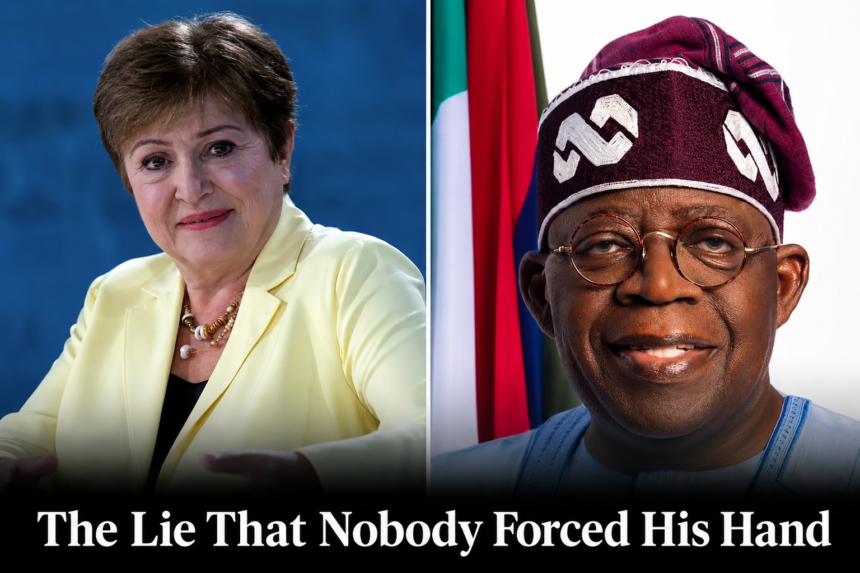
Part 1 of 3 — The Lie That Nobody Forced His Hand
There is a version of this story where Bola Tinubu is a victim. Where a desperate, broke Nigeria was cornered by Washington bankers in grey suits and forced, at the point of a financial gun, to remove its fuel subsidy and float its currency. It is the version his critics reach for because it is the angriest, easiest story to tell. It is also, in one important respect, not true. And Nigerians deserve the true version, because the true version is worse.
Nobody forced Bola Tinubu’s hand. There is no signed IMF loan agreement, no Extended Fund Facility, no Stand-By Arrangement sitting in a vault in Abuja with conditionalities attached to Nigeria’s throat. As of this year, Nigeria owes the IMF nothing beyond routine subscription obligations — the last emergency facility, a $3.4 billion pandemic-era loan, was paid off years ago. When Wale Edun stood down as Finance Minister in April, one of his final acts in office was to rule out any new IMF borrowing programme publicly. Nigeria, in the narrow technical sense, is not “under” the IMF.
And that is precisely the problem. This government did not need to be forced. It volunteered.
What “sold” actually means
On May 29, 2023, in his very first hours in office, President Tinubu declared fuel subsidy dead. Days later, the Central Bank floated the naira. These were, almost word for word, the two policies the IMF and World Bank had been quietly urging on Abuja for years — the same two policies the Fund’s Article IV consultations had recommended to successive governments since at least the Buhari years. Tinubu did not need a loan officer to hand him the script. He read from it because reading from it is what earns you applause in Washington, in London bond markets, and from ratings agencies whose upgrades determine how cheaply your government can borrow on the Eurobond market.
That is what “selling” a country looks like in 2026. Not a mortgage document. A slow, voluntary re-ordering of who a government answers to first — bondholders and raters, or the mother in Kano who cannot find garri. Femi Falana, the human rights lawyer and Senior Advocate of Nigeria who has hammered this point since 2023, has put it in almost identical terms every time a new subsidy is stripped away: on fuel, then on electricity, then on the currency itself, he has said the same two institutions “insisted the government must remove all subsidies.” He is not wrong about who wrote the playbook. He is only wrong, technically, about how it was enforced. Nobody had to enforce it. Tinubu’s economic team enforced it on themselves — and on 230 million Nigerians who never voted for a fiscal contraction package.
No transition plan, then or now
What makes this a betrayal rather than merely a policy choice is what didn’t happen in the weeks around that first declaration. There was no fleet of CNG buses waiting to cushion the fare shock. There was no functioning local refining capacity to blunt the import bill when the naira was floated — the Dangote refinery would not begin meaningful output for another year. There was no cash transfer infrastructure ready to reach the poorest households before, not after, prices moved. Transport fares in Lagos and Abuja doubled within days. Food followed within weeks. The government that removed the subsidy has spent every year since improvising the palliatives it should have built before it pulled the trigger.
The subsidy that never actually died
Here is the part almost nobody in government wants examined closely: the fuel subsidy did not disappear in 2023. It changed its name.
NNPC Limited’s own audited 2024 financial statements — certified by PwC, SIAO and Muhtari Dangana & Co. — show the federation now owes the national oil company roughly ₦17.5 trillion, nearly double the ₦9.36 trillion on the books in 2023. NNPC books this under euphemisms: “energy security expenses,” “under-recovery,” “exchange-rate differentials.” Dele Oye, the immediate past president of NACCIMA and one of Nigeria’s most senior private-sector voices, said it plainly this July: Nigeria is running the most expensive subsidy programme in its history, “hidden behind accounting terminologies designed to obscure rather than illuminate.” He has called for a full forensic audit. He has not gotten one.
The World Bank’s own Nigeria Development Update independently confirmed the shape of the deception: of the ₦1.1 trillion NNPCL owed the Federation Account in 2024, it remitted barely half — roughly ₦600 billion — quietly using the rest to offset its own arrears rather than fund the Federation. In other words, the government that told Nigerians “subsidy is gone” was, in the very same period, allowing its national oil company to sit on money that belonged to the federation while continuing to absorb the price gap on imported fuel. Three years after the declaration, by NNPC’s own paperwork, the burden has never been heavier. It has simply been renamed so nobody in Aso Rock has to say the word “subsidy” out loud.
Borrowing to survive its own reforms
If the reforms were supposed to free Nigeria from debt dependency, the numbers say otherwise. Total public debt stood at ₦87.38 trillion when Tinubu took office in June 2023. By the end of March this year, it had climbed to ₦159.35 trillion — an increase of more than 80 percent in under three years, according to the Debt Management Office’s own figures. External debt alone sits at $51.9 billion, of which multilateral lenders — the World Bank Group foremost among them — hold nearly $24 billion, or almost half. Debt servicing consumed roughly ₦3.14 trillion in Nigerian government borrowing costs in the first quarter of this year on the domestic side alone, working out to about ₦34 billion leaving the treasury every single day just to pay interest. The federal government’s own 2026 budget projections earmark close to ₦15.8 trillion for debt service this year — and Tinubu himself told Nigerians in May that the country would spend $11.6 billion on debt service in 2026.
This is what “fiscal responsibility” bought Nigeria: a debt stock that grew faster under the man who removed the subsidies than it did under the men who kept them.
There is a newer, quieter danger too. The IMF’s own June 2026 Article IV report flagged a proposed $5 billion “total return swap” the government was arranging with an international bank to help finance this year’s deficit — a complex instrument requiring collateral worth 133 percent of the loan in domestic government securities, exposing Nigeria to margin calls if the naira weakens. The Fund itself, the institution Nigeria supposedly has “sold” itself to, warned Abuja against it. Nigeria’s own government is now taking on financing risk more aggressive than what its supposed foreign overlords are comfortable recommending.
A minister sacrificed, not the policy
In April, Tinubu sacked Wale Edun — the finance minister who spent three years as the public face of “the reforms” — and replaced him with Taiwo Oyedele, the tax technocrat who built the new revenue architecture. Presidency sources told local reporters the real story was internal friction and coordination breakdowns, not a change of direction. Whatever the palace politics, the signal to ordinary Nigerians was unmistakable: the man who fronted the hardship was expendable. The hardship itself was not up for review.
What the other side would say
A fair reckoning has to make room for the argument Tinubu’s economic team would make, because it is not a stupid argument. Inflation, on the rebased index, has come down from above 34 percent in December 2024 to under 16 percent by mid-2026. Nigeria has returned to the Eurobond market. Reserves have strengthened. The naira, after its catastrophic 2023–2024 collapse, has actually stabilised — trading around ₦1,360–1,370 officially and ₦1,400–1,430 on the street this August, nowhere near the freefall some critics still describe. The IMF’s own June 2026 assessment credited “strong reforms” with improved macroeconomic outcomes and built resilience. Investors who fled in 2023 have, in measurable numbers, come back. None of this is nothing, and a fair piece of journalism does not pretend otherwise.
But stabilising a currency and reassuring a bondholder are not the same project as feeding a country. The Fund’s own directors, in that same June report, cautioned that conditions “remain difficult for many Nigerians, with poverty and food insecurity likely to worsen.” Even the institution Nigeria is accused of serving admits the macro numbers and the lived reality have come apart. That gap — between what shows up on a term sheet in London and what shows up on a dinner table in Kaduna — is where the rest of this series lives.
Part 2 of this series examines the human toll of these three years — the hunger, the poverty numbers the government would rather you not compare, and the insecurity feeding on both. Part 3 asks what accountability should look like before Nigerians are asked to vote again in 2027.
—
This is Part 1 of a three-part United Continental Post investigative opinion series. Figures on debt, inflation, poverty, exchange rates and fuel subsidy accounting are drawn from the Debt Management Office, National Bureau of Statistics, Central Bank of Nigeria, World Bank Nigeria Development Update (April 2026), IMF Article IV Consultation (June 2026), NNPC Limited’s 2024 audited financial statements, and on-the-record statements by named sources, current as of publication.