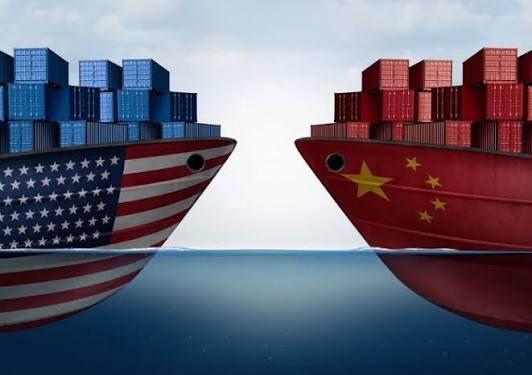
The United States is intensifying efforts to reduce its dependence on China, particularly within the defense industrial base, where supply-chain security is considered a national security priority.
Washington fears that continued reliance on Chinese minerals, components, batteries and technologies could leave American defense production vulnerable if Beijing restricts exports or uses economic pressure during a geopolitical conflict.
The challenge is complicated by the Pentagon’s growing reliance on commercial companies to produce drones, autonomous systems, advanced manufacturing technologies and critical materials. Many of these companies may be American-owned but still depend on Chinese inputs.
As a result, an American-made defense product is not necessarily free from Chinese influence. Its underlying components, raw materials, financing or technology may still be connected to China, creating vulnerabilities that traditional defense reviews may fail to identify.
The experience of US drone maker Skydio illustrates the problem. Although the company manufactures its drones in the United States and relies largely on American components, it previously depended on Chinese batteries.
In 2024, China sanctioned Skydio, disrupting its battery supplies and forcing the company to ration batteries. The incident exposed how a relatively small foreign dependency can threaten the production capacity of an important defense supplier.
Rare earth minerals present another major challenge. US company MP Materials has sought to build a domestic supply chain, but its operations were historically connected to China, including the processing of its output and business relationships involving Chinese interests.
Washington has therefore stepped in to support a domestic “Mine-to-Magnet” supply chain. However, developing alternative American processing and manufacturing capacity remains expensive and commercially difficult.
The problem also extends to advanced manufacturing. Companies such as Divergent Technologies, which develops technology for producing complex engine and rocket components, have attracted significant Chinese investment and commercial interests.
Some Chinese-linked investors have been required to divest their stakes because of US national security regulations. However, questions remain about other Chinese investment relationships and the extent to which previous commercial partnerships may have transferred valuable knowledge or access.
The United States is also using tariffs and other trade measures to encourage companies to relocate critical supply chains. While such measures may reduce dependence on China, they can also create higher costs and unintended disruptions.
Experts argue that trade restrictions alone cannot solve the problem. Companies themselves must diversify suppliers, develop alternative sources and invest in domestic production before a crisis exposes their vulnerabilities.
The Pentagon’s decision to bring more companies from the automotive, robotics, artificial intelligence, mining and advanced manufacturing sectors into defense production creates both opportunities and risks.
Commercial companies often have international supply chains that are more complicated than those traditionally found in the defense industry. Chinese investors may also possess governance, information or intellectual-property rights that create additional security concerns.
Divestment can reduce future exposure, but it cannot necessarily reverse knowledge already transferred or immediately replace deeply embedded supply chains. This makes early identification of vulnerabilities essential.
Ultimately, the United States cannot determine whether a defense technology company is secure simply by looking at where it is headquartered or where its final product is assembled. The critical question is whether its technology, financing and supply chain can continue operating if China ceases to act as a commercial partner and becomes an open adversary.