Inside the Chagoury Contracts the Presidency Won’t Fully Explain
Nigerians did not learn that their president had just given a convicted money launderer the country’s second-highest honour from the president. They learned it from a tweet.
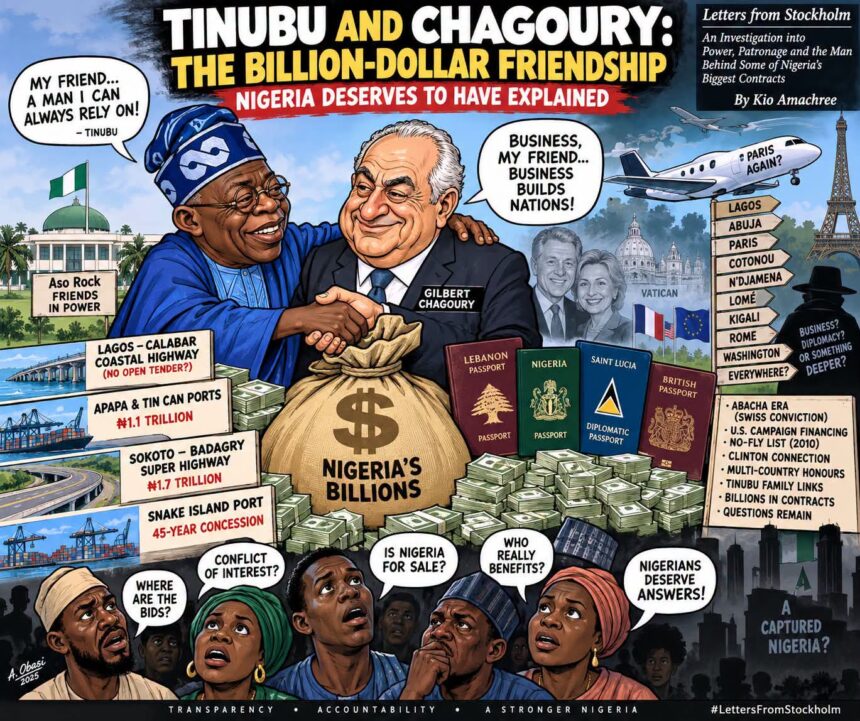
On January 8, 2026, Bola Tinubu signed an instrument conferring the Grand Commander of the Order of the Niger — a rank normally reserved for the Vice President, the Senate President and the Chief Justice, and previously extended to foreign recipients no smaller than Narendra Modi and Ngozi Okonjo-Iweala — on Gilbert Chagoury. There was no ceremony. No presidential statement. The honour sat undisclosed for eleven days until billionaire Femi Otedola posted a photo of the certificate online, calling Chagoury his “mentor” and “role model.” Only then did the presidency confirm it had happened at all, through spokesman Bayo Onanuga, who framed it as a birthday gesture for a man who had turned eighty.
A former Lagos governorship candidate, Funso Doherty, has since written to the Speaker of the House of Representatives demanding a formal probe into how the award was processed. That letter deserves an answer. So does everything else in this file.
Who is being honoured
Gilbert Chagoury is not a mystery man. His record is a matter of court documents on two continents.
In 2000, a Geneva court convicted him of money laundering and aiding a criminal organisation, over accounts he helped set up for the family of dictator Sani Abacha that moved more than $120 million looted from Nigeria’s central bank. He paid a fine and forfeited $66 million. Four years later, Nigeria’s own anti-graft agency tried to arrest him — EFCC chairman Nuhu Ribadu led a 2004 sting to seize his jet as he attempted to re-enter the country — and Chagoury escaped on a tip-off before agents could reach him.
In 2021, the story repeated itself on American soil. The U.S. Department of Justice announced Chagoury had routed roughly $180,000 through straw donors into four federal campaigns, including a fundraiser for then-Congressman Jeff Fortenberry, who was later convicted of lying to the FBI about the very scheme Chagoury financed. Chagoury avoided prosecution himself through a deferred prosecution agreement, paying $1.8 million. The Justice Department said its decision rested partly on his “unique assistance to the government” — language that has fed speculation about intelligence ties in some corners of the Nigerian press. We checked. The assistance the DOJ is referring to is cooperation in the same campaign-finance investigation that helped convict Fortenberry — not, on any record we could locate, anything to do with foreign intelligence services. We found no filing, no cable and no on-record official supporting that theory anywhere, and a newspaper doesn’t get to print an espionage accusation against a private citizen because the pattern feels suggestive. So we’re not printing it. What follows needs no embellishment.
Nigeria’s answer to a convicted man: more contracts
The relationship between Chagoury and Tinubu predates the presidency by nearly two decades. As Lagos governor, Tinubu’s administration granted the Chagoury Group title to ten million square metres of Lagos shoreline in 2007 — the land Hitech Construction has since turned into Eko Atlantic City. The two families’ business lives have been intertwined ever since, and the Council on Foreign Relations has described Chagoury plainly as a presidential “confidante.”
Since 2023, that closeness has translated into a specific, repeating shape: Chagoury-linked firms winning Nigeria’s largest infrastructure awards, one after another, without the open competitive bidding Nigerians are told governs public contracts.
The Lagos–Calabar Coastal Highway, a roughly $3.6 billion project funded substantially by public money despite Works Minister Dave Umahi’s initial claim that Hitech would finance it entirely, went to Hitech through what Umahi himself calls “restrictive bidding” — a legally permitted but far less transparent process than an open tender, and one that let the company win all three sections of the route without ever facing the wider market. In 2025, a roughly $700 million port rehabilitation contract for Tin Can and Apapa went to ITB Nigeria, another Chagoury-controlled firm. In July 2026, the Federal Executive Council handed Hitech a further ₦1.7 trillion — about $1.24 billion — for the Sokoto–Badagry Super Highway. And in March 2026, Chagoury-linked ITB Nigeria emerged as a construction partner in a 45-year, $1 billion-plus concession to develop Snake Island Port alongside MSC and DEME.
Four enormous federal or federally-linked awards. One family. Three years.
The son on the board
The presidency does not deny the most direct conflict-of-interest question in this entire file — it argues it doesn’t matter. When former Vice President Atiku Abubakar pointed out that Seyi Tinubu, the president’s own son, sits on the board of CDK Integrated Industries, a Hitech Construction subsidiary, presidential spokesman Bayo Onanuga confirmed it was true and called it irrelevant, describing CDK as merely a tile-manufacturing company in Ogun State. Separate reporting by the Organized Crime and Corruption Reporting Project found Seyi Tinubu had also been a majority shareholder, alongside Ronald Chagoury Jr., in a British Virgin Islands company — the kind of offshore structure that exists specifically to keep ownership out of public view.
A title subsidiary is a strange hill for the presidency to defend. Nobody is alleging Seyi Tinubu personally poured concrete on the Lagos-Calabar Highway. The question is simpler and harder to wave away: when the son of a sitting president holds a board seat inside the same corporate group that keeps winning his father’s biggest contracts, what does “no corruption in it” — Umahi’s own phrase — actually rest on, beyond the government’s word?
What the government says, and what it hasn’t said
In fairness, the government’s defence is not nothing. Umahi has laid out, section by section, which procurement method was used and insists Tinubu personally recommended no company. Hitech does have two decades of genuine, technically difficult Lagos construction behind it, including the Oworonshoki-Apapa road that reportedly won it the highway job in the first place. Competence is a real answer to part of this story.
It is not an answer to all of it. Competence does not require restrictive bidding over open tender, four times running, for the same family’s companies. It does not require an offshore BVI shareholding. It does not require a presidential honour conferred without a ceremony, disclosed only after a friend posted the certificate online, for a man who eluded an EFCC arrest warrant in 2004.
What Nigeria is owed
This newspaper is not asking Nigerians to believe a conspiracy. We’re asking the presidency to publish what any government confident in its own process would publish without being asked twice: the competing bids, where restrictive bidding law required any; the technical evaluation reports that justified Hitech and ITB over every other qualified contractor; full beneficial-ownership disclosure for every Chagoury-linked entity now holding federal contracts; and a direct, sworn declaration from the president and his son of any financial interest, direct or indirect, either of them retains in Chagoury family companies.
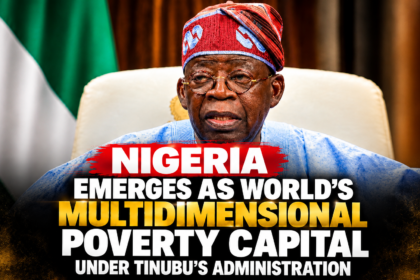
If the answer to all of that is nothing — if this is simply, as the presidency insists, one competent builder winning fair fights — then publishing the paperwork costs the government nothing at all. The only version of this story in which transparency is dangerous is the version in which the process wouldn’t survive being seen. Nigerians who have watched their subsidy renamed, their currency float and their poverty numbers climb past 60 percent are entitled to know which version they’re living in.
—
*This is a United Continental Post editorial. Facts concerning Gilbert Chagoury’s Swiss and U.S. legal history, the Lagos-Calabar Highway, related contract awards, and the January 2026 national honour are drawn from Swiss court records as reported by the Council on Foreign Relations and Sahara Reporters, U.S. Department of Justice records, OCCRP, Premium Times, THISDAY, TheCable, Nairametrics and Vanguard reporting current as of publication. The Presidency’s responses are drawn from public statements by Works Minister Dave Umahi and presidential spokesman Bayo Onanuga.*