The problem was never that Nigeria lacks people who can read. It is that power keeps finding ways to ignore what the reading says.
Nigeria does not have a shortage of educated people. It has produced central bank governors who sit on global monetary panels, surgeons who run departments in London and Houston, engineers whose work holds up bridges on three continents. The crisis is not literacy. It is what happens to knowledge the moment it reaches power.
Call the people who govern Nigeria “illiterates,” and you will, correctly, be accused of imprecision — most of them hold degrees, some of them real. But the word names something real anyway: a political practice that can read a warning in full and still act as though it was never written. That is not a failure of schooling. It is a failure of will, repeated so often it has become a system.
What the government’s own partners keep telling it
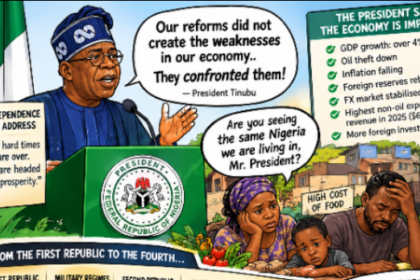
Start with what Nigeria’s own government has been handed, in writing, by people it chose to listen to. The World Bank’s Country Partnership Framework for Nigeria, covering 2026 to 2032, states plainly that 61 percent of Nigerians live below the poverty line, that 79 percent are poor or near-poor, and that 84 percent of children aged five to fourteen cannot read an age-appropriate sentence despite years sitting in a classroom — “learning poverty,” the Bank calls it, a phrase built for exactly this paradox. The same document records that Nigeria spent just 0.14 percent of GDP on social protection in 2021, far below what its own peers spend.
Nobody in government has disputed those figures. A sitting senator read them aloud on live television this year and the Presidency’s response was silence, not correction. That is the pattern this editorial is naming: not ignorance of the facts, but a studied indifference to what the facts demand. A diagnosis delivered by your own invited expert, filed, and left to gather dust, is not a literacy problem. It is a governing culture problem.
When the audit itself is the evidence
Consider a second example, closer to the ground. In 2023, the federal government declared fuel subsidy dead. By 2024, NNPC Limited’s own audited financial statements — certified by PwC, SIAO and Muhtari Dangana & Co., chartered accountants with every credential this essay could ask for — showed the federation owed the national oil company roughly ₦17.5 trillion under line items like “energy security expenses” and “under-recovery.” The people who produced that audit are not illiterate. They are some of the most qualified professionals in the country. What happened to their findings afterward — relabelled, absorbed, left unaudited by any independent forensic review a private-sector voice has publicly demanded — is where the system the Georgetown Journal of International Affairs once called Nigeria’s “epistocratic challenge” shows itself most clearly. Writing in that journal, the political theorist Jason Brennan’s case for matching power to demonstrated competence was invoked to describe exactly this: a country where, as the analysis put it, leadership is too often attained through bribery, intimidation and violence rather than through the knowledge required to govern well, and where the political culture rewards the pursuit of office over the capacity to use it.
Contracts that never had to compete
A third illustration needs no imported theory, only a calendar. When a state government needs a $7 billion port investor, the search that matters is not a global tender — it is whichever door a well-placed friend of the presidency can open first. Nigeria has watched this happen in full public view this year: one businessman’s decades-long closeness to the presidency opening introductions that state governments then present as their own hard-won investment wins. Competence, in a system like this, is not disqualifying. It is simply beside the point. Loyalty and proximity decide who sits at the table; what you know decides nothing.
The data behind the daily transaction
None of this is abstract to the ordinary Nigerian, and the numbers confirming it are now about as solid as social-science data gets. Afrobarometer’s most recent nationally representative survey found that 56 percent of Nigerians who sought a government document in the past year paid a bribe to get it, and 67 percent paid one to receive police assistance. Only one in ten Nigerians believes a person can report corruption without fear of retaliation. Eighty percent say corruption got worse over the past year — worse, not better, after three decades of unbroken civilian rule, two dozen anti-corruption agencies, and a presidency that campaigned, as every administration since 1999 has campaigned, on cleaning house. Tellingly, the same survey found 62 percent of Nigerians believe the Presidency itself is corrupt — the single institution with the clearest access to the country’s best-educated advisers believed, by most of the people it governs, to be the least capable of using that advice honestly.
These numbers do not mean every official demanding a bribe is personally uneducated. They mean weak accountability has turned public service into a toll road, and nobody with the authority to close the road has found it in their interest to do so.
Impunity as a governing choice, not an accident
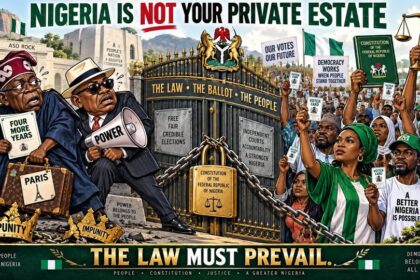
The same pattern holds in Nigeria’s elections, where the stakes are no longer administrative inconvenience but bodies. The European Union’s own observation mission recorded more than 68 people killed in violence connected to the 2023 campaign before voting even began; independent trackers put the final toll for that election cycle above 100. The Crisis Group found that, as of 2022, Nigerian courts had delivered only 60 convictions out of 125 filed cases of alleged electoral violence dating back to 2015. Human Rights Watch documented a military-convened panel investigating violence from an earlier election cycle whose findings had still not been made public four years later. In 2024, the civil-society group SERAP had to obtain a court order simply to compel the electoral commission to investigate and prosecute violence from its own election. None of this reflects a shortage of lawyers who can read the Electoral Act. It reflects a political class that has calculated, correctly so far, that impunity costs less than accountability.
What the fix is not, and what it is
It would be easy, and wrong, to conclude from any of this that Nigeria needs fewer voters and more credentialed gatekeepers — a formal epistocracy, degrees required at the ballot box. That solution trades one elite capture for another, dressed up as meritocracy, and it misreads the actual failure. The problem this editorial has traced is not that uneducated Nigerians keep choosing bad leaders. It is that educated leaders, repeatedly handed the evidence of what their choices cost, choose to ignore it, because nothing in the system forces them to answer for the choice.
What Nigeria is actually missing is not expertise. It is consequence. Transparent decision-making that lets citizens see what their government was told and what it did about it. Prosecutions that follow audits instead of burying them. Electoral violence cases that end in verdicts, not four-year silences. Civic education that teaches citizens to measure a politician’s promises against a politician’s record, so that the next official who treats a World Bank diagnostic as a formality to survive, rather than a warning to act on, pays a price that a title alone cannot protect him from.
A certificate can open the door to office. It has never once, in this country’s history, proven that the person walking through it intended to use what he learned for anyone but himself. Nigeria does not need to find out whether its leaders can read the room. The country has already read them.
This is a United Continental Post editorial. It draws on the World Bank’s Country Partnership Framework for Nigeria FY26-32 and accompanying Streamlined Country Diagnostic; NNPC Limited’s 2024 audited financial statements; “The Failure of Governance in Nigeria: An Epistocratic Challenge,” Georgetown Journal of International Affairs; Afrobarometer’s Round 10 Nigeria survey; the European Union Election Observation Mission’s 2023 preliminary statements; the International Crisis Group’s “Mitigating Risks of Violence in Nigeria’s 2023 Elections”; Human Rights Watch’s reporting on electoral-violence impunity; and SERAP’s 2024 litigation against INEC. Prior UCP reporting on NNPC’s subsidy accounting and patronage-linked contract awards is also drawn on.