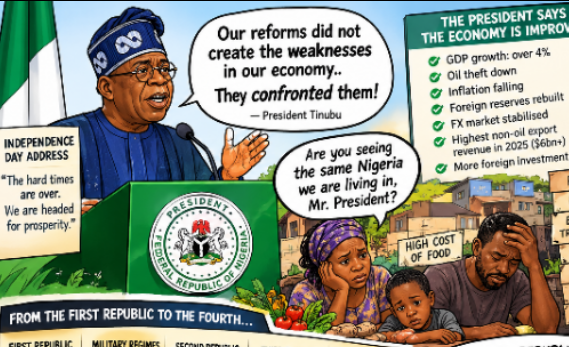
President Bola Ahmed Tinubu’s Independence Day address may have been intended to reassure Nigerians that the country’s economic reforms are beginning to yield results. But for millions of citizens confronting rising food prices, expensive transportation, unaffordable housing, insecurity, unemployment and declining purchasing power, the president’s optimistic assessment raises a difficult question: Is the government seeing the same Nigeria that ordinary Nigerians are living in?
Tinubu argued that his administration’s reforms “did not create the weaknesses in our economy” but confronted problems that had accumulated over decades. Using the analogy of a cancer patient undergoing painful treatment, the President maintained that the economic hardship Nigerians experienced was the necessary discomfort of repairing a damaged system. He further argued that previous governments had merely administered “morphine” instead of confronting the underlying problems.
There is merit in the argument that Nigeria’s economic problems did not begin with the Tinubu administration. Decades of weak productivity, inadequate infrastructure, corruption, insecurity, poor electricity supply, unemployment, dependence on oil revenue and inconsistent economic policies have all contributed to the country’s structural weaknesses. It would therefore be historically inaccurate to blame every economic difficulty confronting Nigerians today on one administration.
But acknowledging the historical roots of Nigeria’s problems does not automatically answer the more immediate question of what the present government has done to the living conditions of Nigerians.
The President said the economy has grown by more than four per cent, oil theft has declined, inflation has fallen substantially, foreign reserves have been rebuilt, the foreign-exchange market has stabilised and non-oil exports reached a record level in 2025. These are indicators that deserve examination. Economic growth and macroeconomic improvements matter, particularly if they translate into greater production, investment and government capacity.
Yet there is another economy that does not appear on government balance sheets: the economy of the ordinary household. It is the economy measured by what a worker can buy with a month’s salary, what a family spends on food, what it costs to travel to work, how much rent consumes, whether parents can afford school expenses and whether a sick person can pay for treatment.
And this is where the President’s optimism encounters the reality of millions of Nigerians.
If the economy is growing while families are struggling to afford basic necessities, then the government has a responsibility not merely to announce growth figures but to explain when that growth will become meaningful in the daily lives of citizens. GDP growth without corresponding improvement in household welfare can leave people wondering what exactly is growing.
The most troubling aspect of the President’s speech is therefore not necessarily his defence of the reforms, but the apparent distance between the language of economic recovery and the lived experience of the population.
To describe the emergency treatment as over and declare that “the foundation has been repaired” may sound reassuring from the standpoint of government policy. But for a Nigerian struggling with food prices, rent, transportation costs, electricity expenses, school fees or medical bills, the emergency may not feel over at all.
This raises the uncomfortable question of whether the administration is becoming insensitive to the depth of the suffering being experienced by ordinary Nigerians. It would be too simplistic to say that the President is completely unaware of the hardship; indeed, his speech expressly acknowledged that some families still struggle to afford food, school fees and medical bills. The bigger issue is whether the government’s understanding of that hardship is sufficiently reflected in its policies, priorities and communication.
A government can legitimately argue that painful reforms are necessary. But it must also recognise that citizens are not economic statistics. They are people who must survive the transition while waiting for the promised benefits of reform.
The President’s comparison of economic reform to cancer treatment also deserves scrutiny. Treatment is justified by the expectation of recovery, but patients ultimately judge treatment by whether their condition improves. In the same way, Nigerians will judge economic reforms not only by foreign reserves, GDP figures or investor confidence, but by whether food becomes affordable, businesses become more productive, jobs become available, electricity becomes reliable and wages regain meaningful purchasing power.
That brings us to a larger historical question: From the First Republic to the present Fourth Republic, can Nigerians honestly say that democracy has produced a better quality of life?
The First Republic had its own serious shortcomings, including regional tensions, political instability and a political system that eventually collapsed into military rule. Nigeria has also passed through several military regimes whose records included both infrastructure development and serious restrictions on democratic freedoms. The present Fourth Republic, which began in 1999, has nevertheless delivered something historically significant: an extended period of constitutional democratic rule and repeated transfers of political power through elections.
But longevity alone should not become the standard for measuring democratic success.
The real test of any republic should include the quality of life of its citizens, the strength of its institutions, security, access to education and healthcare, economic opportunity, justice, infrastructure and the ability of citizens to hold government accountable.
By that measure, declaring one republic “the best” without qualification would oversimplify Nigeria’s complicated political history. Different periods produced different achievements and failures. What Nigerians should demand from the Fourth Republic is not simply that it survive longer than previous democratic experiments, but that it translate democratic governance into tangible improvements in human welfare.
After 27 years of the Fourth Republic, Nigerians are entitled to ask whether democracy has delivered enough.
They are entitled to ask why a country with enormous human and natural resources still struggles to provide reliable electricity, affordable food, secure communities and productive employment. They are entitled to ask why economic growth has not consistently translated into improved household welfare. They are also entitled to challenge government narratives when those narratives appear disconnected from their everyday experiences.
The President is right about one thing: Nigeria cannot repair in four years every weakness accumulated over generations. But the same argument places an important responsibility on his administration. If the reforms are genuinely working, the government must demonstrate how the benefits are reaching ordinary Nigerians and how long citizens should reasonably expect to wait for meaningful relief.
The ultimate measure of economic reform is not how convincingly government explains the pain. It is whether the pain eventually produces a better life.
For Nigerians standing in markets, bus stops, hospitals, schools and workplaces, the question is no longer simply whether the economy is technically recovering. The question is whether their lives are recovering with it.
And until the answer becomes visible in the household, the declaration that the hard times are over will continue to sound premature to those still living through them.