Iranian President Masoud Pezeshkian has insisted that peace negotiations with the United States will only succeed if Washington abandons pressure and threats, as efforts to end the months-long Middle East war remain deadlocked. Meanwhile, Russian President Vladimir Putin has offered to do everything within his power to help resolve the conflict.
Pezeshkian made the remarks on Friday during the Commonwealth of Independent States (CIS) summit in Turkmenistan, stressing that meaningful negotiations must be based on mutual respect and commitments rather than coercion.
“Dialogue holds meaning and a chance of success only when based on mutual respect and mutual commitments, and when devoid of pressure and threat,” he said.
He warned that negotiations conducted under the threat of force amounted to coercion rather than genuine diplomacy, adding that sanctions against Iran would have wider consequences for regional trade, connectivity, energy and stability.
The Iranian president’s latest comments followed his declaration earlier in the week that negotiations with Washington had become meaningless because previous diplomatic engagements had been followed by renewed attacks. He accused the United States of repeatedly violating commitments while resorting to sanctions, pressure and threats.
The war began on February 28 with US and Israeli attacks on Iran, which occurred while Washington and Tehran were engaged in negotiations over Iran’s nuclear programme. Although the warring parties agreed on a memorandum of understanding in June outlining a framework for a permanent resolution, the agreement failed to end hostilities.
The conflict intensified again after Iranian attacks on vessels in the Strait of Hormuz prompted the resumption of US military operations. Subsequent diplomatic efforts, including indirect discussions on the sidelines of the United Nations General Assembly, have failed to produce a breakthrough.
Washington has recently shifted towards increased economic pressure, with the United States reportedly not striking Iran since September 1. Both the US and Israel maintain that their military campaign is aimed at preventing Tehran from acquiring nuclear weapons, an ambition Iran has consistently denied pursuing.
Control of the strategically important Strait of Hormuz has also emerged as a major source of tension. Iran has sought to assert control over the shipping corridor, attacking vessels attempting to pass without its authorisation, while the United States has imposed a counterblockade on Iranian ports and targeted vessels it accuses of violating the restrictions.
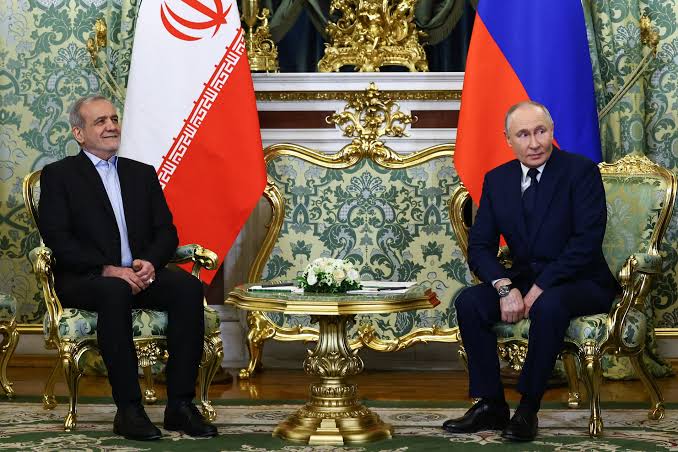
Against this backdrop, Putin met Pezeshkian on Thursday ahead of the CIS summit, pledging Russia’s support for efforts to end the conflict.
“We are ready to do everything that is in our power to contribute to the settlement of this situation,” Putin said, according to Russian media.
He also praised what he described as Iran’s genuine efforts to end the war since the US-Israeli attacks began, while highlighting the positive development of relations between Moscow and Tehran.
The two countries have strengthened their diplomatic and military cooperation since Russia launched its full-scale invasion of Ukraine in February 2022. Western countries and Kyiv have accused Iran of supplying Russia with Shahed drones and short-range missiles for use in the war, while Moscow has been accused of providing Iran with intelligence to support attacks against US targets in the Middle East.
Putin had also expressed his willingness to mediate during a telephone conversation with Pezeshkian on Wednesday, according to Iran’s state news agency, IRNA. The latest meeting followed their encounter at the Shanghai Cooperation Organisation summit in Kyrgyzstan last month.
Despite the diplomatic contacts, Pezeshkian said Tehran wanted a definitive framework for ending the war but accused Washington of attempting to impose its policies on other countries.
He maintained that a resolution would remain elusive if the United States continued to pursue a unilateral approach.
Meanwhile, US President Donald Trump said on Thursday that Washington was holding productive discussions with Iran and ruled out launching another attack before the November 3 US midterm elections.
The CIS summit, which brings together Russia and several former Soviet republics, provides another platform for regional diplomacy. Its participants include leaders from Armenia, Azerbaijan, Belarus, Turkmenistan and other Central Asian countries.
Established in 1991 following the collapse of the Soviet Union, the organisation was created to maintain cooperation among former Soviet republics. However, its influence has been challenged as some members have withdrawn or reduced their participation while pursuing closer economic and diplomatic relationships with other powers.
Analysts say Moscow continues to use the organisation to demonstrate its regional influence despite increasing international isolation over the Ukraine war. Nevertheless, several member states are diversifying their partnerships, particularly by strengthening ties with China and Western countries.
The summit therefore comes at a critical moment for Russia and Iran, both of which face extensive international sanctions and are seeking diplomatic support amid ongoing conflicts. Whether Putin’s offer can help revive negotiations remains uncertain, particularly as Tehran insists that any meaningful agreement must be free from coercion and Washington continues to maintain economic and strategic pressure on Iran.