FG spends N7.7tn on interest in six months as debt obligations squeeze infrastructure and public services
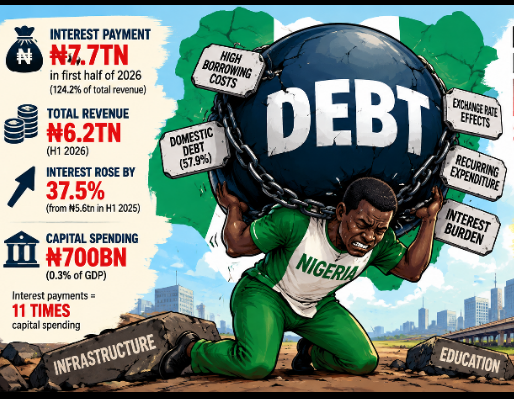
Nigeria’s mounting debt burden is increasingly squeezing government finances, with the Federal Government spending N7.7tn on interest payments in the first half of 2026 alone, exceeding its total revenue of N6.2tn by N1.5tn, according to the World Bank.
The figures highlight the growing pressure of debt servicing on the country’s economy, as rising borrowing costs consume resources that could otherwise fund infrastructure, public services and development projects.
The World Bank’s October 2026 Nigeria Development Update, titled Beyond the Federal Purse: How Higher Revenues Shaped State Priorities, showed that interest payments represented 124.2 per cent of federal revenue between January and June 2026. In practical terms, the government spent more on servicing interest on its debts than it generated in revenue, leaving other expenditure commitments increasingly dependent on additional borrowing and other financing sources.
The report obtained by correspondents showed that interest payments rose by N2.1tn, or 37.5 per cent, from N5.6tn in the corresponding period of 2025 to N7.7tn in the first half of 2026.
The World Bank attributed the increase largely to elevated domestic borrowing costs, noting that interest payments climbed from 2.5 per cent of Gross Domestic Product, equivalent to N5.6tn, to 3.1 per cent, or N7.7tn.
Despite the increase in the nominal amount spent on interest, the interest-to-revenue ratio improved from approximately 155.6 per cent in the first half of 2025 to 124.2 per cent in the corresponding period of 2026. The improvement followed stronger revenue collection, but it did little to change the underlying fiscal challenge: the Federal Government still spent more on interest payments alone than it earned during the six-month period.
Federal revenue increased by N2.6tn, or 72.2 per cent, from N3.6tn in the first half of 2025 to N6.2tn in the corresponding period of 2026. The World Bank linked the improvement to a recovery in oil receipts, stronger corporate tax collections and higher independent revenues, while customs revenue remained stable and Value Added Tax collections stayed comparatively flat.
However, the revenue gains were accompanied by higher expenditure. Total Federal Government spending rose by N1.5tn, from N14.6tn in the first half of 2025 to N16.1tn in the same period of 2026, representing an increase of 10.3 per cent. The figures suggest that the additional revenue was insufficient to ease the pressure of the government’s growing financial obligations significantly.
Personnel expenditure also increased from N3.7tn to N4.2tn following wage adjustments, adding to the burden of recurrent spending. Meanwhile, reported capital expenditure declined sharply from one per cent of GDP in the first half of 2025 to 0.3 per cent in the corresponding period of 2026, amounting to approximately N700bn.
The contrast between debt costs and development spending was particularly striking. At N7.7tn, interest payments were approximately 11 times the N700bn reported for capital expenditure during the six-month period. The disparity underscores the challenge of financing infrastructure and other development priorities when debt obligations absorb a disproportionate share of available public resources.
Combined interest and personnel costs reached N11.9tn, accounting for approximately 73.9 per cent of total federal expenditure and almost twice the government’s revenue during the period. This left a relatively narrow fiscal space for capital projects and other public spending, even as the government sought to sustain revenue growth and manage its broader expenditure commitments.
Despite these pressures, the Federal Government’s fiscal deficit narrowed from N11tn, equivalent to five per cent of GDP, in the first half of 2025 to N9.9tn, or four per cent of GDP, in the corresponding period of 2026. However, the World Bank cautioned against interpreting the improvement as evidence of a fundamental resolution of the country’s fiscal challenges.
“The improved early-year fiscal outturn should be interpreted cautiously given the low reported federal capital spending,” the report stated.
The bank added that personnel and interest costs continued to absorb a substantial share of available fiscal resources, warning that increased capital spending later in the year, alongside recurrent and pre-election expenditure, could intensify fiscal pressures.
It stated, “Personnel and interest costs continue to absorb a large share of fiscal space, and a pickup in capital execution later in the year, alongside recurrent and pre-election spending, is expected to add to pressures.”
The World Bank also identified overlapping budget cycles, weak expenditure planning and poor alignment between approved budget allocations and implementation capacity as persistent weaknesses in Nigeria’s fiscal management. According to the institution, addressing these challenges would be essential to ensuring that public resources translate into completed projects and improved service delivery.
Nigeria’s broader debt position further illustrates the scale of the challenge. The report estimated the country’s public debt stock at approximately N177tn in 2025, representing 40 per cent of GDP, compared with N67tn, or 27.6 per cent of GDP, in 2021. The increase reflected exchange-rate valuation effects and the recognition of previously accumulated liabilities, including securitised Ways and Means advances.
The composition of the debt also has significant implications for public finances. Domestic debt accounted for 57.9 per cent of Nigeria’s total debt stock in 2025 but generated 72.6 per cent of interest payments. This imbalance reflects the relatively high cost of domestic borrowing and the pressure it places on government revenue.
To ease the burden, the World Bank recommended limiting expensive borrowing, prioritising concessional financing and extending debt maturities to reduce refinancing risks. It also urged the government to strengthen revenue mobilisation, improve budget credibility and maintain fiscal discipline to prevent debt obligations from further constraining development expenditure.
Looking ahead, the institution projected that Nigeria’s consolidated fiscal deficit would widen from 3.1 per cent of GDP in 2025 to 3.5 per cent in 2026, partly because of rising federal interest payments, personnel costs and pre-election spending. The projection points to continued pressure on public finances despite the improvement in revenue collection recorded during the first half of the year.
The central concern, therefore, extends beyond the size of Nigeria’s debt stock to the growing cost of servicing it. With interest payments already exceeding federal revenue and reported capital spending falling sharply, the challenge is how to ensure that rising government income translates into infrastructure, employment opportunities and better public services rather than being increasingly absorbed by the cost of past and present borrowing.