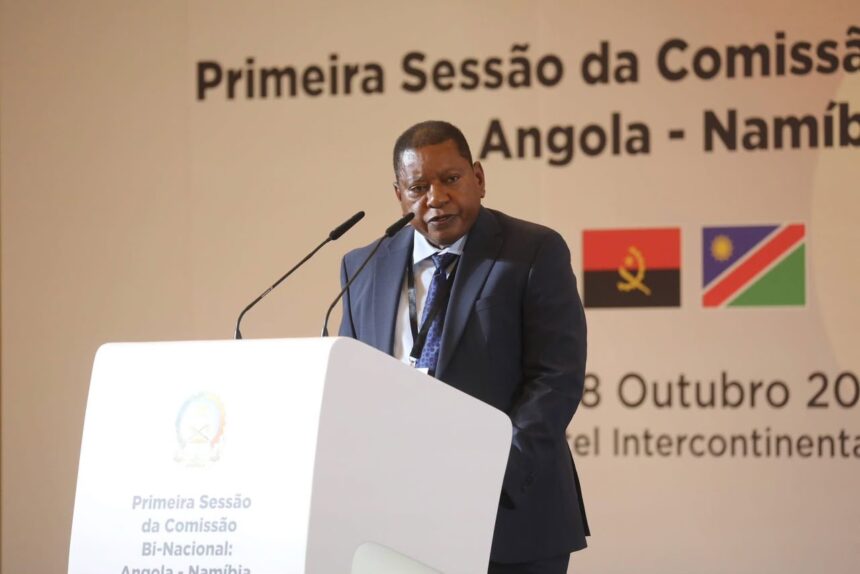
Namibia and Angola have taken a significant step towards deepening economic relations with the launch of their first Bi-National Commission in Luanda, creating a formal framework to advance cooperation in trade, energy, transportation and agriculture.
The inaugural meeting, held on Thursday 25th October 2026 is expected to help both countries translate longstanding diplomatic ties into practical economic benefits. With a shared border and common regional interests, the neighbours are seeking to improve cross-border commerce, expand infrastructure and attract investment capable of stimulating growth.
Jerobeam Shaanika, executive director of Namibia’s Ministry of International Relations and Trade, said the commission would provide an avenue for structured engagement, allowing both governments to address existing challenges and identify new opportunities for collaboration.
Energy development is expected to feature prominently in the partnership. In April 2026, Namibia’s NamPower and Angola’s Rede Nacional de Transporte de Electricidade signed agreements for the Angola-Namibia Power Interconnector Project, known as ANNA.
Valued at approximately N$941 million, the project involves a 166-kilometre, 400-kilovolt transmission line connecting Namibia’s Kunene substation to Angola’s Cahama substation, alongside another 270-kilometre line linking Namibia’s Omatando and Otjikoto substations.
Scheduled for completion in 2029, the infrastructure is expected to support electricity transfers of up to 500 megawatts, improving supply reliability and strengthening regional power trade.
According to report, both governments are also committed to advancing the proposed Baynes Hydropower Plant on the Kunene River, a long-delayed cross-border project with the potential to expand electricity generation and support industrial development. Cooperation between Angola’s Sonangol and Namibia’s Namcor is also expected to facilitate technical training and knowledge transfer for Namibia’s developing oil and gas industry.
Beyond energy, the commission is expected to address persistent barriers to bilateral trade. The absence of a formal trade agreement has complicated cross-border commerce, including issues affecting informal traders and Angolan street vendors operating in northern Namibian towns. Establishing a clearer framework for trade could help resolve these challenges while creating a more predictable environment for businesses.
Transportation infrastructure is another priority, with both countries exploring rail connectivity to facilitate the movement of goods and improve commercial links. Proposals to extend electricity transmission networks and water canals into northern Namibia also feature in their broader cooperation agenda.
The initiative builds on growing political engagement between the two countries. Namibian President Netumbo Nandi-Ndaitwah chose Angola for her first official foreign visit after taking office in March 2025, holding talks with President João Lourenço on agriculture, energy, tourism, oil and gas, logistics, infrastructure and water management.
A joint communiqué outlining agreed priorities and implementation timelines is expected to emerge from the meeting. However, the commission’s ultimate value will depend on whether both governments can move beyond diplomatic commitments to deliver completed projects, stronger trade links and tangible improvements in the livelihoods of their citizens.