China’s economy expanded by 4.5 per cent in the third quarter of 2026, beating analysts’ expectations as strong exports of technology-related products, including semiconductors and artificial intelligence (AI) equipment, helped offset persistent weakness in domestic consumption and the property market.
Figures released on Monday by the National Bureau of Statistics showed that gross domestic product (GDP) growth accelerated from 4.3 per cent in the second quarter, when the world’s second-largest economy recorded its slowest expansion in more than three years. Economic growth for the first nine months of the year stood at 4.6 per cent, putting Beijing closer to achieving its annual growth target.
China has set a GDP growth target of between 4.5 and five per cent for 2026, compared with the five per cent expansion recorded in 2025. However, the International Monetary Fund recently lowered its forecast for the Chinese economy this year to 4.5 per cent, the bottom of the government’s target range.
The latest figures highlight the growing importance of exports to China’s economic performance as domestic demand remains subdued. Strong international demand for technology products has provided a significant boost to manufacturers, but weak household spending and a prolonged downturn in the property sector continue to constrain broader economic activity.
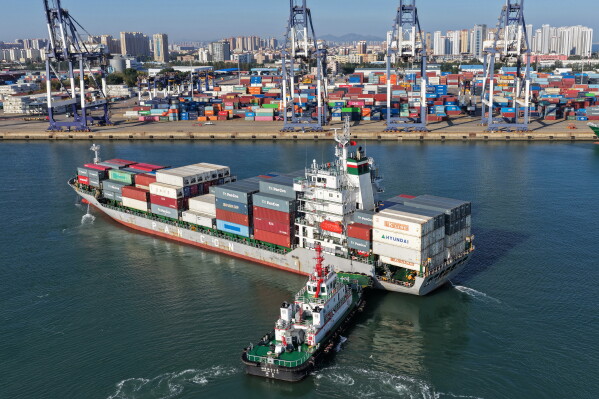
Official data showed that China’s exports increased by more than 16 per cent during the first three quarters of 2026, reaching 23.19 trillion yuan, equivalent to approximately $3.47 trillion. The expansion was largely driven by demand for semiconductors and other technology-related goods, as well as automobiles, including hybrid and electric vehicles.
China’s exporters have also sought new markets in Southeast Asia, Latin America and Europe following the impact of elevated United States tariffs on bilateral trade. The shift has helped sustain overseas sales despite mounting trade restrictions and growing concerns among trading partners about China’s expanding trade surplus.
China recorded a trade surplus of approximately $938 billion between January and September, putting it on course to surpass the record $1.2 trillion surplus registered last year. The widening imbalance has intensified calls from trading partners for Beijing to address the structural factors behind its export strength and relatively weak domestic consumption.
However, the strength of external demand contrasts with sluggish activity at home. Retail sales, a key indicator of household consumption, rose by just 1.1 per cent year-on-year in September, although growth for the first nine months reached 2.6 per cent. The figures underscore the difficulty facing Chinese policymakers as they seek to encourage consumers to spend more and reduce the economy’s dependence on overseas markets.
Industrial production performed more strongly, increasing by 5.5 per cent in September and 5.3 per cent over the January-September period. The performance reflects the resilience of manufacturing and other industrial activities, particularly sectors benefiting from global demand for advanced technology and other high-value products.
Investment figures, however, offered a less encouraging picture. Although fixed-asset investment, which includes spending on factories, machinery and property, edged up by 0.7 per cent in September, it contracted by 7.2 per cent over the first nine months of the year. The decline points to continued weakness in investment activity despite the expansion of export-oriented industries.
China’s property market remains a major source of economic pressure. Years of falling property values, declining construction activity and weakened confidence have weighed on household wealth and spending. The downturn has also complicated efforts to stimulate domestic demand, as many households remain cautious about their financial prospects.
Zhiguo He, a finance professor at Stanford University’s Graduate School of Business who studies China’s economy, said Beijing appeared to be on course to achieve its growth target but would remain concerned about its increasing reliance on exports.
He told Al Jazeera that a controlled slowdown was probably the best outcome available to Chinese policymakers under the circumstances. He also noted that the contraction in the real estate sector was continuing, while households were adjusting their expectations to the changing economic environment.
Meanwhile, Dave Chia, an economist at Moody’s Analytics, said domestic demand remained weak even as trade performed strongly. He expected exports to remain resilient but warned that barriers to global trade posed a risk to the outlook.
Max Zenglein, Asia-Pacific senior economist at The Conference Board, also cautioned against relying exclusively on the headline GDP figure to assess the health of the Chinese economy. He argued that the aggregate growth rate increasingly concealed widening disparities between industries, regions and households, making it more difficult to determine how evenly economic gains were being distributed.
China’s National Bureau of Statistics acknowledged the challenges confronting the economy. Its deputy head, Mao Shengyong, said the international environment remained complex and volatile, while insufficient domestic demand continued to be a prominent problem. He added that further efforts were needed to consolidate the foundations for stable economic improvement.
The contrasting performance of exports and domestic consumption presents Beijing with a difficult policy challenge. While overseas demand has supported manufacturing, employment and economic growth, excessive dependence on exports could expose the country to fresh trade disputes, protectionist measures and weakening demand in major international markets.
The challenge is particularly significant as China’s trading partners increasingly seek to protect domestic industries and reduce persistent trade imbalances. Although Chinese manufacturers have benefited from their competitiveness in technology and electric vehicles, additional tariffs and restrictions could limit their access to important markets.
For Beijing, sustaining growth will therefore require more than expanding industrial output and securing overseas buyers. Strengthening household consumption, restoring confidence in the property market and encouraging productive domestic investment will be essential to achieving more balanced economic growth.
China’s third-quarter performance suggests that its economy remains resilient despite mounting domestic and international pressures.