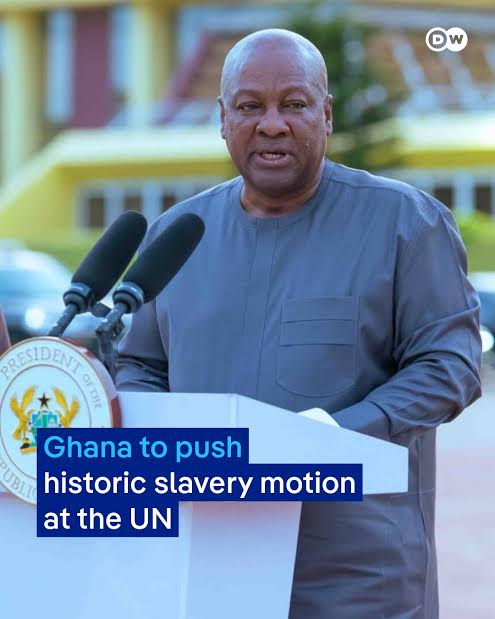
Accra seeks to turn historical injustice into development funding as Africa intensifies campaign for reparatory justice
Ghana is seeking to take the centuries-old demand for reparations for slavery and colonialism into the heart of global development finance, proposing a framework that could compel the international financial system to confront the economic consequences of historical exploitation and provide additional resources to affected economies.
The initiative, which targets the International Monetary Fund (IMF) and the World Bank, represents a potential shift in Africa’s reparations campaign from demands for historical recognition and apologies towards concrete financial arrangements aimed at addressing inequalities rooted in slavery and colonial rule.
Ekwow Spio-Garbrah, Ghana’s Presidential Special Envoy for Reparations, disclosed the proposal in an interview with the Ghana News Agency on the sidelines of the IMF and World Bank annual meetings in Bangkok, Thailand.
The document has been circulated within the Ghanaian government but has yet to be formally submitted to either institution, leaving its prospects dependent on diplomatic negotiations and the willingness of influential shareholder countries to support the initiative.
“The reparational agenda has not yet entered formally into this development financial institutional area, but I’m preparing for that necessity and possibility,” Spio-Garbrah said.
He described reparatory finance as an emerging concept that Ghana hopes to introduce into discussions about the responsibilities of international financial institutions towards countries whose economic trajectories were shaped by slavery, colonial extraction and their enduring consequences.
“The paper is intended for a global audience, so, until we introduce it, it remains there,” he added.
Spio-Garbrah, a former staff member of the World Bank Group’s International Finance Corporation, said the proposal had been presented to the presidency, the ministries of finance and foreign affairs, and the Bank of Ghana to establish a coordinated national position before its eventual presentation to the international community.
However, translating the proposal into an operational financing arrangement could prove difficult because of the distinct mandates and governance structures of the institutions involved.
The IMF primarily provides financial assistance to countries experiencing balance-of-payments difficulties and promotes macroeconomic stability, while the World Bank focuses on long-term development financing and poverty reduction.
Incorporating reparations into their financing frameworks would therefore raise fundamental questions about funding sources, beneficiary countries, eligibility criteria and the form assistance would take. Ghana has yet to specify whether its proposal would involve grants, concessional loans, debt cancellation or a dedicated reparations facility.
The initiative comes amid renewed efforts by African and Caribbean governments to transform longstanding demands for reparatory justice into coordinated international action.
In June, the African Union and the Caribbean Community’s reparations commission endorsed a 19-point reparations framework at a three-day conference in Accra, calling for formal apologies, financial compensation, debt relief and reforms to international financial institutions.
The framework also supported the establishment of a Global Reparations Fund to finance programmes for countries and communities affected by slavery and colonial exploitation. It forms part of a broader African Union campaign to establish reparatory justice as a central issue in international development and policymaking.
Spio-Garbrah said Ghana was also advocating legislation to establish national reparations councils across the African Union’s 55 member states, creating institutional mechanisms through which countries could coordinate their demands and pursue common objectives.
As part of his argument, he cited Germany’s proposed €1.1bn reconstruction and development programme for Namibia following Germany’s acknowledgement of the genocide committed against the Herero and Nama peoples during colonial rule.
The programme, outlined in a 2021 joint declaration and intended to run for 30 years, has encountered opposition from affected communities, which reject Germany’s position that the proposed funding constitutes development assistance rather than reparations.
The joint declaration has yet to be finalised, although Namibian President Netumbo Nandi-Ndaitwah said in April that the matter was expected to be concluded before the end of 2026.
The Netherlands has also earmarked €200mn for initiatives addressing its historical involvement in slavery, including education, research, remembrance and community programmes across the Dutch kingdom and Suriname. The allocation is not designed as a direct compensation scheme for individuals.
Ghana’s latest move builds on a diplomatic milestone in March, when the United Nations General Assembly adopted a resolution spearheaded by President John Dramani Mahama declaring the trafficking and racialised chattel enslavement of Africans the gravest crime against humanity.
The resolution, numbered 80/250, received 123 votes in favour, while the United States, Israel and Argentina voted against it. Fifty-two countries abstained, including Britain and several European nations.
Although the resolution strengthened international diplomatic support for reparatory justice, it is not legally binding and does not create an enforceable obligation requiring countries to pay compensation.