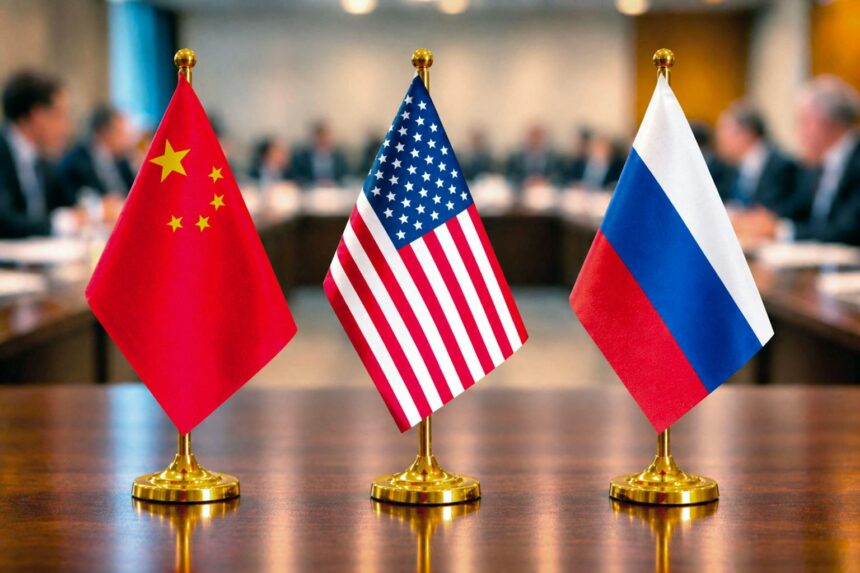
The prospect of a meeting between United States President Donald Trump, Chinese President Xi Jinping and Russian President Vladimir Putin on the sidelines of the Asia-Pacific Economic Cooperation (APEC) summit on November 18–19 has revived comparisons with the historic Yalta Conference of February 1945.
However, despite their ambitions to reshape the international order, the three leaders face a world far more complex and resistant to great-power domination than the one their predecessors confronted.
At Yalta, the leaders of Britain, the United States and the Soviet Union—Winston Churchill, Franklin Roosevelt and Joseph Stalin—discussed the post-war settlement and the political future of Europe. Their decisions reflected the enormous military and political influence exercised by the victorious powers at the end of World War II.
More than eight decades later, Trump, Xi and Putin appear to share an interest in an international system dominated by powerful nations with clearly defined spheres of influence. Their approach suggests a preference for a world in which major powers exercise considerable authority over their respective regions, often at the expense of smaller countries.
Trump’s foreign policy has particularly highlighted this ambition as his administration’s 2025 National Security Strategy identified the Western Hemisphere as a region of American predominance, while suggesting that Russia and China could pursue comparable regional interests.
His approach towards Venezuela and support for politically sympathetic governments in Latin America have further raised concerns about Washington’s willingness to assert its influence in the region.
Putin, meanwhile, has pursued the restoration of Russian influence across the former Soviet sphere, most visibly through the war against Ukraine. Moscow has also employed political pressure, financial incentives and other forms of interference to strengthen governments sympathetic to Russian interests.
China’s ambitions are equally significant. Xi has repeatedly maintained that Taiwan must eventually be reunited with mainland China, while Beijing continues to expand its strategic and economic influence across Southeast Asia and the South China Sea.
Europe, particularly the European Union, remains an important obstacle to this vision of international relations. The EU represents an alternative model in which independent countries cooperate through shared institutions, common rules and the protection of sovereignty, human rights and the rule of law.
The United States and Russia have both been accused of supporting political movements that challenge European integration and weaken the bloc’s unity. Such developments have intensified concerns that the established international order is increasingly being challenged by competing national interests.
However, the world has changed considerably since the era of colonial expansion and territorial empire as imperialism today is not limited to military occupation or the acquisition of territory.
It also involves the ability of powerful states to influence decisions on trade, natural resources, security, economic policies and governance.
Even after gaining independence, many countries continued to experience forms of external control through economic dependence, political pressure and international arrangements that often favoured powerful states.
This demonstrated that the end of formal colonialism did not necessarily eliminate unequal relationships between nations.
Nevertheless, the rise of nationalism, the expansion of independent states and the development of international institutions have made the traditional imperial model increasingly difficult to sustain.
The aggressive competition among major powers contributed to two devastating world wars between 1914 and 1945, convincing many governments that international cooperation was essential to preventing another global catastrophe.
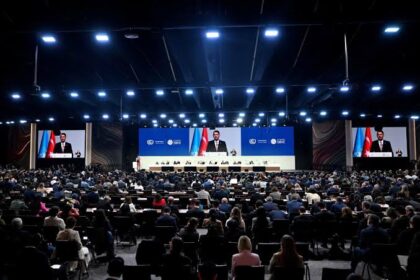
The creation of the United Nations in 1945 marked a major attempt to establish a system in which countries, regardless of their size or military strength, would have internationally recognised rights and a platform for resolving disputes.
From 43 member states in 1946, the organisation has expanded to 193, reflecting the end of colonial empires and the emergence of independent nations.
Unlike the territories discussed by the victorious powers at Yalta, today’s countries are sovereign political entities whose populations increasingly reject external attempts to determine their leadership or political future.
The resistance of Ukraine to Russian aggression and the determination of other nations to defend their sovereignty illustrate the limitations of imposing political arrangements through military power.
Economic globalisation has also made the world more interconnected. International trade, investment and technological development have created relationships that extend beyond traditional geographical boundaries, while countries, including major powers, depend on international markets, supply chains and economic partnerships to sustain growth and domestic stability.
Technology has further complicated the exercise of military power. The growing use of drones, advanced surveillance systems and other relatively affordable weapons has changed modern warfare, allowing smaller countries and non-state actors to challenge militarily superior opponents.
Conflicts in Ukraine, the Middle East and other regions demonstrate that military superiority does not automatically translate into decisive political victories.
Prolonged wars can impose enormous economic and human costs on powerful countries while strengthening resistance among weaker opponents.
The changing nature of warfare also underscores the importance of international alliances.
Military strength, financial resources and advanced weapons remain important, but diplomatic relationships and the support of traditional allies are equally significant.
Trump’s strained relations with some longstanding American partners have therefore raised questions about the future of Washington’s global influence.
Meanwhile, the ability of middle powers to preserve the existing rules-based international system remains uncertain.
Although some countries have called for stronger cooperation to defend multilateralism, their differing economic interests, political priorities and regional ambitions could make a unified response difficult.
For these countries, a world divided into competing spheres of influence could undermine decades of progress towards political independence and economic self-determination. Their challenge is to defend the international institutions and principles that prevent powerful nations from treating smaller states as bargaining chips.
The responsibility, therefore, rests with the world’s remaining democratic governments and other countries committed to multilateral cooperation to strengthen the international order and ensure that global affairs are not determined exclusively by the ambitions of a handful of powerful leaders.