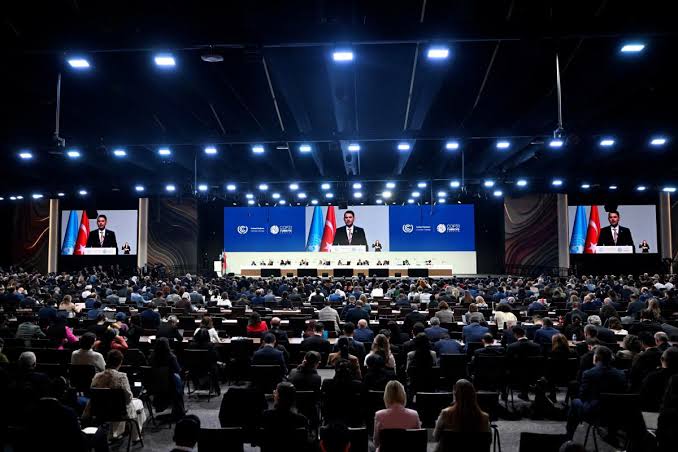
World leaders have called for urgent and coordinated action to tackle the escalating climate crisis, warning that the world is falling behind its environmental commitments as the 31st United Nations Climate Change Conference (COP31) enters its high-level deliberations in Antalya, Türkiye.
The leaders, who addressed the summit, demanded stronger climate financing, accelerated investment in clean energy, improved disaster preparedness and greater cooperation between developed and developing countries, amid mounting evidence of the devastating effects of global warming.
United Nations Secretary-General António Guterres delivered one of the strongest warnings, declaring that fossil fuels must “go the way of the dinosaurs” as the world accelerates its transition towards cleaner energy sources.
He urged governments to move beyond promises and take concrete measures to confront the climate emergency.
Turkish President Recep Tayyip Erdoğan also called on developed nations to intensify their climate commitments, stressing the need for stronger international cooperation and investment in sustainable development.
Meanwhile, the European Union said it had contributed more than $35.5bn in climate finance to developing countries in the previous year and mobilised over $332bn in sustainable investments.
However, several developing countries used the summit to highlight the widening gap between climate commitments and the resources available to vulnerable nations.
Mozambican President Daniel Chapo said his country requires approximately $37.2bn over the next decade to strengthen climate resilience and protect its population against worsening environmental disasters, urging major economies to take the lead in reducing emissions and honouring their climate financing commitments.
Similarly, Madagascar’s President Michael Randrianirina described the climate funding shortfall as a matter of national survival, citing the devastating impact of Cyclone Gezani, which destroyed about three-quarters of the northeastern port city of Toamasina in February 2026.
He said the disaster affected approximately 600,000 people and contributed to nearly $2.5bn in losses during the country’s 2026 cyclone season.
Sudan’s Transitional Sovereignty Council chief, Abdel Fattah al-Burhan, called for climate financing to be separated from political considerations, urging developed countries to double their support for climate adaptation in developing nations.
Somalia’s President Hassan Sheikh Mohamud also demanded the early release of disaster preparedness funds, warning that financial assistance must reach vulnerable communities before disasters strike rather than after lives have been lost.
He recalled that the 2023 El Niño-related floods affected more than two million people in Somalia, warning that another severe flooding event could disrupt the lives of up to 3.4 million people in the country’s southern region.
In Africa, Tanzanian President Samia Suluhu Hassan called for a transparent and equitable global carbon market under Article 6 of the Paris Agreement, insisting that the continent’s energy transition must prioritise affordable electricity and energy justice.
She said carbon markets should guarantee fair pricing, equitable distribution of benefits and environmental integrity, while ensuring that African countries were not disadvantaged in the global transition to cleaner energy.
Rwanda also called for increased green investment and a clear roadmap for delivering the $300bn annual climate finance target agreed at COP29, particularly through greater support for adaptation programmes in vulnerable countries.
Elsewhere, Chinese Vice President Han Zheng urged stronger international cooperation on climate resilience, disaster prevention and early-warning systems.
He said China would expand access to its artificial intelligence-powered meteorological warning technology to help more countries prepare for climate-related emergencies.
Brazilian President Luiz Inácio Lula da Silva warned that geopolitical rivalries, military spending, wars and trade tensions were distracting world leaders from the climate emergency, arguing that environmental protection should remain a priority on the international agenda.
The urgency of the crisis was also highlighted by Austrian President Alexander Van der Bellen, who said the world was doing far too little and moving too slowly to address climate change. He cited Austria’s record-breaking summer temperatures, which contributed to drought, crop failures and reduced electricity generation from hydropower.
Barbados Prime Minister Mia Amor Mottley warned that the world had failed to do enough to keep the 1.5-degree Celsius global warming target within reach, describing any temperature overshoot as a debt being imposed on future generations.
Meanwhile, Finnish President Alexander Stubb called for collective global action, warning that no country, regardless of its geographical location or economic strength, could escape the consequences of climate change.
On the investment front, the European Bank for Reconstruction and Development announced plans to invest $6bn in Türkiye’s clean energy sector, signalling growing efforts to accelerate the transition towards sustainable energy.
Australian Climate Change and Energy Minister Chris Bowen also urged countries to embrace compromise and collective responsibility, warning that every fraction of a degree of global warming could have serious consequences for communities, economies and livelihoods.
The summit, which runs until November 20, is expected to focus on translating existing climate commitments into practical measures, particularly in financing, renewable energy development, adaptation and environmental protection.